Center for Clinical Metabolic Research, Gentofte Hospital, University of Copenhagen, Hellerup, Denmark.
Steno Diabetes Center Copenhagen, Gentofte, Denmark.
Clin Transl Gastroenterol. 2020 Dec;11(12):e00257. doi: 10.14309/ctg.0000000000000257.
A recent study in mice points to the gut-derived hormone glucagon-like peptide 2 (GLP-2) as an important regulator of gallbladder motility inducing gallbladder relaxation and refilling. In this study, we evaluated the effect of exogenous GLP-2 on postprandial gallbladder motility in healthy men.
In a randomized, double-blinded, placebo-controlled, crossover study, we evaluated the effect of 4-hour intravenous infusions of high-dose GLP-2 (10 pmol × kg × min), low-dose GLP-2 (1 pmol × kg × min), and placebo (saline) on postprandial gallbladder motility. A 300-kcal liquid-mixed meal (added 1.5 g of acetaminophen for indirect measurement of gastric emptying) was served 30 minutes after start of intravenous infusions. Gallbladder volume was assessed by ultrasonography.
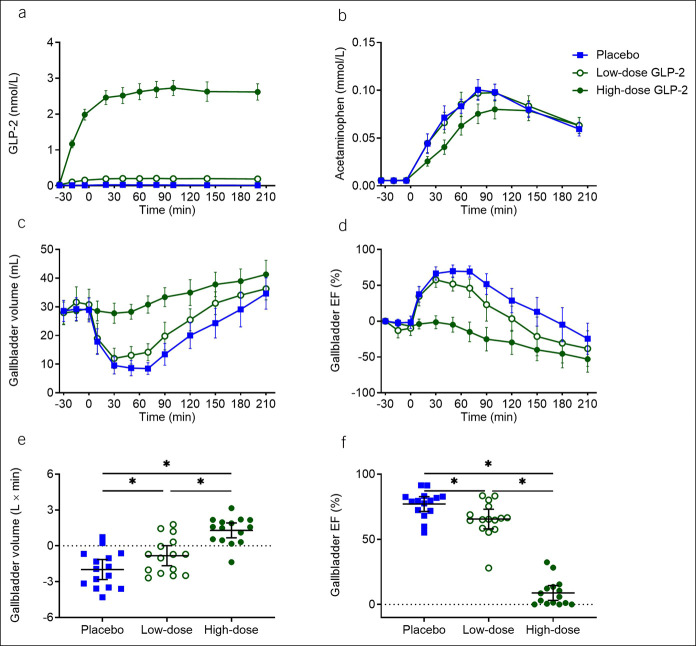
Fifteen healthy men, age 24.3 (22.4-26.1) years (mean [95% confidence interval]) and body mass index 22.5 (21.7-23.4) kg × m, were included. Basal plasma GLP-2 concentration was 14 (11-17) pmol/L. During low-dose and high-dose GLP-2 infusions, steady-state postprandial plasma GLP-2 concentrations amounted to 201 (188-214) and 2,658 (2,443-2,873) pmol/L, respectively, compared with maximum postprandial plasma GLP-2 concentration of 34 (25-44) pmol/L during placebo. Gallbladder emptying (assessed as baseline-subtracted area under the curve for gallbladder volume) was reduced by low-dose GLP-2 (-0.8 [0.7-1.9] L × min, P < 0.0001) and nearly abolished by high-dose GLP-2 (1.3 [-1.7 to 0.01] L × min, P = 0.029) compared to placebo (-2.0 [-2.8 to -1.1] L × min). Compared to placebo, gastric emptying was reduced by high-dose GLP-2 (P = 0.0060 and 0.019), whereas low-dose GLP-2 did not affect gastric emptying (P = 0.13 and 0.85).
Exogenous GLP-2 exerts a dose-dependent inhibitory effect on postprandial gallbladder emptying in healthy men.
最近一项在小鼠身上进行的研究表明,肠源激素胰高血糖素样肽 2(GLP-2)是一种重要的胆囊运动调节剂,可诱导胆囊松弛和充盈。在这项研究中,我们评估了外源性 GLP-2 对健康男性餐后胆囊运动的影响。
在一项随机、双盲、安慰剂对照、交叉研究中,我们评估了 4 小时静脉输注高剂量 GLP-2(10 pmol×kg×min)、低剂量 GLP-2(1 pmol×kg×min)和安慰剂(生理盐水)对餐后胆囊运动的影响。静脉输注开始后 30 分钟,给予 300 卡路里的液体混合餐(添加 1.5 克对乙酰氨基酚以间接测量胃排空)。通过超声评估胆囊体积。
共纳入 15 名健康男性,年龄 24.3(22.4-26.1)岁(平均值[95%置信区间]),体重指数 22.5(21.7-23.4)kg×m。基础血浆 GLP-2 浓度为 14(11-17)pmol/L。在低剂量和高剂量 GLP-2 输注期间,稳态餐后血浆 GLP-2 浓度分别达到 201(188-214)和 2658(2443-2873)pmol/L,而安慰剂时最大餐后血浆 GLP-2 浓度为 34(25-44)pmol/L。与安慰剂相比,低剂量 GLP-2 降低了胆囊排空(评估为基线减去胆囊体积曲线下面积)(-0.8[0.7-1.9]L×min,P<0.0001),高剂量 GLP-2 几乎消除了胆囊排空(-1.3[-1.7 至 0.01]L×min,P=0.029)。与安慰剂相比,高剂量 GLP-2 降低了胃排空(P=0.0060 和 0.019),而低剂量 GLP-2 对胃排空没有影响(P=0.13 和 0.85)。
外源性 GLP-2 对健康男性餐后胆囊排空具有剂量依赖性抑制作用。