Shazleen Siti Shazra, Yasim-Anuar Tengku Arisyah Tengku, Ibrahim Nor Azowa, Hassan Mohd Ali, Ariffin Hidayah
Laboratory of Biopolymer and Derivatives, Institute of Tropical Forestry and Forest Products (INTROP), Universiti Putra Malaysia, Serdang 43400, Malaysia.
Department of Bioprocess Technology, Faculty of Biotechnology and Biomolecular Sciences, Universiti Putra Malaysia, Serdang 43400, Malaysia.
Polymers (Basel). 2021 Jan 27;13(3):389. doi: 10.3390/polym13030389.
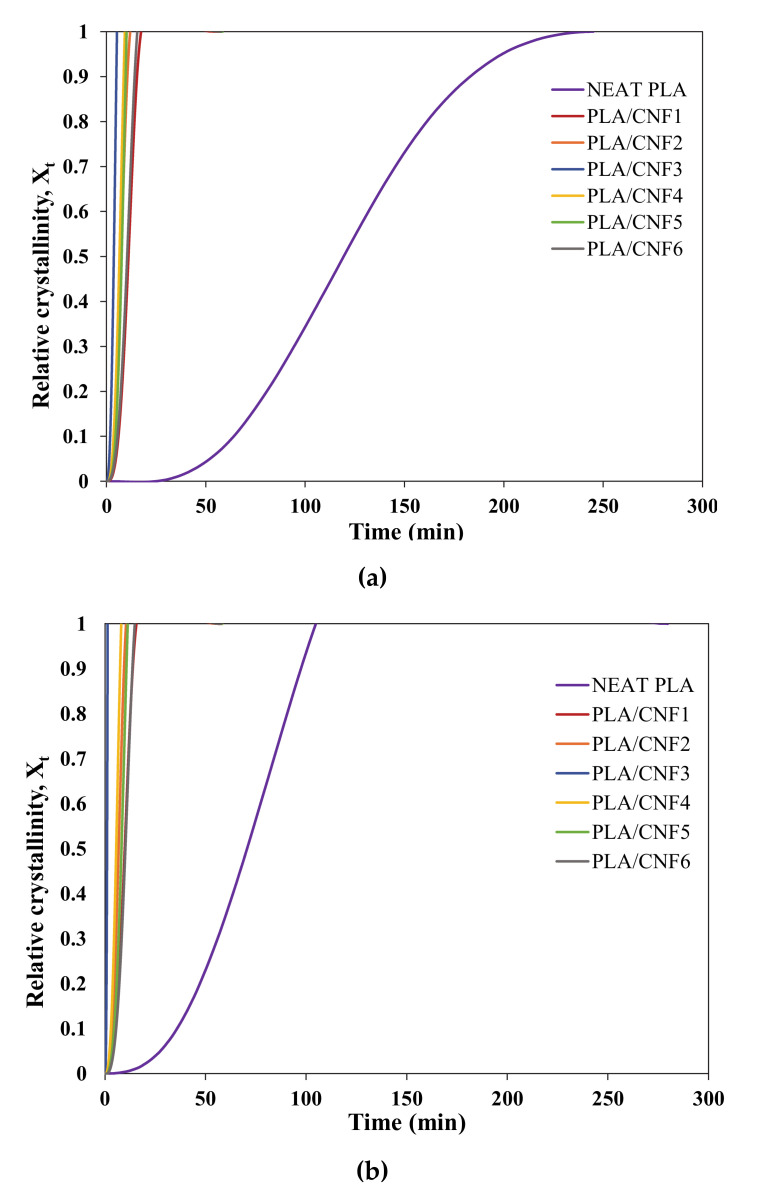
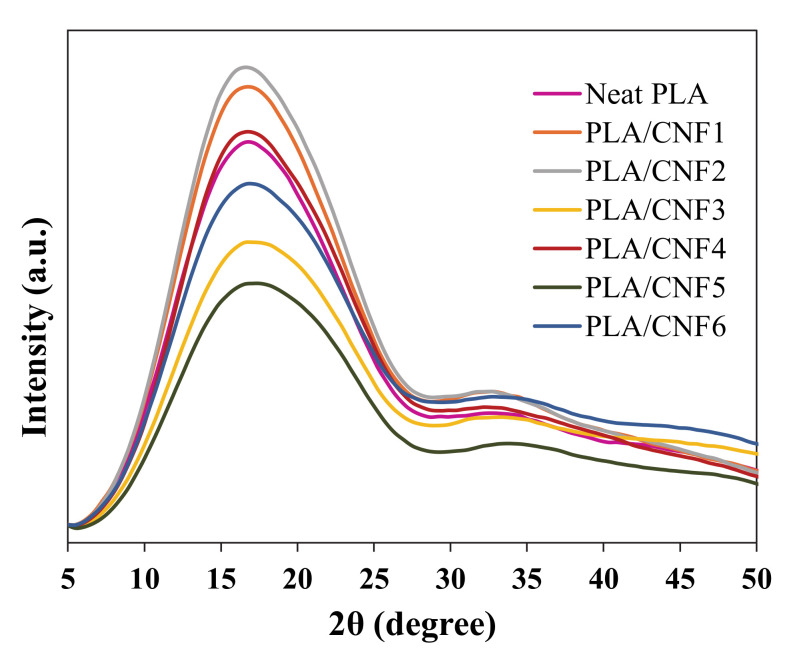
Polylactic acid (PLA), a potential alternative material for single use plastics, generally portrays a slow crystallization rate during melt-processing. The use of a nanomaterial such as cellulose nanofibers (CNF) may affect the crystallization rate by acting as a nucleating agent. CNF at a certain wt.% has been evidenced as a good reinforcement material for PLA; nevertheless, there is a lack of information on the correlation between the amount of CNF in PLA that promotes its functionality as reinforcement material, and its effect on PLA nucleation for improving the crystallization rate. This work investigated the nucleation effect of PLA incorporated with CNF at different fiber loading (1-6 wt.%) through an isothermal and non-isothermal crystallization kinetics study using differential scanning calorimetry (DSC) analysis. Mechanical properties of the PLA/CNF nanocomposites were also investigated. PLA/CNF3 exhibited the highest crystallization onset temperature and enthalpy among all the PLA/CNF nanocomposites. PLA/CNF3 also had the highest crystallinity of 44.2% with an almost 95% increment compared to neat PLA. The highest crystallization rate of 0.716 min was achieved when PLA/CNF3 was isothermally melt crystallized at 100 °C. The crystallization rate was 65-fold higher as compared to the neat PLA (0.011 min). At CNF content higher than 3 wt.%, the crystallization rate decreased, suggesting the occurrence of agglomeration at higher CNF loading as evidenced by the FESEM micrographs. In contrast to the tensile properties, the highest tensile strength and Young's modulus were recorded by PLA/CNF4 at 76.1 MPa and 3.3 GPa, respectively. These values were, however, not much different compared to PLA/CNF3 (74.1 MPa and 3.3 GPa), suggesting that CNF at 3 wt.% can be used to improve both the crystallization rate and the mechanical properties. Results obtained from this study revealed the dual function of CNF in PLA nanocomposite, namely as nucleating agent and reinforcement material. Being an organic and biodegradable material, CNF has an increased advantage for use in PLA as compared to non-biodegradable material and is foreseen to enhance the potential use of PLA in single use plastics applications.
聚乳酸(PLA)作为一次性塑料的一种潜在替代材料,在熔融加工过程中通常表现出缓慢的结晶速率。使用诸如纤维素纳米纤维(CNF)之类的纳米材料可能会作为成核剂影响结晶速率。已证明一定重量百分比的CNF是PLA的良好增强材料;然而,关于PLA中促进其作为增强材料功能的CNF含量与其对PLA成核以提高结晶速率的影响之间的相关性,缺乏相关信息。这项工作通过使用差示扫描量热法(DSC)分析的等温及非等温结晶动力学研究,研究了不同纤维负载量(1 - 6 wt.%)的含CNF的PLA的成核效果。还研究了PLA/CNF纳米复合材料的力学性能。在所有PLA/CNF纳米复合材料中,PLA/CNF3表现出最高的结晶起始温度和焓。PLA/CNF3还具有44.2%的最高结晶度,与纯PLA相比几乎增加了95%。当PLA/CNF3在100°C等温熔融结晶时,实现了0.716 min的最高结晶速率。该结晶速率比纯PLA(0.011 min)高65倍。在CNF含量高于3 wt.%时,结晶速率下降,这表明如场发射扫描电子显微镜(FESEM)显微照片所示,在较高的CNF负载量下发生了团聚。与拉伸性能相反,PLA/CNF4分别记录到最高的拉伸强度和杨氏模量,分别为76.1 MPa和3.3 GPa。然而,这些值与PLA/CNF3(74.1 MPa和3.3 GPa)相比没有太大差异,表明3 wt.%的CNF可用于提高结晶速率和力学性能。本研究获得的结果揭示了CNF在PLA纳米复合材料中的双重功能,即作为成核剂和增强材料。作为一种有机且可生物降解的材料,与不可生物降解材料相比,CNF在PLA中的使用具有更大优势,并且预计会增强PLA在一次性塑料应用中的潜在用途。