School of Science, Monash University Malaysia, Jalan Lagoon Selatan, 47500, Bandar Sunway, Selangor Darul Ehsan, Malaysia.
Health System and Population Studies Division, International Centre for Diarrhoeal Disease Research, Bangladesh, Dhaka, Bangladesh.
Sci Rep. 2021 Jan 29;11(1):2618. doi: 10.1038/s41598-021-82311-3.
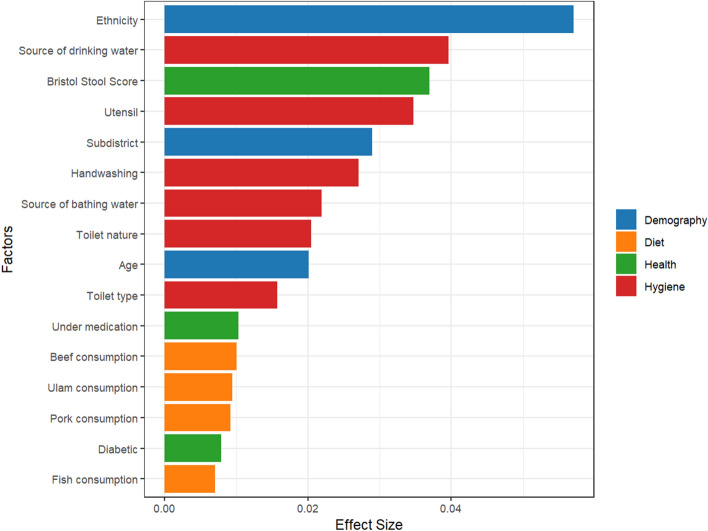
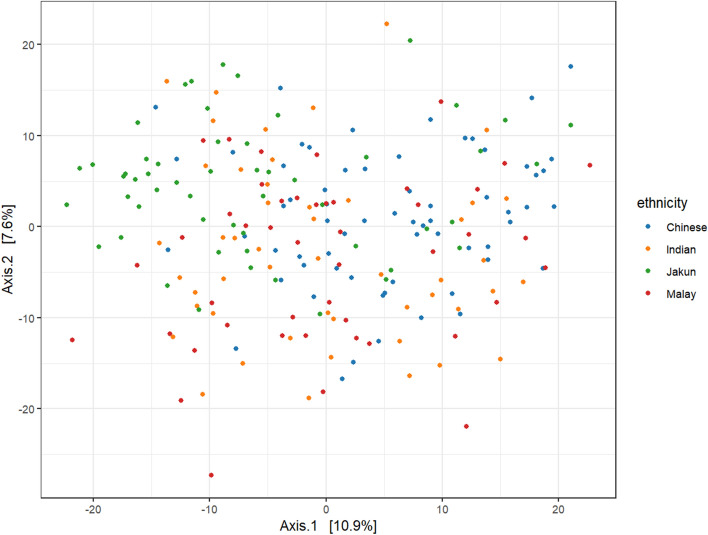
No studies have investigated the influence of ethnicity in a multi-ethnic middle-income country with a long-standing history of co-habitation. Stool samples from 214 Malaysian community members (46 Malay, 65 Chinese, 49 Indian, and 54 Jakun) were collected. The gut microbiota of the participants was investigated using 16S amplicon sequencing. Ethnicity exhibited the largest effect size across participants (PERMANOVA Pseudo-F = 4.24, R = 0.06, p = 0.001). Notably, the influence of ethnicity on the gut microbiota was retained even after controlling for all demographic, dietary factors and other covariates which were significantly associated with the gut microbiome (PERMANOVA Pseudo-F = 1.67, R = 0.02, p = 0.002). Our result suggested that lifestyle, dietary, and uncharacterized differences collectively drive the gut microbiota variation across ethnicity, making ethnicity a reliable proxy for both identified and unidentified lifestyle and dietary variation across ethnic groups from the same community.
尚无研究调查在一个多民族的中等收入国家(具有长期共同居住的历史)中,种族对肠道微生物群的影响。我们收集了 214 名马来西亚社区成员(46 名马来人、65 名华人、49 名印度人和 54 名杰昆人)的粪便样本。采用 16S 扩增子测序法研究参与者的肠道微生物群。种族对参与者的影响最大(PERMANOVA Pseudo-F=4.24,R=0.06,p=0.001)。值得注意的是,即使在控制了与肠道微生物组显著相关的所有人口统计学、饮食因素和其他协变量后,种族对肠道微生物群的影响仍然存在(PERMANOVA Pseudo-F=1.67,R=0.02,p=0.002)。我们的结果表明,生活方式、饮食和未被描述的差异共同导致了不同种族之间的肠道微生物群的变化,使种族成为同一社区中不同种族之间已识别和未识别的生活方式和饮食差异的可靠替代指标。