Department of Infectious and Tropical Diseases, University of Brescia and ASST Spedali Civili Hospital, Brescia, Italy.
Endocrinology, Montichiari Hospital, ASST Spedali Civili Brescia, Montichiari, Brescia, Italy.
J Endocrinol Invest. 2021 Sep;44(9):1971-1979. doi: 10.1007/s40618-021-01512-9. Epub 2021 Jan 29.
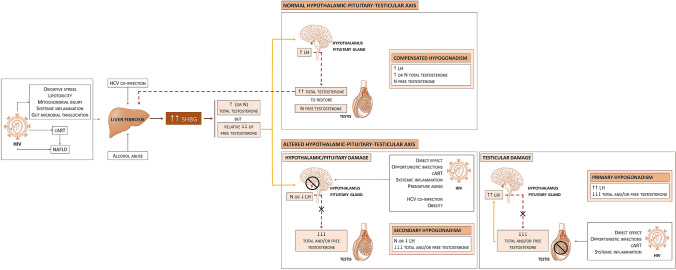
Hypogonadism is frequent in HIV-infected men and might impact on metabolic and sexual health. Low testosterone results from either primary testicular damage, secondary hypothalamic-pituitary dysfunction, or from liver-derived sex-hormone-binding-globulin (SHBG) elevation, with consequent reduction of free testosterone. The relationship between liver fibrosis and hypogonadism in HIV-infected men is unknown. Aim of our study was to determine the prevalence and type of hypogonadism in a cohort of HIV-infected men and its relationship with liver fibrosis.
We performed a cross-sectional retrospective study including 107 HIV-infected men (median age 54 years) with hypogonadal symptoms. Based on total testosterone (TT), calculated free testosterone, and luteinizing hormone, five categories were identified: eugonadism, primary, secondary, normogonadotropic and compensated hypogonadism. Estimates of liver fibrosis were performed by aspartate aminotransferase (AST)-to-platelet ratio index (APRI) and Fibrosis-4 (FIB-4) scores.
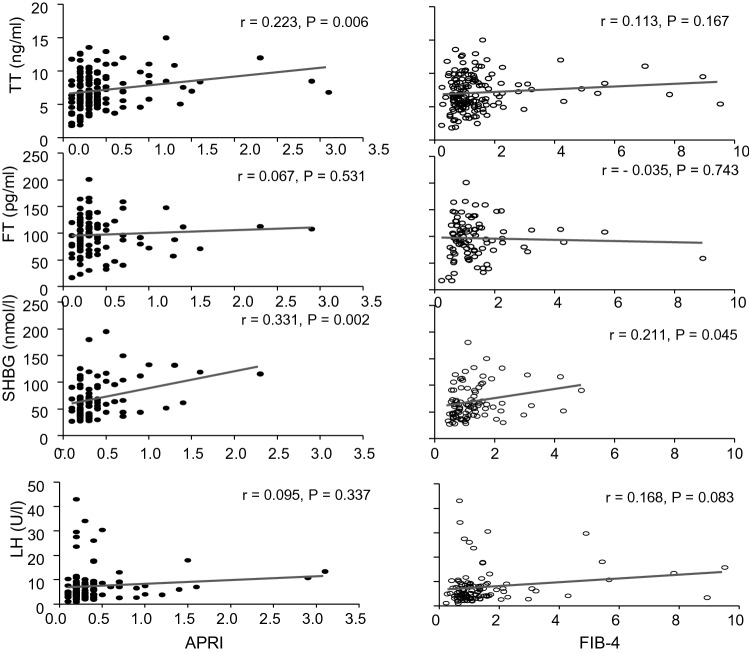
Hypogonadism was found in 32/107 patients (30.8%), with normogonadotropic (10/107, 9.3%) and compensated (17/107, 15.8%) being the most frequent forms. Patients with secondary/normogonadotropic hypogonadism had higher body mass index (BMI) (p < 0001). Patients with compensated hypogonadism had longer HIV infection duration (p = 0.031), higher APRI (p = 0.035) and FIB-4 scores (p = 0.008), and higher HCV co-infection. Univariate analysis showed a direct significant correlation between APRI and TT (p = 0.006) and SHBG (p = 0.002), and between FIB-4 and SHBG (p = 0.045). Multivariate analysis showed that SHBG was independently associated with both liver fibrosis scores.
Overt and compensated hypogonadism are frequently observed among HIV-infected men. Whereas obesity is related to secondary hypogonadism, high SHBG levels, related to liver fibrosis degree and HCV co-infection, are responsible for compensated forms.
HIV 感染男性中常发生性腺功能减退症,可能会影响代谢和性功能健康。睾丸原发性损伤、下丘脑-垂体功能障碍或肝源性性激素结合球蛋白(SHBG)升高导致游离睾酮减少,均可导致低睾酮。HIV 感染男性中肝纤维化与性腺功能减退症之间的关系尚不清楚。我们的研究目的是确定一组 HIV 感染男性中性腺功能减退症的患病率和类型及其与肝纤维化的关系。
我们进行了一项横断面回顾性研究,纳入了 107 例有性腺功能减退症状的 HIV 感染男性(中位年龄 54 岁)。根据总睾酮(TT)、计算的游离睾酮和黄体生成素,将其分为五类:正常性腺功能、原发性、继发性、正常促性腺激素和代偿性性腺功能减退症。通过天门冬氨酸氨基转移酶(AST)与血小板比值指数(APRI)和纤维化-4(FIB-4)评分来评估肝纤维化程度。
107 例患者中发现 32 例(30.8%)存在性腺功能减退症,其中最常见的是正常促性腺激素(10/107,9.3%)和代偿性(17/107,15.8%)。继发性/正常促性腺激素性腺功能减退症患者的体重指数(BMI)更高(p<0.0001)。代偿性性腺功能减退症患者的 HIV 感染时间更长(p=0.031),APRI(p=0.035)和 FIB-4 评分(p=0.008)更高,HCV 合并感染也更多。单因素分析显示,APRI 与 TT(p=0.006)和 SHBG(p=0.002)呈直接显著相关,FIB-4 与 SHBG 呈直接显著相关(p=0.045)。多因素分析显示,SHBG 与两种肝纤维化评分均独立相关。
HIV 感染男性中常发生显性和代偿性性腺功能减退症。肥胖与继发性性腺功能减退症有关,而与肝纤维化程度和 HCV 合并感染相关的高 SHBG 水平则导致代偿性性腺功能减退症。