Department for Shoulder and Elbow Surgery, Center for Musculoskeletal Surgery, Humboldt-Universität zu Berlin, and Berlin Institute of Health, Charité-University Medicine Berlin, Corporate Member of Freie Universität Berlin, Augustenburger Platz 1, 13353, Berlin, Germany.
Arch Orthop Trauma Surg. 2022 Aug;142(8):1715-1721. doi: 10.1007/s00402-021-03779-2. Epub 2021 Jan 30.
There is a paucity of literature regarding serum C-reactive protein (CRP) in the evaluation of a shoulder periprosthetic joint infection (PJI). The purpose of the current study was to establish cutoff values for diagnosing shoulder PJI and evaluate the influence of the type of infecting microorganism and the classification subgroups according to last proposed International Consensus Meeting (ICM) criteria on the CRP level.
A retrospective analysis of all 136 patients, who underwent septic or aseptic revision shoulder arthroplasty in our institution between January 2010 and December 2019, was performed. Shoulder PJI was defined according to the last proposed definition criteria of the ICM. Serum CRP levels were compared between infected and non-infected cases, between infection subgroups, as well as between different species of infecting microorganisms. A receiver-operating characteristic (ROC) analysis was performed to display sensitivity and specificity of serum CRP level for shoulder PJI.
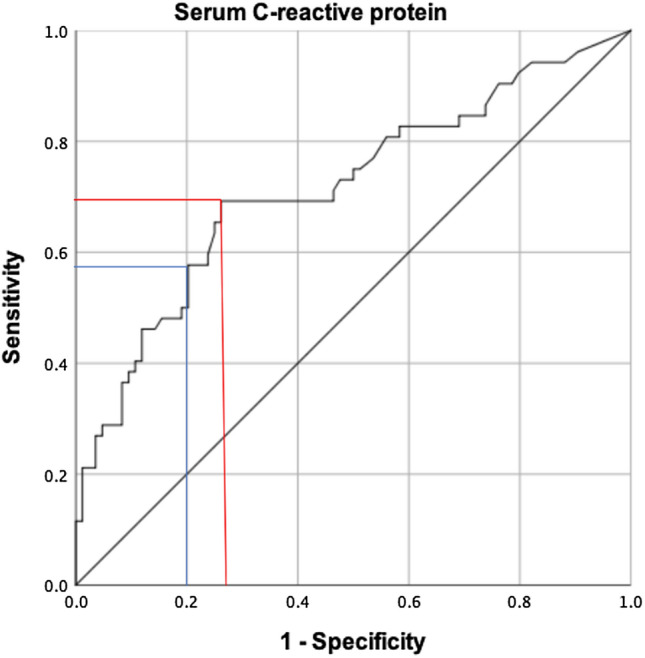
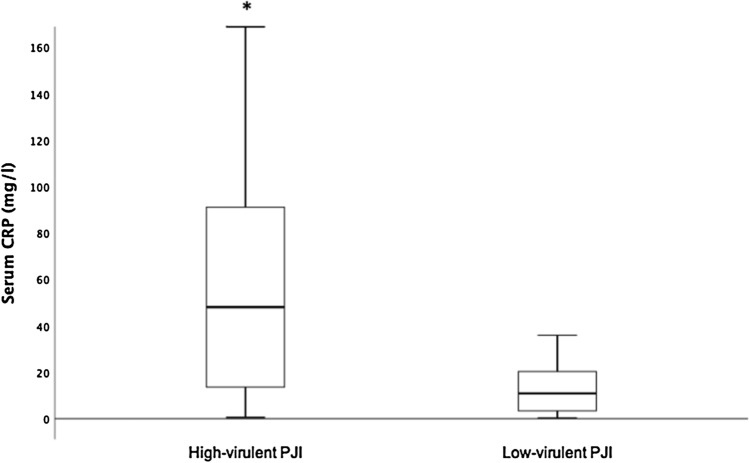
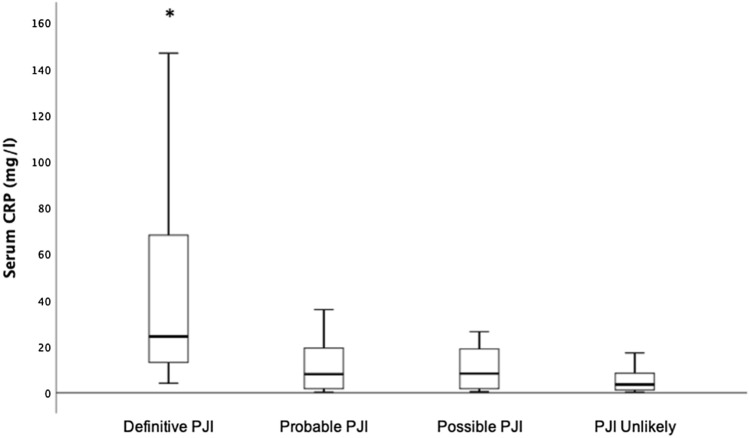
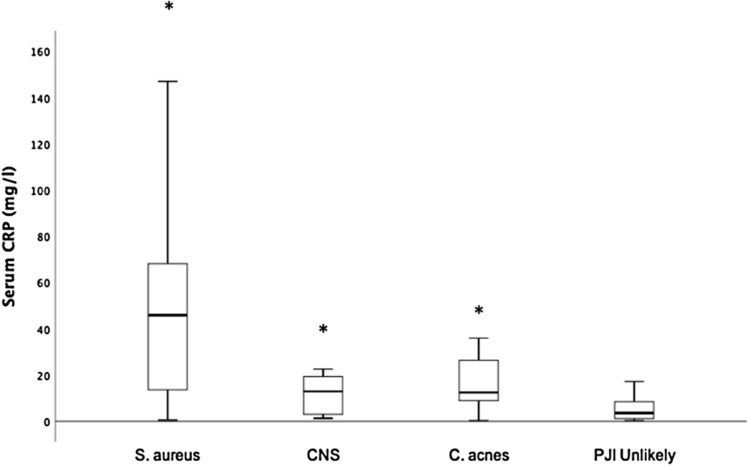
A total of 52 patients (38%) were classified as infected, 18 meeting the criteria for definitive infection, 26 for probable infection and 8 for possible infection. According to the ROC curve, an optimized serum CRP threshold of 7.2 mg/l had a sensitivity of 69% and specificity of 74% (area under curve = 0.72). Patients with definitive infection group demonstrated significantly higher median serum CRP levels (24.3 mg/l), when compared to probable, possible infection groups and PJI unlikely group (8 mg/l, 8.3 mg/l, 3.6 mg/l, respectively, p < 0.05). The most common isolated microorganism was Cutibacterium acnes in 25 patients (48%) followed by coagulase-negative staphylococci (CNS) in 20 patients (39%). Patients with a PJI caused by high-virulent microorganisms had a significantly higher median serum CRP level compared to patients with PJI caused by low-virulent microorganisms (48 mg/l vs. 11.3 mg/l, p = 0.04).
Serum CRP showed a low sensitivity and specificity for the diagnosis of shoulder PJI, even applying cutoffs optimized by receiver-operating curve analysis. Low-virulent microorganisms and patients with probable and possible infections are associated with lower CRP levels compared to patients with definitive infection and infections caused by high-virulent microorganisms.
Diagnostic Level III.
在评估肩假体关节感染(PJI)时,有关血清 C 反应蛋白(CRP)的文献很少。本研究的目的是建立诊断肩 PJI 的截断值,并评估感染微生物的类型以及根据最近提出的国际共识会议(ICM)标准进行的分类亚组对 CRP 水平的影响。
对 2010 年 1 月至 2019 年 12 月在我院行感染或无菌性翻修肩关节置换术的 136 例患者进行回顾性分析。肩 PJI 根据最近提出的 ICM 定义标准进行定义。比较感染和非感染病例、感染亚组以及不同感染微生物之间的血清 CRP 水平。进行受试者工作特征(ROC)分析以显示血清 CRP 水平对肩 PJI 的敏感性和特异性。
共有 52 例患者(38%)被归类为感染,其中 18 例符合明确感染标准,26 例为可能感染,8 例为可疑感染。根据 ROC 曲线,优化的血清 CRP 截断值为 7.2mg/L,其敏感性为 69%,特异性为 74%(曲线下面积=0.72)。与可能感染组和不可能感染组相比,明确感染组患者的血清 CRP 水平明显更高(24.3mg/L)(分别为 8mg/L、8.3mg/L 和 3.6mg/L,p<0.05)。最常见的分离微生物是 25 例患者(48%)的痤疮丙酸杆菌(Cutibacterium acnes),其次是凝固酶阴性葡萄球菌(CNS)20 例患者(39%)。由高毒力微生物引起的 PJI 患者的血清 CRP 水平明显高于由低毒力微生物引起的 PJI 患者(48mg/L 与 11.3mg/L,p=0.04)。
即使应用 ROC 分析优化的截断值,血清 CRP 对肩 PJI 的诊断也显示出低敏感性和特异性。与明确感染和高毒力微生物引起的感染相比,低毒力微生物和可能感染及可疑感染患者的 CRP 水平较低。
诊断水平 III。