Movement Disorders Section, Department of Neurology, Hannover Medical School, Carl-Neuberg-Str. 1, 30625, Hannover, Germany.
Department of Neurology, Hannover Medical School, Hannover, Germany.
J Neural Transm (Vienna). 2021 Mar;128(3):315-319. doi: 10.1007/s00702-021-02307-1. Epub 2021 Jan 30.
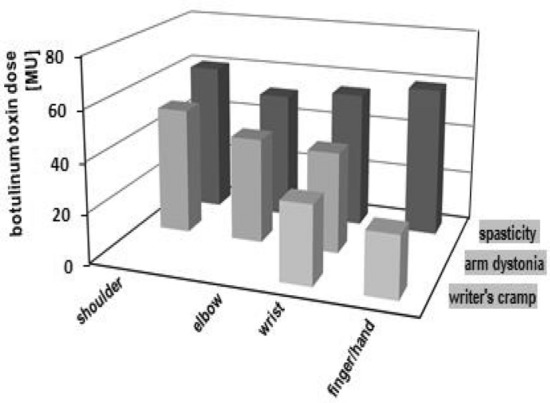
Botulinum toxin (BT) has been successfully used for many years to treat various muscle hyperactivity disorders including dystonia and spasticity. Its dosing is guided by dosing tables describing target muscles and dose ranges. To refine the BT dosing, we wanted to analyse how contextual factors may influence the injector's final dosing decision.In a retrospective review of real-life data of 1170 BT treatments, we studied the influence of various contextual factors on the BT doses in 21 arm muscles of 252 patients receiving BT therapy for different muscle hyperactivity disorders.We found that BT arm doses are significantly higher in treatment of spasticity than in treatment of dystonia. We also found that spontaneous arm dystonia requires higher BT doses in a proximal application pattern, whereas task specific writer's cramp requires considerably reduced BT doses with a distal application pattern. Injections of non-arm muscles influence the BT dosing in arm muscles only marginally.Our study demonstrates that BT dosing does not only depend on the particularities of the individual target muscle injected, such as its volume and its static or phasic function. BT dosing and its application pattern rather depend on additional contextual factors such as the aetiology and pathophysiology of the muscle hyperactivity treated. These contextual factors need to be included in dosing tables and may improve the outcome of BT therapy.
肉毒毒素(BT)已成功用于治疗多种肌肉过度活动障碍,包括肌张力障碍和痉挛。其剂量是根据描述目标肌肉和剂量范围的剂量表来指导的。为了优化 BT 剂量,我们希望分析环境因素如何影响注射者的最终剂量决策。
在对 252 名接受 BT 治疗不同肌肉过度活动障碍的患者的 1170 例 BT 治疗的真实数据进行回顾性分析中,我们研究了各种环境因素对 21 个手臂肌肉中 BT 剂量的影响。
我们发现,痉挛治疗中的 BT 手臂剂量明显高于肌张力障碍治疗。我们还发现,自发性手臂肌张力障碍在近端应用模式下需要更高的 BT 剂量,而特定任务的书写痉挛则需要在远端应用模式下显著降低 BT 剂量。非手臂肌肉的注射仅对手臂肌肉的 BT 剂量有轻微影响。
我们的研究表明,BT 剂量不仅取决于注射的特定目标肌肉的特殊性,如肌肉体积及其静态或动态功能,而且取决于其他环境因素,如治疗的肌肉过度活动的病因和病理生理学。这些环境因素需要包含在剂量表中,可能会提高 BT 治疗的效果。