Center for Medical Genetics & Hunan Provincial Key Laboratory of Medical Genetics, School of Life Sciences, Central South University, Changsha 410008, China; Department of Neurology, Beth Israel Deaconess Medical Center & Harvard Medical School, Boston, MA 02115, USA.
Department of Neurology, Xuanwu Hospital, Capital Medical University, Beijing 100053, China.
J Sport Health Sci. 2021 Jul;10(4):454-461. doi: 10.1016/j.jshs.2021.01.008. Epub 2021 Jan 27.
Physical activity has been hypothesized to play a protective role in neurodegenerative diseases. However, effect estimates previously derived from observational studies were prone to confounding or reverse causation.
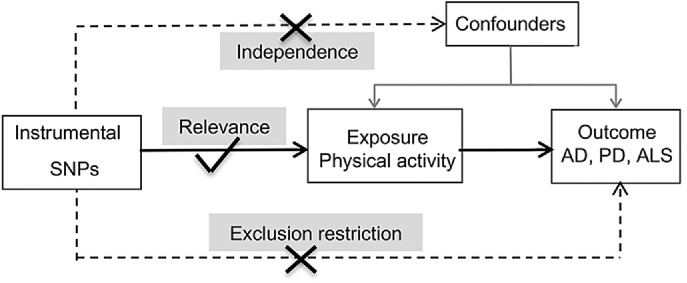
We performed a two-sample Mendelian randomization (MR) analysis to explore the causal association of accelerometer-measured physical activity with 3 common neurodegenerative diseases: Alzheimer's disease (AD), Parkinson's disease (PD), and amyotrophic lateral sclerosis (ALS). We selected genetic instrumental variants reaching genome-wide significance (p < 5 × 10) from 2 largest meta-analyses of about 91,100 UK Biobank participants. Summary statistics for AD, PD, and ALS were retrieved from the up-to-date studies in European ancestry led by the international consortia. The random-effect, inverse-variance weighted MR was employed as the primary method, while MR pleiotropy residual sum and outlier (MR-PRESSO), weighted median, and MR-Egger were implemented as sensitivity tests. All statistical analyses were performed using the R programming language (Version 3.6.1; R Foundation for Statistical Computing, Vienna, Austria).
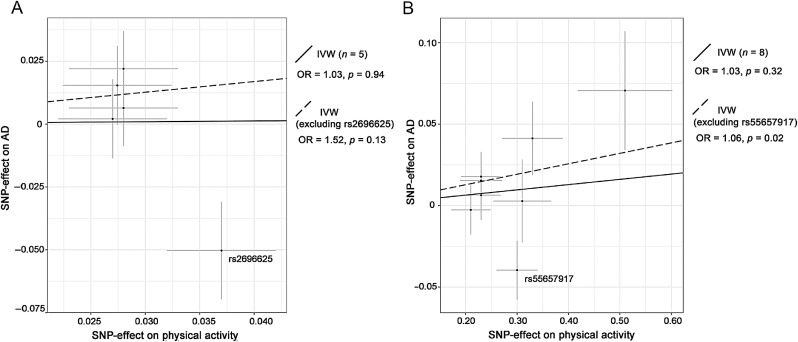
Primary MR analysis and replication analysis utilized 5 and 8 instrumental variables, which explained 0.2% and 0.4% variance in physical activity, respectively. In each set, one variant at 17q21 was significantly associated with PD, and MR sensitivity analyses indicated them it as an outlier and source of heterogeneity and pleiotropy. Primary results with the removal of outlier variants suggested odds ratios (ORs) of neurodegenerative diseases per unit increase in objectively measured physical activity were 1.52 for AD (95% confidence interval (95%CI): 0.88-2.63, p = 0.13) and 3.35 for PD (95%CI: 1.32-8.48, p = 0.01), while inconsistent results were shown in the replication set for AD (OR = 1.06, 95%CI: 1.01-1.12, p = 0.02) and PD (OR = 0.99, 95%CI: 0.88-0.12, p = 0.97). Similarly, the beneficial effect of physical activity on ALS (OR = 0.51, 95%CI: 0.29-0.91, p = 0.02) was not confirmed in the replication analysis (OR = 0.96, 95%CI: 0.91-1.02, p = 0.22).
Genetically predicted physical activity was not robustly associated with risk of neurodegenerative disorders. Triangulating evidence across other studies is necessary in order to elucidate whether enhancing physical activity is an effective approach in preventing the onset of AD, PD, or ALS.
体力活动被假设在神经退行性疾病中发挥保护作用。然而,先前从观察性研究中得出的效应估计值容易受到混杂或反向因果关系的影响。
我们进行了两样本孟德尔随机化(MR)分析,以探讨加速度计测量的体力活动与 3 种常见神经退行性疾病(阿尔茨海默病[AD]、帕金森病[PD]和肌萎缩侧索硬化症[ALS])之间的因果关联。我们从大约 91,100 名英国生物库参与者的两项最大荟萃分析中选择了达到全基因组意义水平(p<5×10)的遗传工具变量。AD、PD 和 ALS 的汇总统计数据是从由国际联盟领导的欧洲血统的最新研究中检索到的。使用随机效应、逆方差加权 MR 作为主要方法,同时使用 MR 多效性残余总和和异常值(MR-PRESSO)、加权中位数和 MR-Egger 作为敏感性测试。所有统计分析均使用 R 编程语言(版本 3.6.1;R 基金会用于统计计算,维也纳,奥地利)进行。
主要 MR 分析和复制分析分别使用了 5 个和 8 个工具变量,分别解释了体力活动的 0.2%和 0.4%的方差。在每个集合中,17q21 上的一个变体与 PD 显著相关,MR 敏感性分析表明它是一个异常值和异质性和多效性的来源。去除异常值变体后的主要结果表明,与客观测量的体力活动每增加一个单位相关的神经退行性疾病的优势比(OR)分别为 AD 为 1.52(95%置信区间[95%CI]:0.88-2.63,p=0.13)和 PD 为 3.35(95%CI:1.32-8.48,p=0.01),而在 AD 的复制集合中显示出不一致的结果(OR=1.06,95%CI:1.01-1.12,p=0.02)和 PD(OR=0.99,95%CI:0.88-0.12,p=0.97)。同样,体力活动对 ALS(OR=0.51,95%CI:0.29-0.91,p=0.02)的有益影响在复制分析中也未得到证实(OR=0.96,95%CI:0.91-1.02,p=0.22)。
遗传预测的体力活动与神经退行性疾病的风险没有明显关联。为了阐明增强体力活动是否是预防 AD、PD 或 ALS 发作的有效方法,有必要在其他研究中综合证据。