Khurshid Shaan, Weng Lu-Chen, Nauffal Victor, Pirruccello James P, Venn Rachael A, Al-Alusi Mostafa A, Benjamin Emelia J, Ellinor Patrick T, Lubitz Steven A
Cardiovascular Research Center, Massachusetts General Hospital, Boston MA, USA.
Cardiovascular Disease Initiative, Broad Institute of Harvard and the Massachusetts Institute of Technology, Cambridge MA, USA.
NPJ Digit Med. 2022 Sep 2;5(1):131. doi: 10.1038/s41746-022-00676-9.
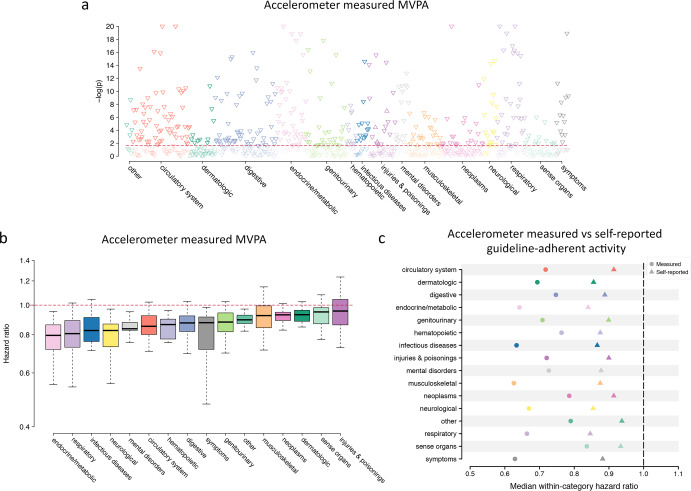
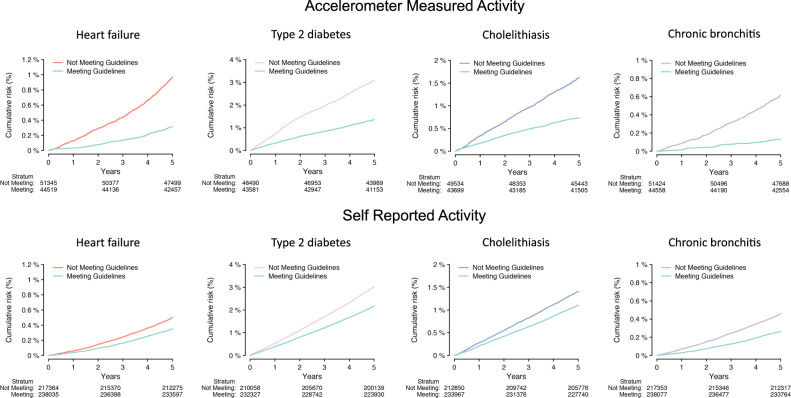
Physical activity is regarded as favorable to health but effects across the spectrum of human disease are poorly quantified. In contrast to self-reported measures, wearable accelerometers can provide more precise and reproducible activity quantification. Using wrist-worn accelerometry data from the UK Biobank prospective cohort study, we test associations between moderate-to-vigorous physical activity (MVPA) - both total MVPA minutes and whether MVPA is above a guideline-based threshold of ≥150 min/week-and incidence of 697 diseases using Cox proportional hazards models adjusted for age, sex, body mass index, smoking, Townsend Deprivation Index, educational attainment, diet quality, alcohol use, blood pressure, anti-hypertensive use. We correct for multiplicity at a false discovery rate of 1%. We perform analogous testing using self-reported MVPA. Among 96,244 adults wearing accelerometers for one week (age 62 ± 8 years), MVPA is associated with 373 (54%) tested diseases over a median 6.3 years of follow-up. Greater MVPA is overwhelmingly associated with lower disease risk (98% of associations) with hazard ratios (HRs) ranging 0.70-0.98 per 150 min increase in weekly MVPA, and associations spanning all 16 disease categories tested. Overall, associations with lower disease risk are enriched for cardiac (16%), digestive (14%), endocrine/metabolic (10%), and respiratory conditions (8%) (chi-square p < 0.01). Similar patterns are observed using the guideline-based threshold of ≥150 MVPA min/week. Some of the strongest associations with guideline-adherent activity include lower risks of incident heart failure (HR 0.65, 95% CI 0.55-0.77), type 2 diabetes (HR 0.64, 95% CI 0.58-0.71), cholelithiasis (HR 0.61, 95% CI 0.54-0.70), and chronic bronchitis (HR 0.42, 95% CI 0.33-0.54). When assessed within 456,374 individuals providing self-reported MVPA, effect sizes for guideline-adherent activity are substantially smaller (e.g., heart failure HR 0.84, 95% CI 0.80-0.88). Greater wearable device-based physical activity is robustly associated with lower disease incidence. Future studies are warranted to identify potential mechanisms linking physical activity and disease, and assess whether optimization of measured activity can reduce disease risk.
体育活动被认为对健康有益,但对人类各种疾病的影响却缺乏精确量化。与自我报告的测量方法不同,可穿戴式加速度计能够提供更精确且可重复的活动量化数据。利用英国生物银行前瞻性队列研究中的腕部佩戴式加速度计数据,我们使用Cox比例风险模型,在对年龄、性别、体重指数、吸烟情况、汤森德贫困指数、教育程度、饮食质量、饮酒情况、血压、抗高血压药物使用情况进行调整后,测试了中度至剧烈体育活动(MVPA,包括总MVPA分钟数以及MVPA是否高于基于指南的每周≥150分钟的阈值)与697种疾病发病率之间的关联。我们以1%的错误发现率对多重性进行校正。我们还使用自我报告的MVPA进行了类似测试。在96244名佩戴加速度计一周的成年人(年龄62±8岁)中,在中位随访6.3年期间,MVPA与373种(54%)测试疾病相关。更多的MVPA绝大多数与较低的疾病风险相关(98%的关联),每周MVPA每增加150分钟,风险比(HRs)范围为0.70 - 0.98,且关联涵盖所有16个测试疾病类别。总体而言,与较低疾病风险的关联在心脏疾病(16%)、消化系统疾病(14%)、内分泌/代谢疾病(10%)和呼吸系统疾病(8%)中更为富集(卡方检验p < 0.01)。使用基于指南的每周≥150分钟MVPA阈值时也观察到类似模式。与遵循指南的活动关联最强的一些疾病包括心力衰竭发病风险降低(HR 0.65,95%CI 0.55 - 0.77)、2型糖尿病(HR 0.64,95%CI 0.58 - 0.71)、胆结石(HR 0.61,95%CI 0.54 - 0.70)和慢性支气管炎(HR 0.42,95%CI 0.33 - 0.54)。在456374名提供自我报告MVPA的个体中进行评估时,遵循指南活动的效应大小显著较小(例如,心力衰竭HR 0.84,95%CI 0.80 - 0.88)。基于可穿戴设备的更多体育活动与较低的疾病发病率密切相关。有必要开展进一步研究以确定体育活动与疾病之间潜在的关联机制,并评估优化测量的活动是否能够降低疾病风险。