INSERM U 1127, CNRS UMR 7225, Sorbonne Universités, UPMC Univ Paris 06 UMR S 1127, Institut du Cerveau et de la Moelle épinière, ICM, F-75013 Paris, France.
INSERM U 1127, CNRS UMR 7225, Sorbonne Universités, UPMC Univ Paris 06 UMR S 1127, Institut du Cerveau et de la Moelle épinière, ICM, F-75013 Paris, France; Center for NeuroImaging Research (CENIR), Institut du Cerveau et de la Moelle épinière, 75013 Paris, France.
Neuroimage Clin. 2021;29:102566. doi: 10.1016/j.nicl.2021.102566. Epub 2021 Jan 19.
Progressive myelopathy causes severe handicap in men with adrenomyeloneuropathy (AMN), an X-linked disorder due to ABCD1 pathogenic variants. At present, treatments are symptomatic but disease-modifying therapies are under evaluation. Given the small effect size of clinical scales in AMN, biomarkers with higher effect size are needed. Here we used high-resolution magnetic resonance techniques to identify non-invasive in vivo biomarkers of the brain and spine with high effect sizes.
We performed a multiparametric imaging and spectroscopy study in 23 male patients with AMN (age: 44 ± 11) and 23 male controls (age: 43 ± 11) of similar age and body-mass index. We combined (i) macrostructural analyses of the spine, using cross-sectional area (CSA) and magnetization transfer ratio (MTR), (ii) microstructural analyses of the spine and the brain, using diffusion tensor and the newly developed fixel-based analysis, and (iii) advanced metabolic analyses of the spine using metabolite cycling coupled to a semi-LASER sequences.
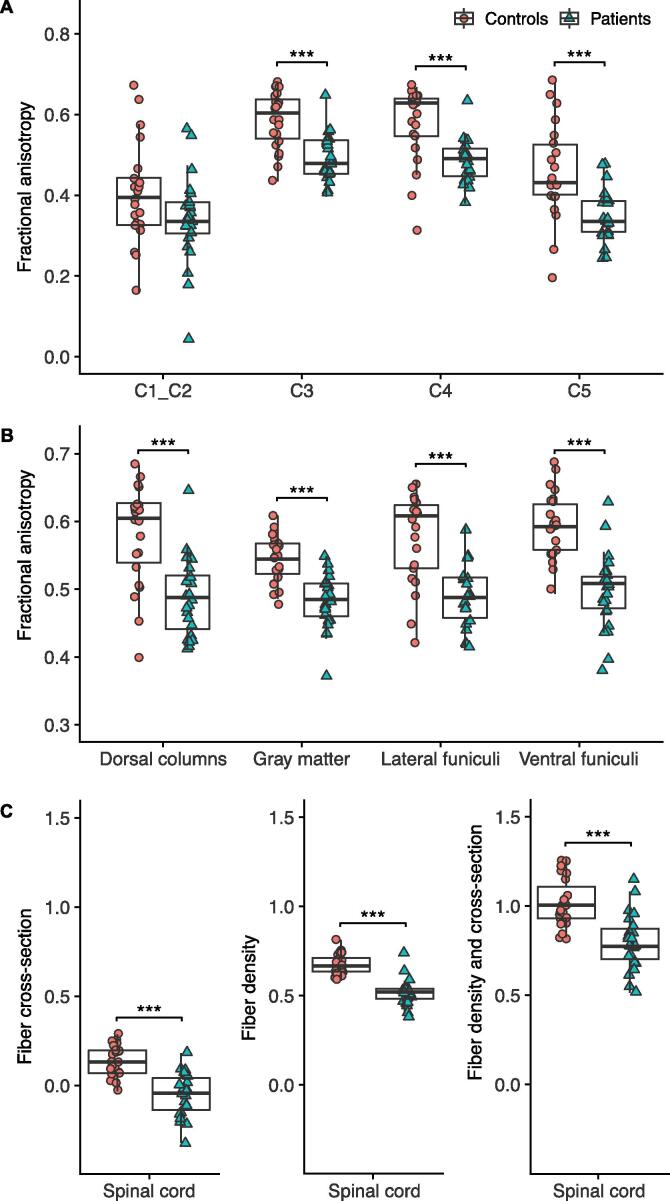
Macrostructural alterations (decrease in CSA and MTR) were observed in patients at all spinal cord levels studied (C1-T2 for CSA and C1-C5 for MTR) (p < 0.001). Microstructural alterations were observed in the spine and brain on diffusion tensor and fixel-based metrics though the latter showed higher effect sizes. Metabolic alterations were observed in patients as a decreased total N-acetylaspartate/myo-inositol ratio (p < 0.001). Overall, MTR showed the highest effect size.
This cross-sectional study supports the use of multiparametric techniques that elucidate the structural, microstructural and metabolic alterations in AMN. These outcome measures should be tested longitudinally and in clinical trials.
进行性脊髓病导致肾上腺脑白质营养不良(AMN)男性患者严重残疾,该病是由于 ABCD1 致病性变异引起的 X 连锁疾病。目前,治疗方法是对症治疗,但正在评估疾病修饰疗法。鉴于 AMN 临床量表的效应量较小,需要具有更高效应量的生物标志物。在这里,我们使用高分辨率磁共振技术来识别具有高效应量的大脑和脊柱的非侵入性体内生物标志物。
我们对 23 名 AMN 男性患者(年龄:44±11)和 23 名年龄和体重指数相似的男性对照者(年龄:43±11)进行了多参数成像和光谱学研究。我们结合了(i)脊柱的宏观结构分析,使用横截面积(CSA)和磁化转移率(MTR),(ii)脊柱和大脑的微观结构分析,使用扩散张量和新开发的基于固定元素的分析,以及(iii)使用代谢物循环与半-LASER 序列结合的脊柱的高级代谢分析。
在所有研究的脊髓水平(CSA 为 C1-T2,MTR 为 C1-C5)都观察到患者的宏观结构改变(CSA 和 MTR 降低)(p<0.001)。在扩散张量和固定元素指标上观察到微观结构改变,尽管后者显示出更高的效应量。在患者中观察到代谢改变,表现为总 N-乙酰天冬氨酸/肌醇比降低(p<0.001)。总体而言,MTR 显示出最高的效应量。
这项横断面研究支持使用多参数技术来阐明 AMN 的结构、微观结构和代谢改变。这些结局指标应进行纵向和临床试验测试。