Epidemiology, German Cancer Research Centre, Heidelberg, Germany.
Hematology, Oncology and Tumor Immunology, Charité Universitätsmedizin Berlin, Berlin, Germany.
Bone Marrow Transplant. 2021 Jul;56(7):1573-1583. doi: 10.1038/s41409-020-01186-6. Epub 2021 Jan 30.
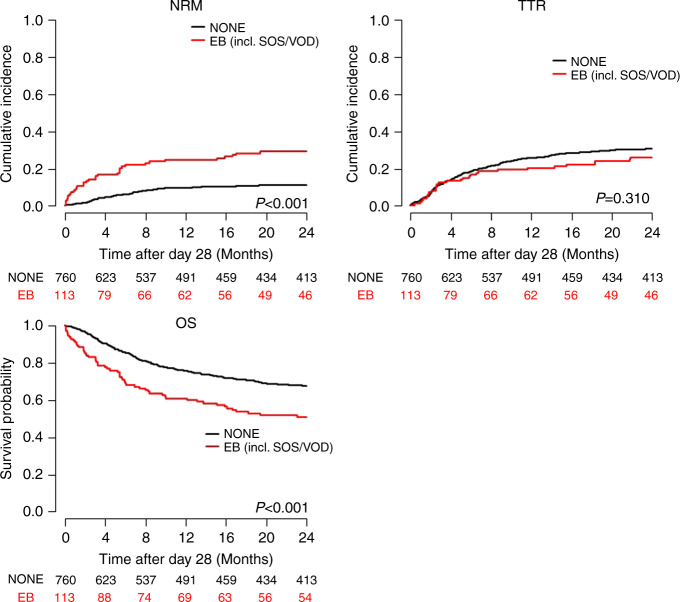
Hyperbilirubinemia occurs frequently after allogeneic stem cell transplantation. Causes include primary liver damage and endothelial complications as major contributors. Here, we have investigated the impact of early bilirubinemia (EB) on posttransplant outcomes. Maximum total bilirubin levels (days 0-28) were categorized using maximally selected log rank statistics to identify a cut off for the endpoint non-relapse mortality (NRM) in a training cohort of 873 patients. EB above this cut off was correlated with NRM and overall survival (OS) and with pre- and posttransplant Angiopoietin-2, interleukin (IL)18, CXCL8 and suppressor of tumorigenicity-2 (ST2) serum levels, and the endothelial activation and stress index (EASIX). Clinical correlations were validated in a sample of 388 patients transplanted in an independent institution. The EB cut off was determined at 3.6 mg/dL (61.6 µM). EB predicted OS (HR 1.60, 95% CI 1.21-2.12, p < 0.001), and NRM (CSHR 2.14; 1.28-3.56, p = 0.004), also independent of typical endothelial complications such as veno-occlusive disease, refractory acute graft-versus-host disease, or transplant-associated microangiopathy. However, EB correlated with high Angiopoietin-2, EASIX-pre and EASIX-day 0, as well as increased levels of posttransplant CXCL8, IL18, and ST2. In summary, EB indicates a poor prognosis. The association of EB with endothelial biomarkers suggests an endothelial pathomechanism also for this posttransplant complication.
高胆红素血症在异基因造血干细胞移植后经常发生。其病因包括原发性肝损伤和内皮并发症。在此,我们研究了早期胆红素血症(EB)对移植后结局的影响。使用最大选择对数秩统计对最大总胆红素水平(第 0-28 天)进行分类,以确定训练队列中 873 例患者终点非复发死亡率(NRM)的截止值。超过该截止值的 EB 与 NRM 和总生存率(OS)以及移植前和移植后血管生成素-2、白细胞介素(IL)18、CXCL8 和抑瘤素-2(ST2)血清水平、内皮激活和应激指数(EASIX)相关。在另一家机构接受移植的 388 例患者样本中验证了临床相关性。EB 截止值确定为 3.6mg/dL(61.6µM)。EB 预测 OS(HR 1.60,95%CI 1.21-2.12,p<0.001)和 NRM(CSHR 2.14;1.28-3.56,p=0.004),也独立于典型的内皮并发症,如静脉阻塞性疾病、难治性急性移植物抗宿主病或移植相关微血管病。然而,EB 与高血管生成素-2、EASIX-前和 EASIX-第 0 天相关,以及移植后 CXCL8、IL18 和 ST2 水平升高。总之,EB 表明预后不良。EB 与内皮生物标志物的相关性提示内皮发病机制也可能与这种移植后并发症有关。