Department of Orthopaedic Surgery, UPMC Freddie Fu Sports Medicine Center, University of Pittsburgh, 3200 S. Water St, Pittsburgh, PA, 15203, USA.
Department for Orthopaedic Sports Medicine, Klinikum rechts der Isar, Technical University of Munich, Ismaninger Str. 22, 81675, Munich, Germany.
Knee Surg Sports Traumatol Arthrosc. 2022 Jan;30(1):139-148. doi: 10.1007/s00167-021-06460-8. Epub 2021 Jan 31.
To compare clinical outcomes, radiographic characteristics, and surgical factors between patients with single and multiple anterior cruciate ligament (ACL) graft failures. It was hypothesized that patients experiencing multiple ACL graft failures exhibit lower patient-reported outcome scores (PROs) and a higher (steeper) posterior tibial slope (PTS) than patients with single ACL graft failure.
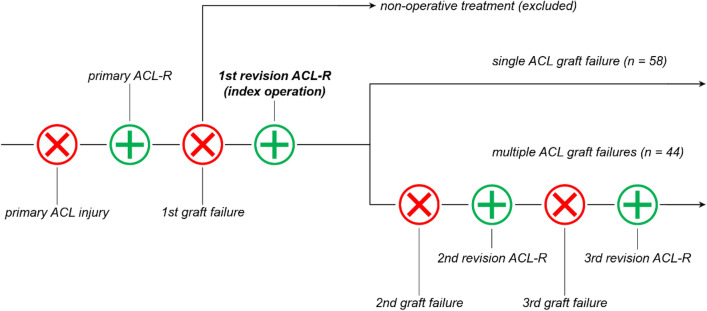
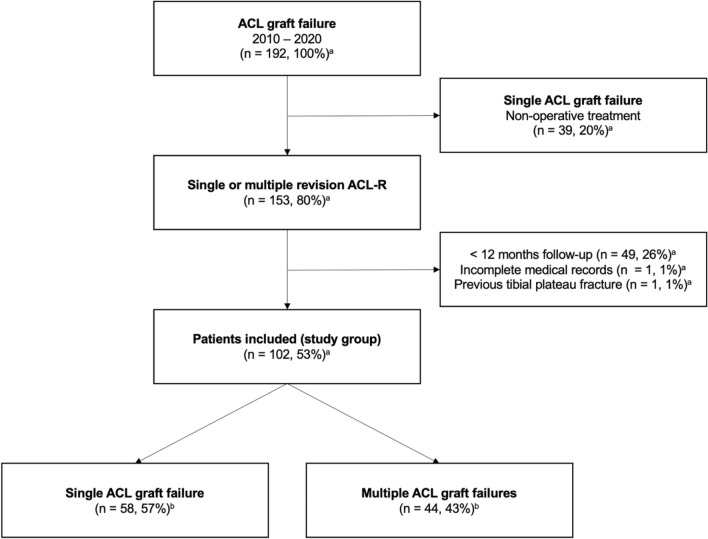
Patients undergoing revision ACL reconstruction with a minimum follow-up of 12 months were included in this retrospective cohort study. Based on the number of ACL graft failures, patients were assigned either to the group "single ACL graft failure "or" multiple ACL graft failures ". The PTS was measured on strict lateral radiographs. Validated PROs including the International Knee Documentation Committee (IKDC) subjective knee form, Knee Injury and Osteoarthritis Outcome Score, Lysholm Score, Tegner Activity Scale, ACL-Return to Sport after Injury Scale, and Visual Analogue Scale for pain were collected.
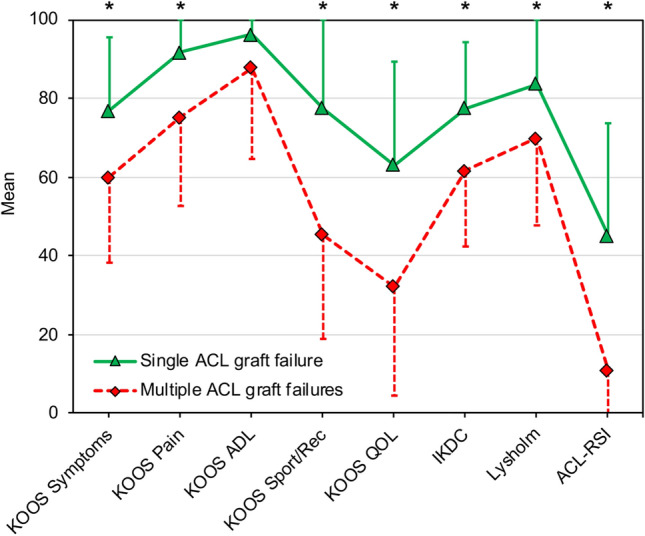
Overall, 102 patients were included with 58 patients assigned to the single ACL graft failure group and 44 patients to the multiple ACL graft failures group. Quadriceps tendon autograft was used significantly more often (55% vs. 11%, p < 0.001) and allografts were used significantly less often (31% vs. 66%, p < 0.001) as the graft for first revision ACL reconstruction in patients with single versus multiple ACL graft failures. Patients with multiple ACL graft failures were associated with statistically significantly worse PROs (IKDC: 61.7 ± 19.3 vs. 77.4 ± 16.8, p < 0.05; Tegner Activity Scale: 4 (range, 0-7) vs. 6 (range 2-10), p < 0.05), higher PTS (12 ± 3° vs. 9 ± 3°, p < 0.001), and higher rates of subsequent surgery (73% vs. 14%, p < 0.001) and complications (45% vs. 17%, p < 0.05) than patients with single ACL graft failure.
Compared to single ACL graft failure in this study multiple ACL graft failures were associated with worse PROs, higher PTS, and allograft use. During the first revision ACL reconstruction, it is recommended to avoid the use of allografts and to consider slope-reducing osteotomies to avoid multiple ACL graft failures and improve PROs.
Level 3.
比较单发性和多发性前交叉韧带(ACL)移植物失败患者的临床结果、影像学特征和手术因素。假设多发性 ACL 移植物失败的患者比单发性 ACL 移植物失败的患者报告的患者结局评分(PROs)更低,且胫骨后倾角(PTS)更高(更陡峭)。
本回顾性队列研究纳入了接受至少 12 个月随访的接受 ACL 翻修重建的患者。根据 ACL 移植物失败的数量,患者被分配到“单发性 ACL 移植物失败”或“多发性 ACL 移植物失败”组。在严格的外侧位 X 线片上测量 PTS。收集了包括国际膝关节文献委员会(IKDC)主观膝关节评分表、膝关节损伤和骨关节炎结果评分、Lysholm 评分、Tegner 活动量表、ACL 损伤后重返运动量表和疼痛视觉模拟评分在内的有效 PROs。
共有 102 例患者纳入研究,其中 58 例患者被分配到单发性 ACL 移植物失败组,44 例患者被分配到多发性 ACL 移植物失败组。在单发性 ACL 移植物失败患者中,股四头肌肌腱自体移植物的使用率显著更高(55%比 11%,p<0.001),同种异体移植物的使用率显著更低(31%比 66%,p<0.001),而用于初次 ACL 翻修重建的移植物。与单发性 ACL 移植物失败的患者相比,多发性 ACL 移植物失败的患者 PROs 更差(IKDC:61.7±19.3 比 77.4±16.8,p<0.05;Tegner 活动量表:4(范围,0-7)比 6(范围 2-10),p<0.05),PTS 更高(12±3°比 9±3°,p<0.001),且后续手术(73%比 14%,p<0.001)和并发症(45%比 17%,p<0.05)的发生率更高。
与本研究中单发性 ACL 移植物失败相比,多发性 ACL 移植物失败与较差的 PROs、较高的 PTS 和同种异体移植物的使用有关。在初次 ACL 翻修重建时,建议避免使用同种异体移植物,并考虑采用降低后倾角的截骨术,以避免多发性 ACL 移植物失败并改善 PROs。
3 级。