Department of Critical Care Medicine, Erciyes University Medical School, Kayseri, Turkey
Department of Internal Medicine, Division of Hematology, Erciyes University Medical School, Kayseri, Turkey
Turk J Med Sci. 2021 Aug 30;51(4):1756-1763. doi: 10.3906/sag-2007-228.
BACKGROUND/AIM: High flow nasal cannula (HFNC) was mostly used in intensive care units (ICUs) with few studies in other departments. We hypothesized that HFNC applied at wards is beneficial for acute respiratory failure in hematological malignancy patients.
The study is a single center, randomized controlled study. Inclusion criteria were hypoxemic respiratory failure and hematological malignancy. Patients were randomized to either venturi mask/nasal cannula oxygen treatment or HFNC.
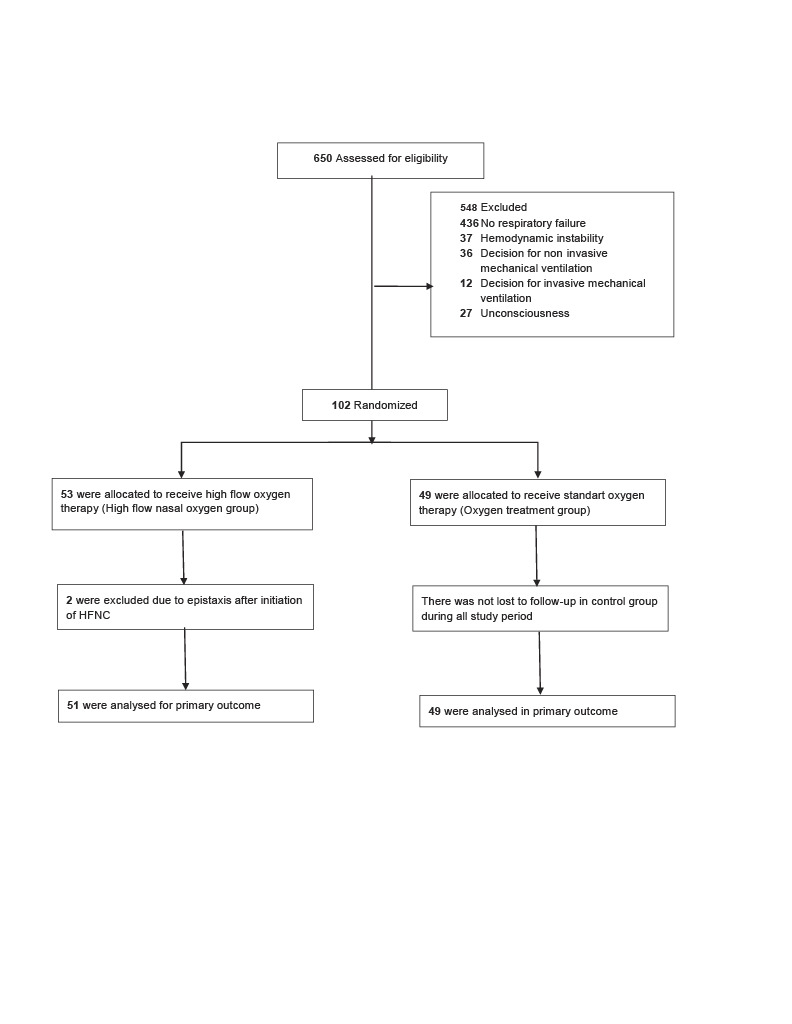
One hundred patients were included in the study. Median age was 58.5 (18–86) years and APACHE II score was 17 (5–29). HFNC group was 51 patients and the oxygen treatment group 49 patients. P/F ratios were similar between the groups throughout the study period. Endotracheal intubation was required in 10 (20.0%) patients in oxygen group and 17 (33.0%) patients in HFNC group (p = 0.14). A total of 17 (35.0%) patients in oxygen group and 17 (33.0%) patients in HFNC group received noninvasive mechanical ventilation (p = 0.97). Median VAS comfort scores at the 2nd and 24th hours were not different between groups. The 28-day mortality rate was 36.7% (18 deaths) in the standard group and 45.0% (23 deaths) in the HFNC group (p = 0.39).
HFNC applied in wards is not superior to standard oxygen treatment for acute respiratory failure in hematological malignancy patients.
背景/目的:高流量鼻导管(HFNC)主要用于重症监护病房(ICU),在其他科室的应用研究较少。我们假设在病房应用 HFNC 对血液恶性肿瘤患者的急性呼吸衰竭有益。
该研究为单中心、随机对照研究。纳入标准为低氧性呼吸衰竭和血液恶性肿瘤。患者随机分为文丘里面罩/鼻导管吸氧治疗组或 HFNC 组。
本研究共纳入 100 例患者。中位年龄为 58.5(18-86)岁,急性生理学与慢性健康状况评分系统Ⅱ(APACHEⅡ)评分为 17(5-29)。HFNC 组 51 例,氧疗组 49 例。整个研究期间,两组的 P/F 比值相似。氧疗组有 10 例(20.0%)患者需要气管插管,HFNC 组有 17 例(33.0%)患者需要气管插管(p=0.14)。氧疗组有 17 例(35.0%)患者和 HFNC 组有 17 例(33.0%)患者接受无创机械通气(p=0.97)。第 2 小时和第 24 小时的 VAS 舒适度评分在两组之间无差异。标准组 28 天死亡率为 36.7%(18 例死亡),HFNC 组为 45.0%(23 例死亡)(p=0.39)。
在病房应用 HFNC 并不优于标准氧疗治疗血液恶性肿瘤患者的急性呼吸衰竭。