Department of Emergency and Intensive Care Medicine, JA Hiroshima General Hospital, Jigozen 1-3-3, Hatsukaichi, Hiroshima, 738-8503, Japan.
Department of Critical and Emergency Medicine, National Hospital Organization Yokohama Medical, Yokohama, Japan.
Crit Care. 2021 Nov 29;25(1):414. doi: 10.1186/s13054-021-03835-8.
Although non-invasive respiratory management strategies have been implemented to avoid intubation, patients with de novo acute hypoxaemic respiratory failure (AHRF) are high risk of treatment failure. In the previous meta-analyses, the effect of non-invasive ventilation was not evaluated according to ventilation modes in those patients. Furthermore, no meta-analyses comparing non-invasive respiratory management strategies with invasive mechanical ventilation (IMV) have been reported. We performed a network meta-analysis to compare the efficacy of non-invasive ventilation according to ventilation modes with high-flow nasal oxygen (HFNO), standard oxygen therapy (SOT), and IMV in adult patients with AHRF.
The Cochrane Central Register of Controlled Trials, MEDLINE, EMBASE, and Ichushi databases were searched. Studies including adults with AHRF and randomized controlled trials (RCTs) comparing two different respiratory management strategies (continuous positive airway pressure (CPAP), pressure support ventilation (PSV), HFNO, SOT, or IMV) were reviewed.
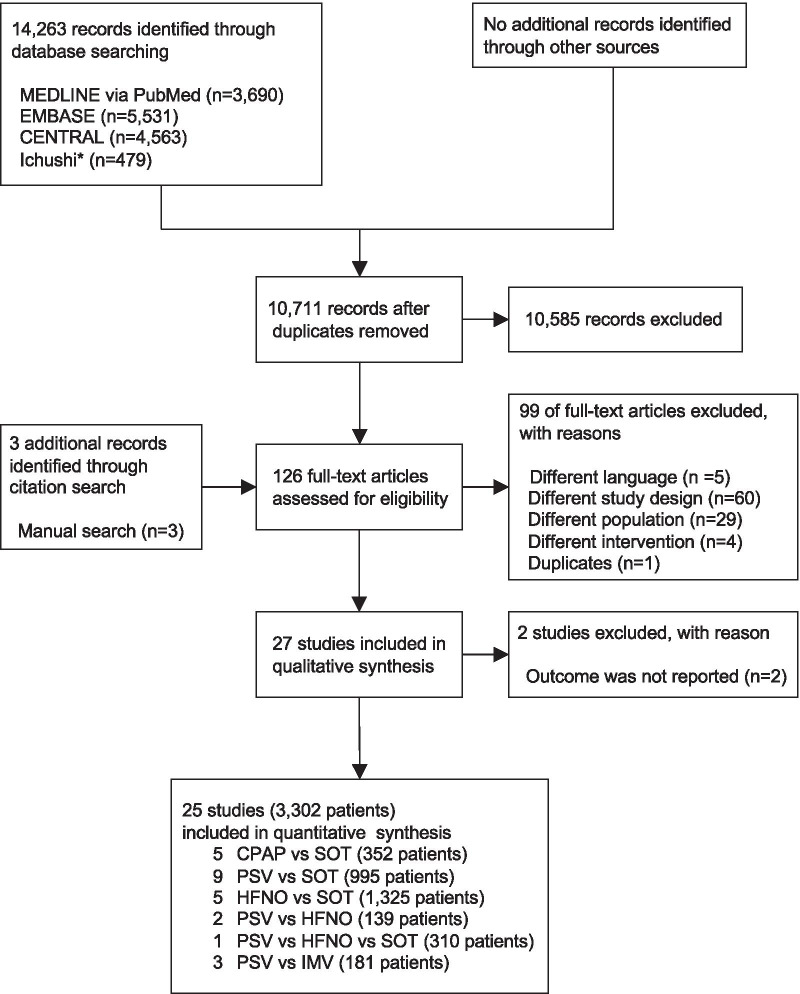
We included 25 RCTs (3,302 participants: 27 comparisons). Using SOT as the reference, CPAP (risk ratio [RR] 0.55; 95% confidence interval [CI] 0.31-0.95; very low certainty) was associated significantly with a lower risk of mortality. Compared with SOT, PSV (RR 0.81; 95% CI 0.62-1.06; low certainty) and HFNO (RR 0.90; 95% CI 0.65-1.25; very low certainty) were not associated with a significantly lower risk of mortality. Compared with IMV, no non-invasive respiratory management was associated with a significantly lower risk of mortality, although all certainties of evidence were very low. The probability of being best in reducing short-term mortality among all possible interventions was higher for CPAP, followed by PSV and HFNO; IMV and SOT were tied for the worst (surface under the cumulative ranking curve value: 93.2, 65.0, 44.1, 23.9, and 23.9, respectively).
When performing non-invasive ventilation among patients with de novo AHRF, it is important to avoid excessive tidal volume and lung injury. Although pressure support is needed for some of these patients, it should be applied with caution because this may lead to excessive tidal volume and lung injury. Trial registration protocols.io (Protocol integer ID 49375, April 23, 2021). https://doi.org/10.17504/protocols.io.buf7ntrn .
尽管已经实施了非侵入性呼吸管理策略来避免插管,但新发急性低氧性呼吸衰竭(AHRF)患者仍有治疗失败的高风险。在之前的荟萃分析中,并未根据这些患者的通气模式来评估无创通气的效果。此外,尚无比较无创呼吸管理策略与有创机械通气(IMV)的荟萃分析报告。我们进行了一项网络荟萃分析,以比较根据通气模式使用高流量鼻氧(HFNO)、标准氧疗(SOT)和 IMV 治疗成人 AHRF 的无创通气的疗效。
检索了 Cochrane 对照试验中心注册库、MEDLINE、EMBASE 和 Ichushi 数据库。综述了纳入了新发 AHRF 成人患者的随机对照试验(RCT),并比较了两种不同呼吸管理策略(持续气道正压通气(CPAP)、压力支持通气(PSV)、HFNO、SOT 或 IMV)。
我们纳入了 25 项 RCT(3302 名参与者:27 项比较)。以 SOT 为参照,CPAP(风险比[RR]0.55;95%置信区间[CI]0.31-0.95;极低可信度)与死亡率降低显著相关。与 SOT 相比,PSV(RR 0.81;95%CI 0.62-1.06;低可信度)和 HFNO(RR 0.90;95%CI 0.65-1.25;极低可信度)与死亡率降低无显著相关性。与 IMV 相比,没有一种无创呼吸管理策略与死亡率降低显著相关,尽管所有证据的确定性均极低。在所有可能的干预措施中,CPAP 降低短期死亡率的可能性最高,其次是 PSV 和 HFNO;IMV 和 SOT 并列最差(累积排序曲线下面积值:93.2、65.0、44.1、23.9 和 23.9)。
在新发 AHRF 患者中进行无创通气时,重要的是要避免过度潮气量和肺损伤。尽管一些患者需要压力支持,但应谨慎应用,因为这可能导致过度潮气量和肺损伤。试验注册方案.io(方案整数 ID 49375,2021 年 4 月 23 日)。https://doi.org/10.17504/protocols.io.buf7ntrn。