Procházková Lenka, Remias Daniel, Holzinger Andreas, Řezanka Tomáš, Nedbalová Linda
Department of Ecology, Faculty of Science, Charles University, Viničná 7, Prague, Czech Republic.
School of Engineering, University of Applied Sciences Upper Austria, Stelzhamerstr. 23, 4600 Wels, Austria.
Polar Biol. 2021;44(1):105-117. doi: 10.1007/s00300-020-02778-0. Epub 2020 Dec 11.
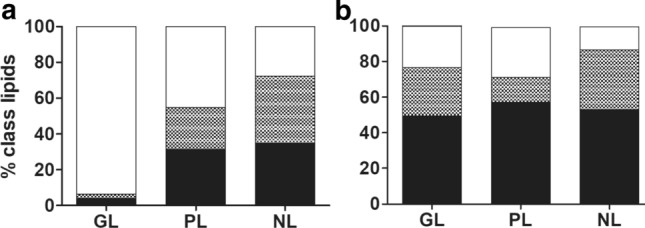
Red snow caused by spherical cysts can be found worldwide, while an orange snow phenomenon caused by spherical cells is restricted to (Sub-)Arctic climates. Both bloom types, occurring in the same localities at Svalbard, were compared ecophysiologically. Using a combination of molecular markers and light- and transmission electron microscopy, cells were identified as and (Chlorophyceae). In search for reasons for a cosmopolitan vs. a more restricted distribution of these microbes, significant differences in fatty acid and pigment profiles of field samples were found. accumulated much lower levels of polyunsaturated fatty acids (21% vs. 48% of total fatty acids) and exhibited lower astaxanthin-to-chlorophyll- ratio (2-8 vs. 12-18). These compounds play an important role in adaptation to extreme conditions at the snow surface and within snow drifts. Accordingly, the performance of photosystem II showed that one third to nearly half of the photosynthetic active irradiation was sufficient in , compared to , to become light saturated. Furthermore, formation of plastoglobules observed in but missing in may contribute to photoprotection. The rapid light curves of the two species show to a certain extent the shade-adapted photosynthesis under the light conditions at Svalbard (high -value 0.16 vs. 0.11, low saturation point 59 vs. 86). These results indicate significant physiological and ultrastructural differences of the two genetically closely related cryoflora species, but the reasons why has not been found at conditions outside (Sub-)Arctic climate types remain unknown.
The online version of this article (10.1007/s00300-020-02778-0) contains supplementary material, which is available to authorised users.
由球形囊肿引起的红雪在全球范围内都能发现,而由球形细胞引起的橙雪现象则仅限于(亚)北极气候。在斯瓦尔巴群岛的同一地点出现的这两种藻华类型进行了生态生理学比较。结合分子标记以及光学和透射电子显微镜,将细胞鉴定为 和 (绿藻纲)。为了探寻这些微生物在全球分布与分布范围较窄的原因,发现野外样本的脂肪酸和色素谱存在显著差异。 积累的多不饱和脂肪酸水平低得多(占总脂肪酸的21% 对48%),并且虾青素与叶绿素的比率较低(2 - 8对12 - 18)。这些化合物在适应雪表面和雪堆内的极端条件中起重要作用。相应地,光系统II的性能表明,与 相比, 中三分之一到近一半的光合有效辐射就足以达到光饱和。此外,在 中观察到但在 中未观察到的质体小球的形成可能有助于光保护。这两个物种的快速光曲线在一定程度上显示了斯瓦尔巴群岛光照条件下的阴生适应光合作用(高 值0.16对0.11,低饱和点 59对86)。这些结果表明这两种遗传关系密切的低温植物物种在生理和超微结构上存在显著差异,但在(亚)北极气候类型以外的条件下未发现 的原因仍然未知。
本文的在线版本(10.1007/s00300-020-)包含补充材料,可供授权用户使用。 2778-0