Khayrani Apriliana Cahya, Irdiani Rafidha, Aditama Reza, Pratami Diah Kartika, Lischer Kenny, Ansari Mohammad Javed, Chinnathambi Arunachalam, Alharbi Sulaiman Ali, Almoallim Hesham S, Sahlan Muhamad
Department of Chemical Engineering, Faculty of Engineering, Universitas Indonesia, 16424 Depok, West Java, Indonesia.
Department of Chemistry, Bandung Institute of Technology, Jalan Ganeca no 10, 40132 Bandung, West Java, Indonesia.
J King Saud Univ Sci. 2021 Mar;33(2):101297. doi: 10.1016/j.jksus.2020.101297. Epub 2020 Dec 30.
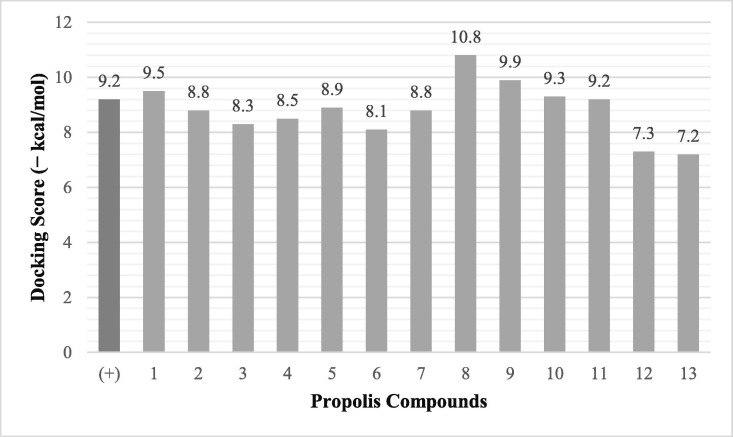
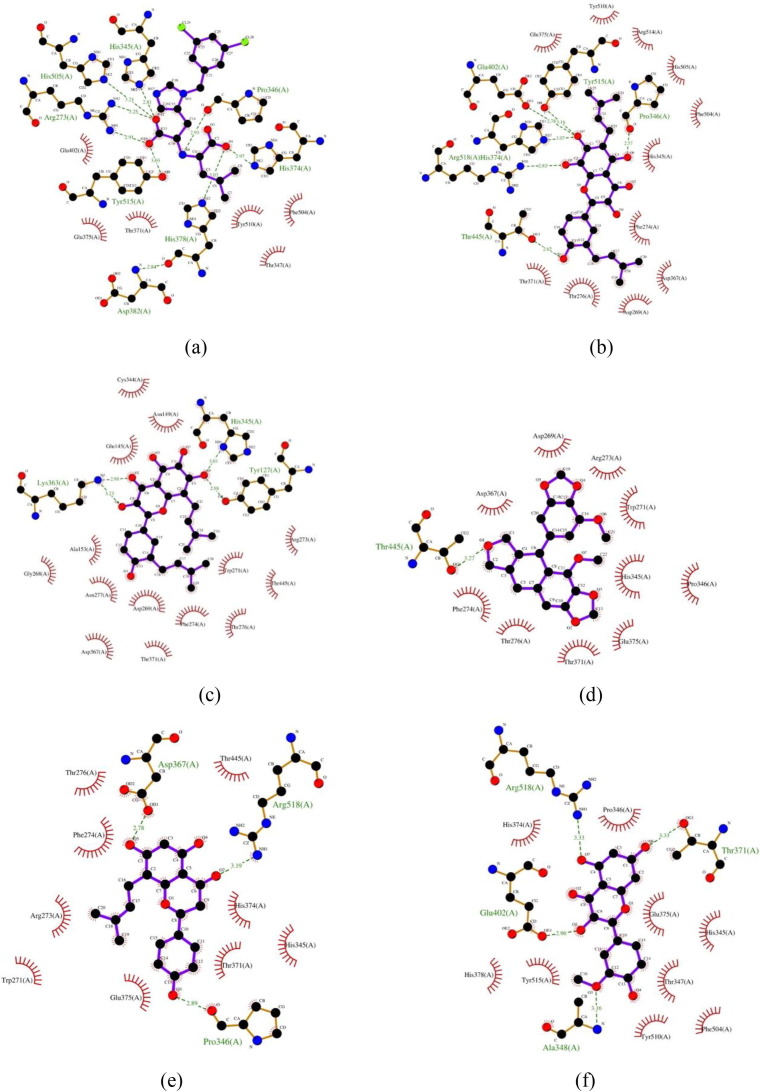
Coronavirus disease (COVID-19) is a global pandemic caused by severe acute respiratory syndrome coronavirus-2 (SARS-CoV-2). Up to date, there has been no specific cure to treat the disease. Indonesia is one of the countries that is still fighting to control virus transmission. Yet, at the same time, Indonesia has a rich biodiversity of natural medicinal products that potentially become an alternative cure. Thus, this study examined the potency of a natural medicinal product, Sulawesi propolis compounds produced by Tetragonula sapiens, inhibiting angiotensin-converting activity enzyme-2 (ACE-2), a receptor of SARS-CoV-2 in the human body. In this study, molecular docking was done to analyze the docking scores as the representation of binding affinity and the interaction profiles of propolis compounds toward ACE-2. The results illustrated that by considering the docking score and the presence of interaction with targeted sites, five compounds, namely glyasperin A, broussoflavonol F, sulabiroins A, (2S)-5,7-dihydroxy-4'-methoxy-8-prenylflavanone and isorhamnetin are potential to inhibit the binding of ACE-2 and SARS-CoV-2, with the docking score of -10.8, -9.9, -9.5, -9.3 and -9.2 kcal/mol respectively. The docking scores are considered to be more favorable compared to MLN-4760 as a potent inhibitor.
冠状病毒病(COVID-19)是由严重急性呼吸综合征冠状病毒2(SARS-CoV-2)引起的全球大流行疾病。截至目前,尚无治疗该疾病的特效疗法。印度尼西亚是仍在努力控制病毒传播的国家之一。然而,与此同时,印度尼西亚拥有丰富多样的天然药用产品,有可能成为一种替代疗法。因此,本研究考察了一种天然药用产品——智人四方蜜蜂所产的苏拉威西蜂胶化合物,对人体中SARS-CoV-2的受体血管紧张素转换酶2(ACE-2)活性的抑制作用。在本研究中,进行了分子对接以分析对接分数,作为蜂胶化合物对ACE-2的结合亲和力和相互作用概况的表征。结果表明,考虑到对接分数以及与靶位点的相互作用情况,五种化合物,即格利亚斯帕林A、布鲁索黄酮醇F、苏拉比罗因A、(2S)-5,7-二羟基-4'-甲氧基-8-异戊烯基黄酮和异鼠李素,有潜力抑制ACE-2与SARS-CoV-2的结合,其对接分数分别为-10.8、-9.9、-9.5、-9.3和-9.2千卡/摩尔。与作为强效抑制剂的MLN-4760相比,这些对接分数被认为更有利。