Research, Development and Innovation Department, Apis Flora Indl. Coml. Ltda, Ribeirão Preto, São Paulo, Brazil.
D'Or Institute for Research and Education (IDOR), Hospital São Rafael, Salvador, Brazil.
Biomed Pharmacother. 2020 Nov;131:110622. doi: 10.1016/j.biopha.2020.110622. Epub 2020 Aug 17.
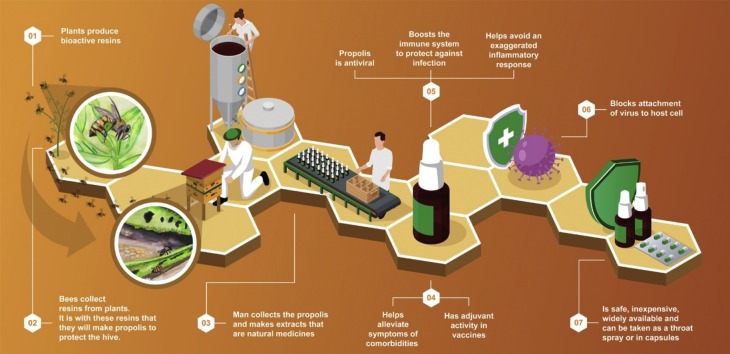
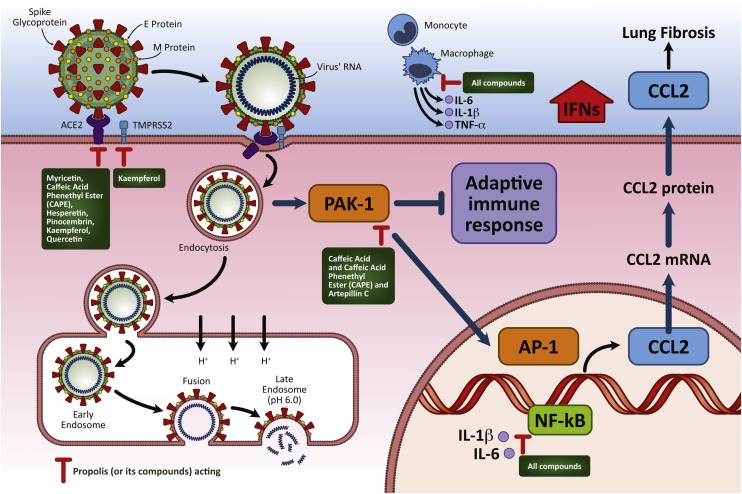
Propolis, a resinous material produced by honey bees from plant exudates, has long been used in traditional herbal medicine and is widely consumed as a health aid and immune system booster. The COVID-19 pandemic has renewed interest in propolis products worldwide; fortunately, various aspects of the SARS-CoV-2 infection mechanism are potential targets for propolis compounds. SARS-CoV-2 entry into host cells is characterized by viral spike protein interaction with cellular angiotensin-converting enzyme 2 (ACE2) and serine protease TMPRSS2. This mechanism involves PAK1 overexpression, which is a kinase that mediates coronavirus-induced lung inflammation, fibrosis, and immune system suppression. Propolis components have inhibitory effects on the ACE2, TMPRSS2 and PAK1 signaling pathways; in addition, antiviral activity has been proven in vitro and in vivo. In pre-clinical studies, propolis promoted immunoregulation of pro-inflammatory cytokines, including reduction in IL-6, IL-1 beta and TNF-α. This immunoregulation involves monocytes and macrophages, as well as Jak2/STAT3, NF-kB, and inflammasome pathways, reducing the risk of cytokine storm syndrome, a major mortality factor in advanced COVID-19 disease. Propolis has also shown promise as an aid in the treatment of various of the comorbidities that are particularly dangerous in COVID-19 patients, including respiratory diseases, hypertension, diabetes, and cancer. Standardized propolis products with consistent bioactive properties are now available. Given the current emergency caused by the COVID-19 pandemic and limited therapeutic options, propolis is presented as a promising and relevant therapeutic option that is safe, easy to administrate orally and is readily available as a natural supplement and functional food.
蜂胶是由蜜蜂从植物渗出物中产生的一种树脂状物质,长期以来一直被用于传统草药医学中,作为一种健康辅助品和免疫系统增强剂被广泛消费。COVID-19 大流行使蜂胶产品在全球范围内重新受到关注;幸运的是,SARS-CoV-2 感染机制的各个方面都是蜂胶化合物的潜在靶点。SARS-CoV-2 进入宿主细胞的特征是病毒刺突蛋白与细胞血管紧张素转换酶 2(ACE2)和丝氨酸蛋白酶 TMPRSS2 的相互作用。这种机制涉及 PAK1 的过表达,PAK1 是一种激酶,介导冠状病毒引起的肺炎症、纤维化和免疫系统抑制。蜂胶成分对 ACE2、TMPRSS2 和 PAK1 信号通路具有抑制作用;此外,体外和体内都证明了其具有抗病毒活性。在临床前研究中,蜂胶促进了促炎细胞因子的免疫调节,包括减少 IL-6、IL-1β 和 TNF-α。这种免疫调节涉及单核细胞和巨噬细胞,以及 Jak2/STAT3、NF-κB 和炎性小体途径,降低了细胞因子风暴综合征的风险,细胞因子风暴综合征是 COVID-19 疾病晚期的一个主要死亡因素。蜂胶在治疗 COVID-19 患者中特别危险的各种合并症方面也显示出希望,包括呼吸道疾病、高血压、糖尿病和癌症。现在有具有一致生物活性特性的标准化蜂胶产品。鉴于 COVID-19 大流行引起的当前紧急情况和有限的治疗选择,蜂胶被提出作为一种有希望且相关的治疗选择,它安全、易于口服给药,并且作为天然补充剂和功能性食品很容易获得。