Department of Cardiology, West China Hospital of Sichuan University, Chengdu, Sichuan, China.
Department of Nursing, West China Hospital of Sichuan University, Chengdu, Sichuan, China.
Cardiovasc Ther. 2021 Jan 13;2021:8836450. doi: 10.1155/2021/8836450. eCollection 2021.
Thrombocytopenia was intuitively considered to be associated with higher risk of bleeding and multiple comorbidities after percutaneous coronary intervention (PCI). However, controversial results exist, and the real-world clinical impact of thrombocytopenia in patients undergoing PCI is largely unknown. The aim of this study was to evaluate the influence of baseline thrombocytopenia on the prognosis of patients undergoing PCI.
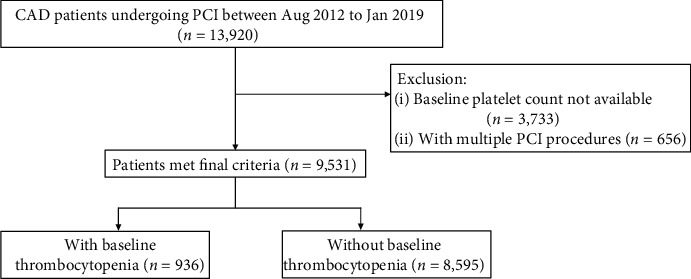
Using the West China Hospital Inpatient Sample database, patients who underwent PCI were identified from August 2012 to January 2019. Baseline thrombocytopenia was defined as a preprocedural platelet count of 100 × 10/L or less obtained from a routine blood sample taken within 48 hours before coronary PCI. The clinical effect of the advanced thrombocytopenia group (≤85 × 10/L), according to the median value of platelet count in the thrombocytopenia cohort, was further assessed. The primary outcome was a composite of in-hospital death, bleeding events, and post-PCI transfusion.
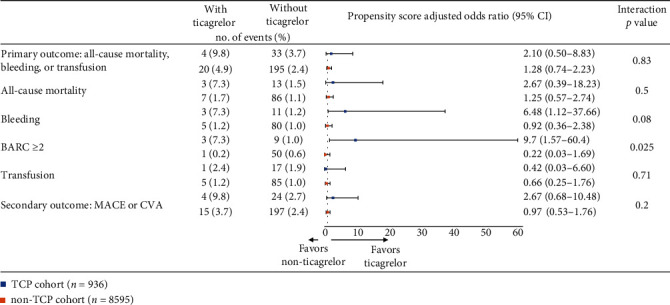
Of 9531 patients enrolled in our study, 936 had baseline thrombocytopenia and 8595 patients did not have. There were no significant differences in the primary outcome between the two groups. However, advanced thrombocytopenia was independently associated with higher risk of primary outcome (OR 1.67, 95% CI 1.06 to 2.65, = 0.029). Acute coronary syndrome (ACS) patients with thrombocytopenia were associated with higher odds of major bleeding (BARC ≥ 2) (OR 2.56, 95% CI 1.24 to 5.44, = 0.011). Compared with the nonthrombocytopenia group, the thrombocytopenia group with ticagrelor use had higher odds of major bleeding (OR 9.7, 95% CI 1.57 to 60.4 versus OR 0.22, 95% CI 0.03 to 1.69, interaction = 0.025).
It seems feasible for patients with thrombocytopenia to receive PCI, but close attention should be paid to advanced thrombocytopenia, the risk of postprocedure bleeding in ACS patients, and the use of more potent P2Y inhibitor.
血小板减少症通常被认为与经皮冠状动脉介入治疗(PCI)后出血风险增加和多种合并症相关。然而,目前的研究结果存在争议,血小板减少症对行 PCI 患者的真实临床影响尚不清楚。本研究旨在评估基线血小板减少症对行 PCI 患者预后的影响。
本研究使用华西医院住院患者样本数据库,从 2012 年 8 月至 2019 年 1 月期间筛选出接受 PCI 的患者。基线血小板减少症定义为在接受冠状动脉 PCI 前 48 小时内常规血液样本中血小板计数<100×10/L。根据血小板减少症队列中血小板计数的中位数,进一步评估血小板计数较低的重度血小板减少症组(≤85×10/L)的临床效果。主要终点是住院期间死亡、出血事件和 PCI 后输血的复合结局。
本研究共纳入 9531 例患者,其中 936 例存在基线血小板减少症,8595 例患者不存在。两组之间的主要终点没有显著差异。然而,重度血小板减少症与主要终点风险增加独立相关(比值比 1.67,95%置信区间 1.06 至 2.65, = 0.029)。伴有血小板减少症的急性冠脉综合征(ACS)患者发生主要出血(BARC≥2)的可能性更高(比值比 2.56,95%置信区间 1.24 至 5.44, = 0.011)。与非血小板减少症组相比,使用替格瑞洛的血小板减少症组发生大出血的可能性更高(比值比 9.7,95%置信区间 1.57 至 60.4 与比值比 0.22,95%置信区间 0.03 至 1.69,交互作用 = 0.025)。
血小板减少症患者行 PCI 似乎是可行的,但应密切关注重度血小板减少症、ACS 患者术后出血风险以及更有效的 P2Y 抑制剂的使用。