Athamnah Mohammad N, Masade Salim, Hamdallah Hanady, Banikhaled Nasser, Shatnawi Wafa, Elmughrabi Marwa, Al Azzam Hussein S O
General Surgery Department, Princess Basma Teaching Hospital, Jordan Ministry of Health, Irbid, Jordan.
Jordanian Royal Medical Services, Jordan.
J Pediatr Surg Case Rep. 2021 Mar;66:101779. doi: 10.1016/j.epsc.2021.101779. Epub 2021 Jan 7.
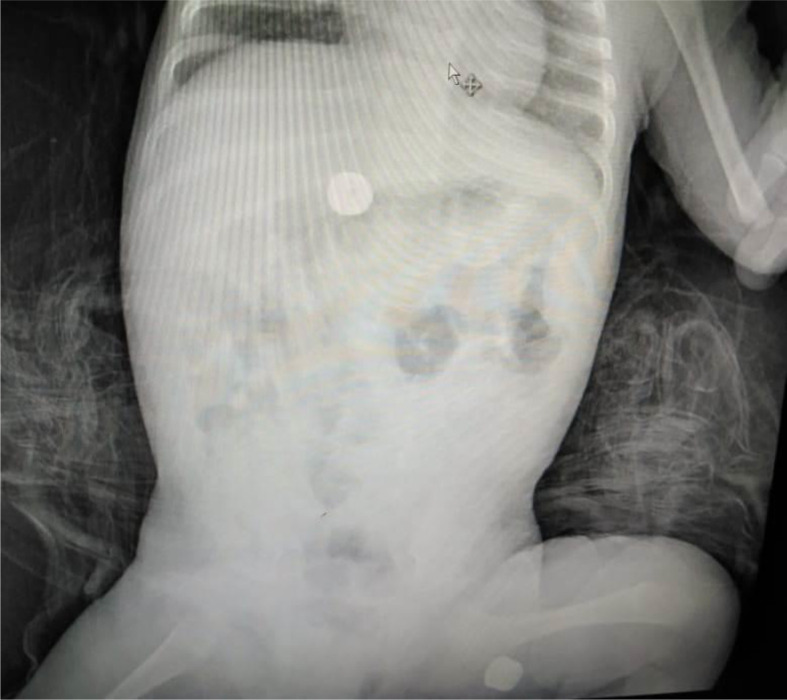
The novel Corona virus disease 2019 (COVID-19) first presented in Wuhan, China. The virus was able to spread throughout the world, causing a global health crisis. The virus spread widely in Jordan after a wedding party held in northern Jordan. In most cases of COVID-19 infection, respiratory symptoms are predominant. However, in rare cases the disease may present with non-respiratory symptoms. The presentation of COVID-19 as a case of intussusception in children is a strange and rare phenomenon. We present here a case of a two-and-a-half month old male baby who was brought to hospital due to fever, frequent vomiting, dehydration and blood in stool. He was diagnosed as intussusception. The child was tested for corona due to the large societal spread of the virus and because he was near his mother, who was suffering from symptoms similar to corona or seasonal flu (she did not conduct a corona test). Patient was treated without surgery and recovered quickly. The COVID-19 infection was without respiratory symptoms, and there was no need for the child to remain in hospital after treatment of intussusception. The relationship between viruses, mesenteric lymphoid hyperplasia, and intussusception is a confirmed relation. ACE2 is the key receptor required for SARA-COV-2 to enter the host cells. ACE2 has been also found in the brush border of the intestinal mucosa, as well as it is a key inflammatory regulator in the intestine. This may suggest that SARSA-COV-2 could invade the respiratory tract as well as gastrointestinal tract or both. Few case reports documented the presentation of COVID-19 as intussusception in children. In the light of the wide-spread of corona virus, performing COVID-19 tests for children with intussusception can help linking the two entities. Development of gastrointestinal symptoms in COVID-19 positive children should raise concern about the development of intussusception.
新型冠状病毒病2019(COVID-19)最初在中国武汉出现。该病毒能够在全球传播,引发了一场全球健康危机。在约旦北部举办了一场婚礼派对后,该病毒在约旦广泛传播。在大多数COVID-19感染病例中,呼吸道症状占主导。然而,在罕见情况下,该疾病可能表现为非呼吸道症状。COVID-19表现为儿童肠套叠病例是一种奇怪且罕见的现象。我们在此呈现一例两个半月大的男婴病例,该男婴因发热、频繁呕吐、脱水和便血被送往医院。他被诊断为肠套叠。由于病毒在社会上的广泛传播,且该男婴靠近其出现类似新冠或季节性流感症状(她未进行新冠检测)的母亲,所以对该儿童进行了新冠检测。患者未接受手术治疗且恢复迅速。COVID-19感染没有呼吸道症状,在肠套叠治疗后该儿童无需继续住院。病毒、肠系膜淋巴组织增生和肠套叠之间的关系是已被证实的关系。ACE2是SARS-CoV-2进入宿主细胞所需的关键受体。ACE2也在肠黏膜的刷状缘中被发现,并且它是肠道中的关键炎症调节因子。这可能表明SARS-CoV-2可能侵袭呼吸道以及胃肠道或两者。很少有病例报告记录COVID-19表现为儿童肠套叠。鉴于冠状病毒的广泛传播,对患有肠套叠的儿童进行COVID-19检测有助于将这两种情况联系起来。COVID-19阳性儿童出现胃肠道症状应引起对肠套叠发生的关注。