Ly Han, Verma Nirmal, Sharma Savita, Kotiya Deepak, Despa Sanda, Abner Erin L, Nelson Peter T, Jicha Gregory A, Wilcock Donna M, Goldstein Larry B, Guerreiro Rita, Brás José, Hanson Angela J, Craft Suzanne, Murray Andrew J, Biessels Geert Jan, Troakes Claire, Zetterberg Henrik, Hardy John, Lashley Tammaryn, Despa Florin
Department of Pharmacology and Nutritional Sciences University of Kentucky Lexington Kentucky USA.
The Research Center for Healthy Metabolism University of Kentucky Lexington Kentucky USA.
Alzheimers Dement (N Y). 2021 Jan 20;7(1):e12130. doi: 10.1002/trc2.12130. eCollection 2021.
This study assessed the hypothesis that circulating human amylin (amyloid-forming) cross-seeds with amyloid beta (Aβ) in early Alzheimer's disease (AD).
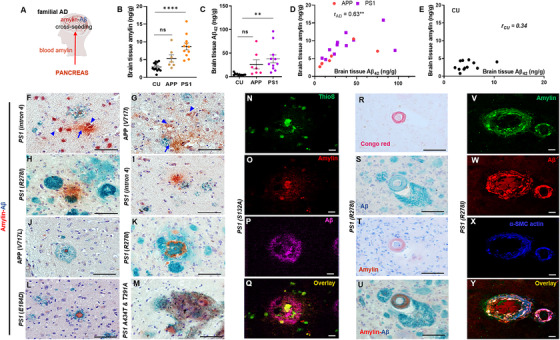
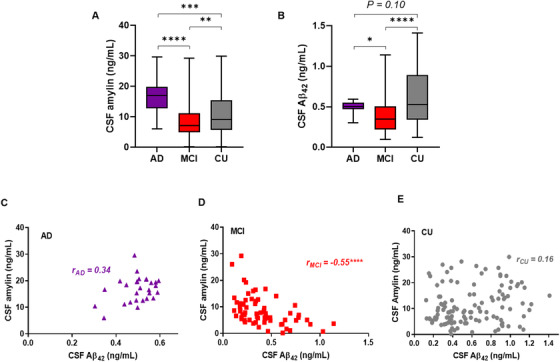
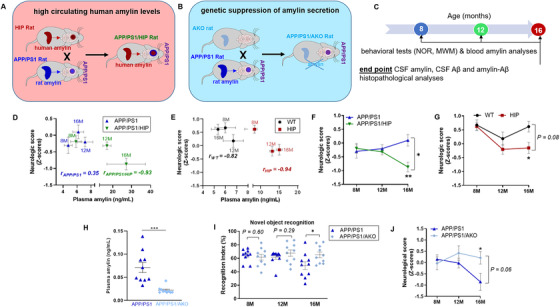
Evidence of amylin-AD pathology interaction was tested in brains of 31 familial AD mutation carriers and 20 cognitively unaffected individuals, in cerebrospinal fluid (CSF) (98 diseased and 117 control samples) and in genetic databases. For functional testing, we genetically manipulated amylin secretion in APP/PS1 and non-APP/PS1 rats.
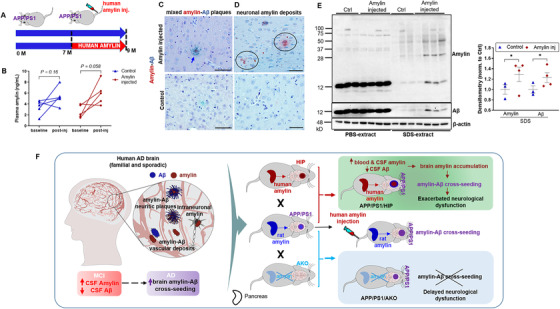
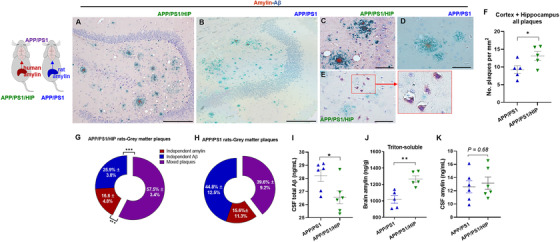
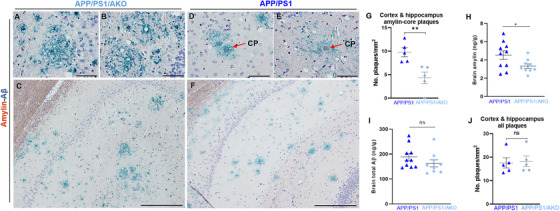
Amylin-Aβ cross-seeding was identified in AD brains. High CSF amylin levels were associated with decreased CSF Aβ concentrations. AD risk and amylin gene are not correlated. Suppressed amylin secretion protected APP/PS1 rats against AD-associated effects. In contrast, hypersecretion or intravenous injection of human amylin in APP/PS1 rats exacerbated AD-like pathology through disruption of CSF-brain Aβ exchange and amylin-Aβ cross-seeding.
These findings strengthened the hypothesis of circulating amylin-AD interaction and suggest that modulation of blood amylin levels may alter Aβ-related pathology/symptoms.
本研究评估了以下假设,即在早期阿尔茨海默病(AD)中,循环中的人胰岛淀粉样多肽(可形成淀粉样蛋白)与β淀粉样蛋白(Aβ)相互交叉播种。
在31名家族性AD突变携带者和20名认知未受影响个体的大脑、脑脊液(CSF)(98份患病样本和117份对照样本)以及基因数据库中测试胰岛淀粉样多肽与AD病理相互作用的证据。为了进行功能测试,我们对APP/PS1和非APP/PS1大鼠的胰岛淀粉样多肽分泌进行了基因操作。
在AD大脑中发现了胰岛淀粉样多肽 - Aβ交叉播种。脑脊液中高胰岛淀粉样多肽水平与脑脊液中Aβ浓度降低相关。AD风险与胰岛淀粉样多肽基因不相关。抑制胰岛淀粉样多肽分泌可保护APP/PS1大鼠免受AD相关影响。相反,在APP/PS1大鼠中过分泌或静脉注射人胰岛淀粉样多肽会通过破坏脑脊液 - 脑Aβ交换和胰岛淀粉样多肽 - Aβ交叉播种而加剧AD样病理。
这些发现强化了循环中胰岛淀粉样多肽与AD相互作用的假设,并表明调节血液中胰岛淀粉样多肽水平可能会改变与Aβ相关的病理/症状。