Pot Gerda K, Battjes-Fries Marieke Ce, Patijn Olga N, van der Zijl Nynke, Pijl Hanno, Voshol Peter
Louis Bolk Instituut, Department of Nutrition and Health, Bunnik, The Netherlands.
King's College London Division of Diabetes and Nutritional Sciences, London, UK.
BMJ Nutr Prev Health. 2020 Aug 18;3(2):188-195. doi: 10.1136/bmjnph-2020-000081. eCollection 2020 Dec.
A wealth of evidence supports short-term efficacy of lifestyle interventions in type 2 diabetes (T2D). However, little is known about long-term effects of lifestyle interventions in real-life settings.
This observational, single-arm study evaluated long-term impact of 'Voeding Leeft: Reverse-Diabetes2-Now', a 6-month multicomponent lifestyle programme, on glycaemic control and glucose-lowering medication (GLmed) use, other T2D parameters and quality of life in 438 T2D participants at 6, 12, 18 and 24 months using paired sample t-tests, χ and generalised linear models.
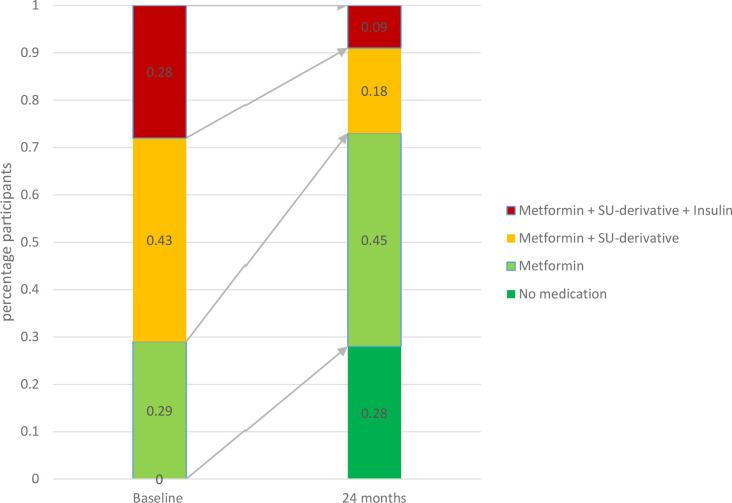
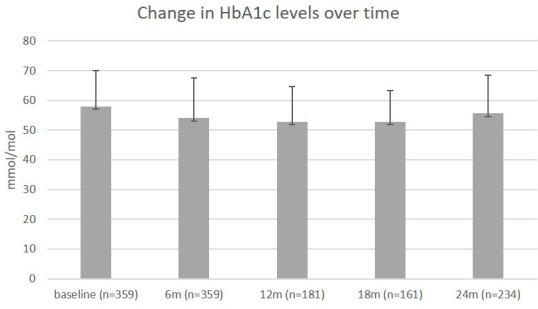
At 24 months, 234 participants provided information on GLmed and HbA1c ('responders'). 67% of the responders used less GLmed, and 28% ceased all GLmed. Notably, 71% of insulin users at baseline (n=47 of 66 insulin users) were off insulin at 24 months. Mean HbA1c levels were similar at 24 months compared with baseline (55.6±12.8 vs. 56.3±10.5 mmol/mol, p=0.43), but more responders had HbA1c levels ≤53 mmol/mol at 24 months (53% vs 45% at baseline). Furthermore, triglyceride levels (-0.34±1.02 mmol/L, p=0.004), body weight (-7.0±6.8 kg, p<0.001), waist circumference (-7.9±8.2 cm, p<0.001), body mass index (-2.4±2.3 kg/m, p<0.001) and total cholesterol/high-density lipoprotein (HDL) ratio (-0.22±1.24, p=0.044) were lower, while HDL (+0.17 ± 0.53 mmol/L, p<0.001) and low-density lipoprotein-cholesterol levels (+0.18 ± 1.06 mmol/L, p=0.040) were slightly higher. No differences were observed in fasting glucose or total cholesterol levels. Quality of life and self-reported health significantly improved.
This study indicates robust, durable real-life benefits of this lifestyle group programme after up to 24 months of follow-up, particularly in terms of medication use, body weight and quality of life in T2D patients.
大量证据支持生活方式干预对2型糖尿病(T2D)的短期疗效。然而,对于现实生活中生活方式干预的长期影响知之甚少。
这项观察性单臂研究评估了为期6个月的多成分生活方式计划“饮食生活:逆转糖尿病2 - 现在”对438名T2D参与者在6个月、12个月、18个月和24个月时血糖控制、降糖药物(GLmed)使用、其他T2D参数和生活质量的长期影响,采用配对样本t检验、χ检验和广义线性模型。
在24个月时,234名参与者提供了关于GLmed和糖化血红蛋白(HbA1c)的信息(“应答者”)。67%的应答者减少了GLmed的使用,28%停止了所有GLmed的使用。值得注意的是,基线时71%的胰岛素使用者(66名胰岛素使用者中的47名)在24个月时停用了胰岛素。与基线相比,24个月时平均HbA1c水平相似(55.6±12.8 vs. 56.3±10.5 mmol/mol,p = 0.43),但在24个月时更多应答者的HbA1c水平≤53 mmol/mol(53% vs. 基线时的45%)。此外,甘油三酯水平(-0.34±1.02 mmol/L,p = 0.004)、体重(-7.0±6.8 kg,p<0.001)、腰围(-7.9±8.2 cm,p<0.001)、体重指数(-2.4±2.3 kg/m²,p<0.001)和总胆固醇/高密度脂蛋白(HDL)比值(-0.22±1.24,p = 0.044)降低,而HDL(+0.17±0.53 mmol/L,p<0.001)和低密度脂蛋白胆固醇水平(+0.18±1.06 mmol/L,p = 0.040)略有升高。空腹血糖或总胆固醇水平未观察到差异。生活质量和自我报告的健康状况显著改善。
本研究表明,在长达24个月的随访后,该生活方式群体计划在现实生活中具有强大而持久的益处,特别是在T2D患者的药物使用、体重和生活质量方面。