Harrison Rachel A, van Leeuwen Edwin J C, Whiten Andrew
Centre for Social Learning and Cognitive Evolution, and Scottish Primate Research Group, School of Psychology & Neuroscience, University of St Andrews, St Andrews KY16 9JP, UK.
Department of Ecology and Evolution, University of Lausanne, Lausanne 1015, Switzerland.
iScience. 2021 Jan 5;24(2):102033. doi: 10.1016/j.isci.2021.102033. eCollection 2021 Feb 19.
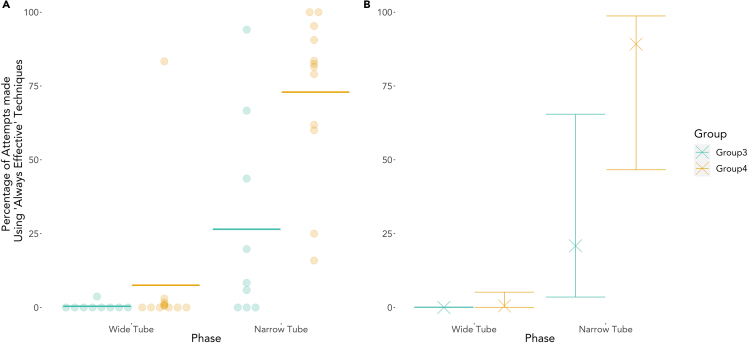
Behavioral flexibility is a critical ability allowing animals to respond to changes in their environment. Previous studies have found evidence of inflexibility when captive chimpanzees are faced with changing task parameters. We provided two groups of sanctuary-housed chimpanzees with a foraging task in which solutions were restricted over time. Initially, juice could be retrieved from within a tube by hand or by using tool materials, but effective solutions were then restricted by narrowing the tube, necessitating the abandonment of previous solutions and adoption of new ones. Chimpanzees responded flexibly, but one group increased their use of effective techniques to a greater extent than the other. Tool-composite techniques emerged in both groups, but primarily in the more flexible group. The more flexible group also showed higher rates of socio-positive behaviors at the task. In conjunction, these findings support the hypothesis that social tolerance may facilitate the emergence and spread of novel behaviors.
行为灵活性是一种关键能力,使动物能够对环境变化做出反应。先前的研究发现,当圈养黑猩猩面临任务参数变化时,存在不灵活性的证据。我们为两组生活在保护区的黑猩猩提供了一项觅食任务,随着时间的推移,解决方案受到限制。最初,可以通过手工或使用工具材料从管子内获取果汁,但随后通过缩小管子来限制有效解决方案,这就需要放弃先前的解决方案并采用新的解决方案。黑猩猩做出了灵活的反应,但其中一组比另一组更大程度地增加了对有效技术的使用。两组都出现了工具组合技术,但主要出现在更灵活的组中。更灵活的组在任务中也表现出更高的社会积极行为发生率。综合来看,这些发现支持了社会容忍可能促进新行为出现和传播的假设。