Ko Mei-Ju, Huang Jenq-Wen, Wu Hon-Yen, Tsai Wan-Chuan, Hsu Le-Yin, Tsai Ping-Hsiu, Chien Kuo-Liong, Hung Kuan-Yu
Department of Dermatology, Taipei City Hospital, Taipei City, Taiwan.
Acta Derm Venereol. 2021 Feb 11;101(2):adv00390. doi: 10.2340/00015555-3758.
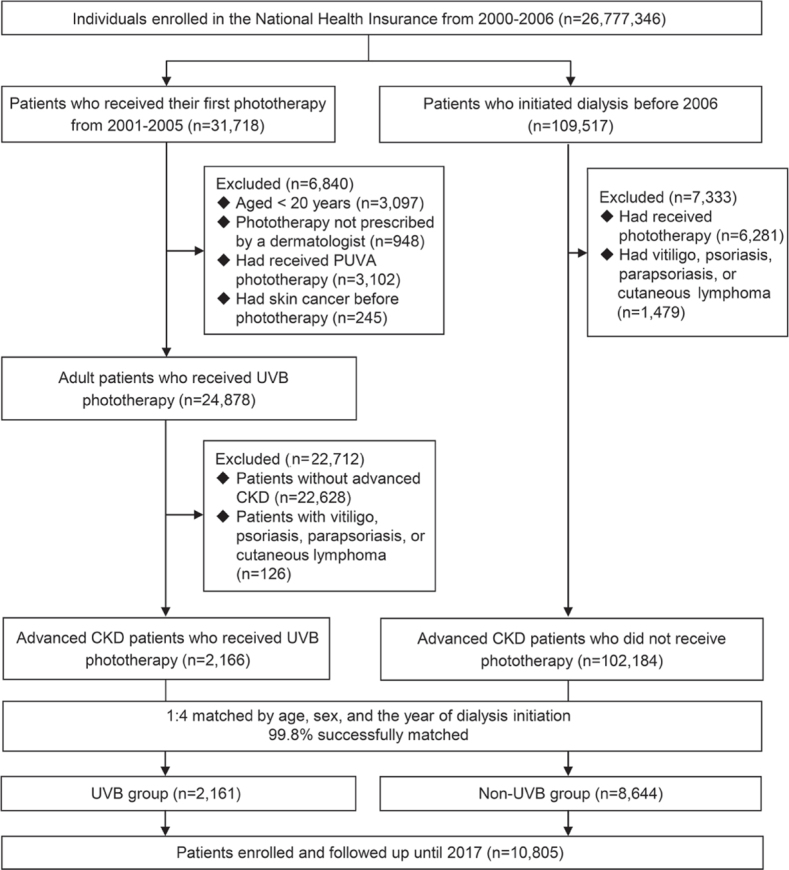
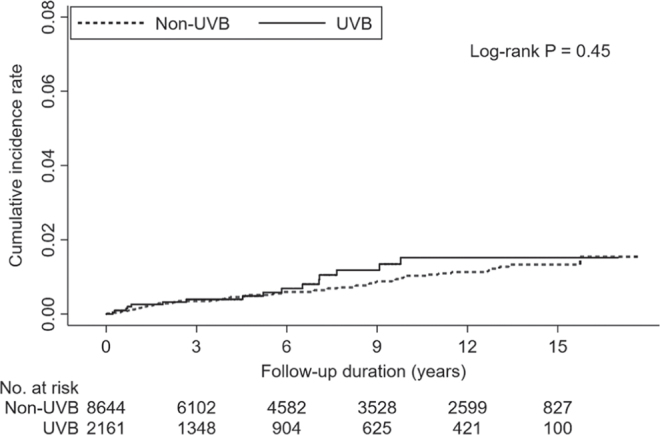
The safety of ultraviolet B (UVB) phototherapy with respect to cutaneous carcinogenesis has not been established for patients with chronic kidney disease. To investigate this issue, a nationwide cohort study of 10,805 patients with advanced chronic kidney disease was conducted using data from the National Health Insurance of Taiwan, the Taiwan Cancer Registry, and the national death registry. After a median follow-up of 75 months, 16 of 2,161 patients in the UVB group and 63 of 8,644 patients in the non-UVB group developed skin cancers. Compared with the non-UVB group, patients in the UVB group did not show an increased risk of skin cancer (hazard ratio 1.066; 95% confidence interval 0.584-1.944), non-melanoma skin cancer (hazard ratio 1.067; 95% confidence interval 0.571-1.996), or cutaneous melanoma (hazard ratio 1.009; 95% confidence interval 0.115-8.879). In addition, patients who received more UVB phototherapy did not show an increased risk of skin cancer. UVB phototherapy appears to be a safe treatment for uraemic pruritus in patients with chronic kidney disease.
对于慢性肾病患者,紫外线B(UVB)光疗在皮肤癌发生方面的安全性尚未确定。为研究此问题,利用台湾国民健康保险、台湾癌症登记处和国家死亡登记处的数据,对10,805例晚期慢性肾病患者进行了一项全国性队列研究。中位随访75个月后,UVB组2,161例患者中有16例发生皮肤癌,非UVB组8,644例患者中有63例发生皮肤癌。与非UVB组相比,UVB组患者皮肤癌风险未增加(风险比1.066;95%置信区间0.584 - 1.944),非黑色素瘤皮肤癌风险未增加(风险比1.067;95%置信区间0.571 - 1.996),皮肤黑色素瘤风险也未增加(风险比1.009;95%置信区间0.115 - 8.879)。此外,接受更多UVB光疗的患者皮肤癌风险也未增加。UVB光疗似乎是慢性肾病患者尿毒症性瘙痒的一种安全治疗方法。