Division of Infectious Diseases and Hospital Epidemiology, University Hospital Zurich, University of Zurich, Zurich, Switzerland.
Institute of Microbiology, Infectious Diseases and Immunology, Charité-Universitätsmedizin Berlin, Berlin, Germany.
Antimicrob Resist Infect Control. 2021 Feb 1;10(1):27. doi: 10.1186/s13756-021-00883-1.
The skin commensal Cutibacterium avidum has been recognized as an emerging pathogen for periprosthetic joint infections (PJI). One currently assumes that the early occurring PJIs are a consequence of skin commensals contaminating the peri-implant tissue during surgery. We addressed whether standard skin antisepsis with povidone-iodine/alcohol before total hip arthroplasty (THA) is effective to eliminate colonizing bacteria with focus on C. avidum.
In a single-center, prospective study, we screened all patients for skin colonizing C. avidum in the groin before THA. Only in the patients positive for C. avidum, we preoperatively repeated skin swabs after the first and third skin antisepsis and antibiotic prophylaxis. We also obtained dermis biopsies for microbiology and fluorescence in situ hybridization (FISH).
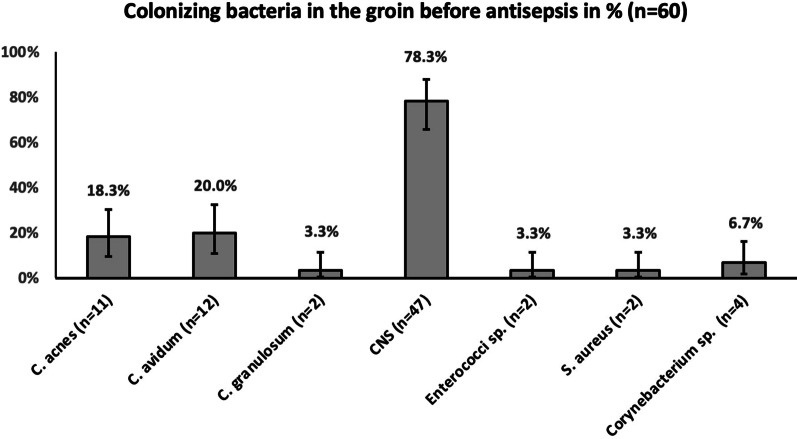
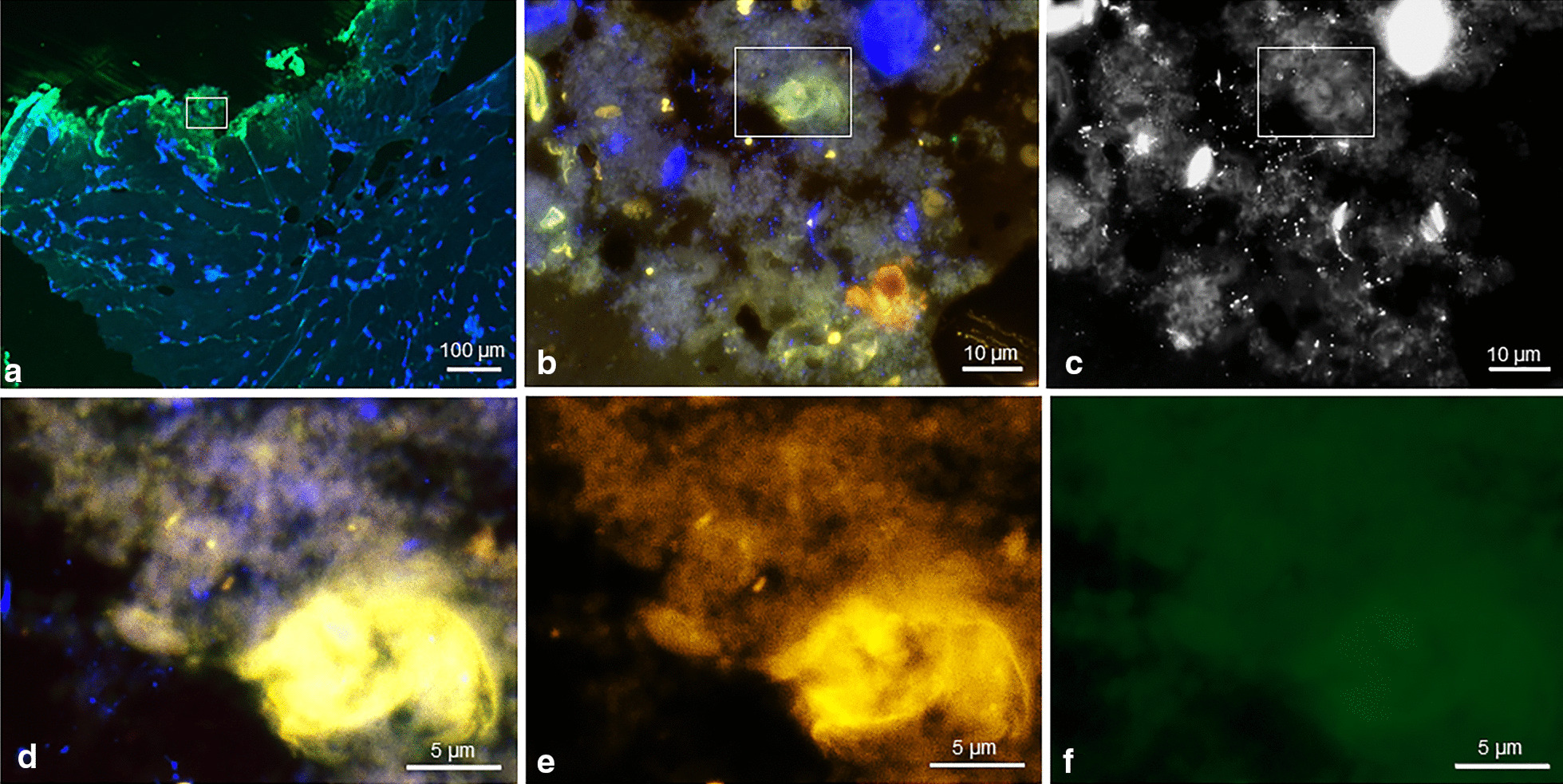
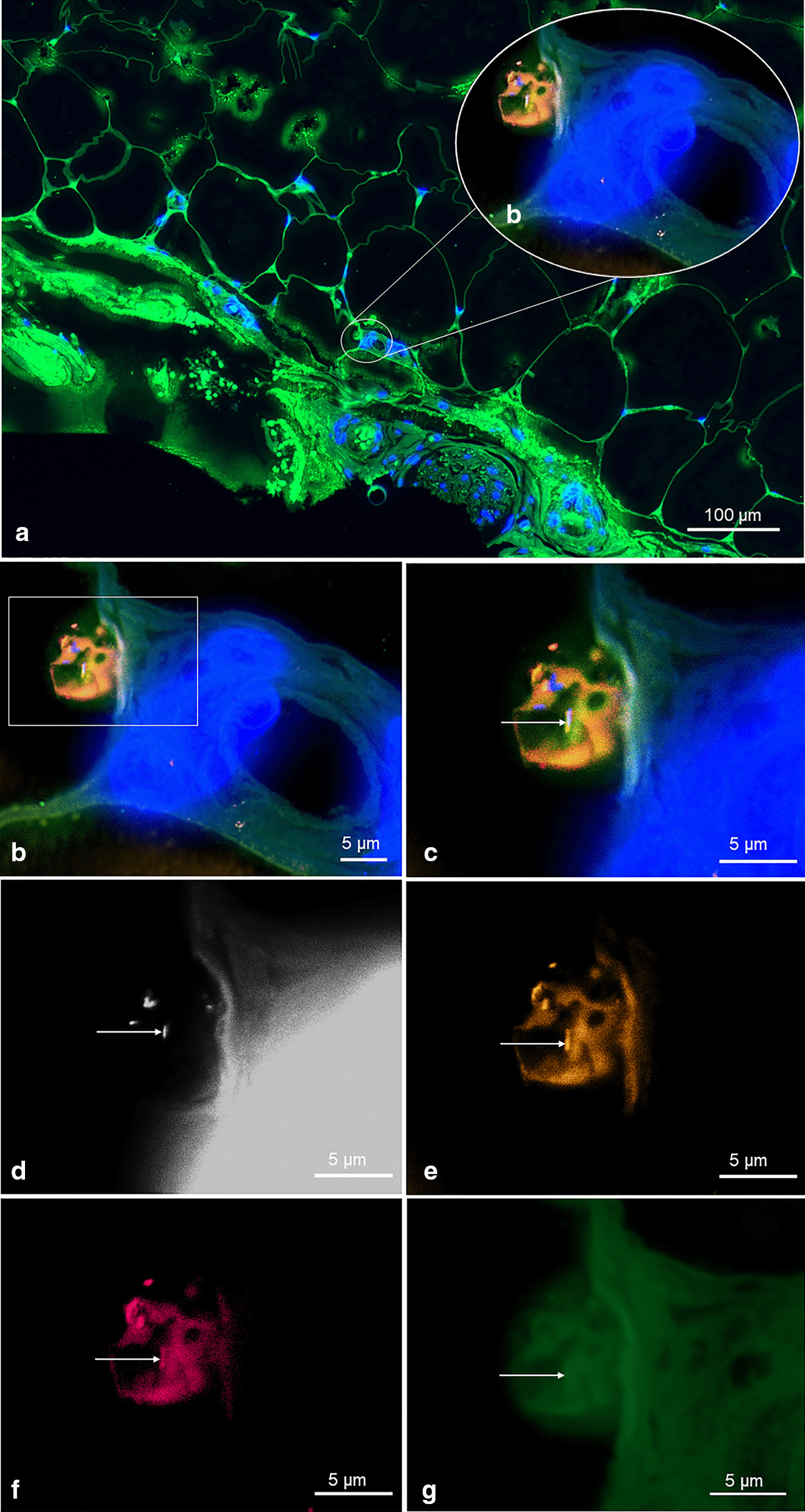
Fifty-one out of 60 patients (85%) were colonized on the skin with various bacteria, in particular with C. avidum in 12 out of 60. Skin antisepsis eliminated C. avidum in eight of ten (20%) colonized patients undergoing THA. Deeper skin (dermis) biopsies were all culture negative, but FISH detected single positive ribosome-rich C. avidum in one case near sweat glands.
Standard skin antisepsis was not effective to completely eliminate colonizing C. avidum on the skin in the groin of patients undergoing THA. Colonizing with C. avidum might pose an increased risk for PJI when considering a THA. Novel more effective antisepsis strategies are needed. Trial registration No clinical trial.
皮肤共生菌痤疮丙酸杆菌已被认为是假体周围关节感染(PJI)的新兴病原体。目前人们认为早期发生的 PJI 是由于皮肤共生菌在手术过程中污染了植入物周围组织所致。我们研究了在全髋关节置换术(THA)前使用聚维酮碘/酒精进行标准皮肤消毒是否能有效消除定植细菌,重点是痤疮丙酸杆菌。
在一项单中心前瞻性研究中,我们在 THA 前筛选所有腹股沟处皮肤定植痤疮丙酸杆菌的患者。仅在痤疮丙酸杆菌阳性的患者中,我们在第一次和第三次皮肤消毒和抗生素预防后重复术前皮肤拭子。我们还获得了皮肤活检进行微生物学和荧光原位杂交(FISH)检测。
60 名患者中有 51 名(85%)皮肤定植了各种细菌,其中 12 名(20%)定植了痤疮丙酸杆菌。皮肤消毒消除了 10 名(20%)定植患者中的 8 名(80%)痤疮丙酸杆菌。深层皮肤(真皮)活检均为培养阴性,但 FISH 在靠近汗腺的一个病例中检测到单个阳性核糖体丰富的痤疮丙酸杆菌。
在接受 THA 的患者腹股沟皮肤中,标准皮肤消毒不能有效完全消除定植的痤疮丙酸杆菌。考虑到 THA,痤疮丙酸杆菌定植可能会增加 PJI 的风险。需要新的更有效的消毒策略。
无临床试验。