CNRS-UMR9019, Équipe labellisée "La Ligue contre le Cancer," 94805 Villejuif, France.
Gustave Roussy Cancer Center, 94805 Villejuif, France.
Sci Adv. 2021 Jan 1;7(1). doi: 10.1126/sciadv.abb5414. Print 2021 Jan.
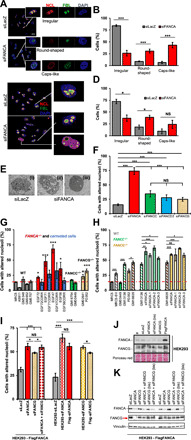
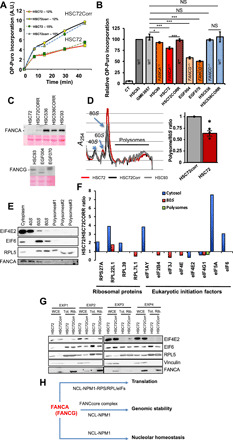
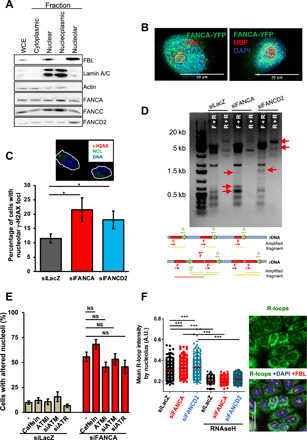
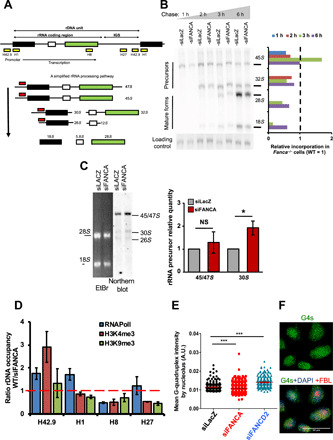
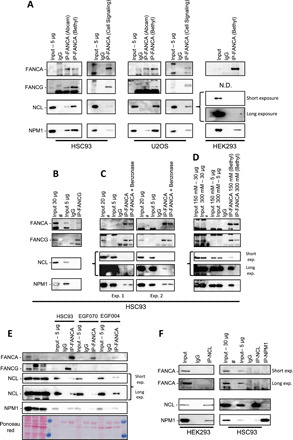
Fanconi anemia (FA), the most common inherited bone marrow failure and leukemia predisposition syndrome, is generally attributed to alterations in DNA damage responses due to the loss of function of the DNA repair and replication rescue activities of the FANC pathway. Here, we report that FANCA deficiency, whose inactivation has been identified in two-thirds of FA patients, is associated with nucleolar homeostasis loss, mislocalization of key nucleolar proteins, including nucleolin (NCL) and nucleophosmin 1 (NPM1), as well as alterations in ribosome biogenesis and protein synthesis. FANCA coimmunoprecipitates with NCL and NPM1 in a FANCcore complex-independent manner and, unique among the FANCcore complex proteins, associates with ribosomal subunits, influencing the stoichiometry of the translational machineries. In conclusion, we have identified unexpected nucleolar and translational consequences specifically associated with FANCA deficiency that appears to be involved in both DNA damage and nucleolar stress responses, challenging current hypothesis on FA physiopathology.
范可尼贫血症(FA)是最常见的遗传性骨髓衰竭和白血病易感性综合征,通常归因于 DNA 损伤反应的改变,这是由于 FANC 途径的 DNA 修复和复制救援活性的功能丧失所致。在这里,我们报告说,FANCA 缺陷与核仁稳态丧失、关键核仁蛋白(包括核仁磷蛋白(NCL)和核仁磷酸蛋白 1(NPM1))的定位错误以及核糖体生物发生和蛋白质合成的改变有关。FANCA 以 FANC 核心复合物非依赖性的方式与 NCL 和 NPM1 共免疫沉淀,并且与 FANC 核心复合物蛋白中的其他蛋白不同,它与核糖体亚基结合,影响翻译机器的化学计量。总之,我们已经确定了与 FANCA 缺陷相关的意外核仁与翻译后果,这似乎与 DNA 损伤和核仁应激反应都有关,这对 FA 病理生理学的当前假说提出了挑战。