Wan Qin-Li, Meng Xiao, Dai Wenyu, Luo Zhenhuan, Wang Chongyang, Fu Xiaodie, Yang Jing, Ye Qunshan, Zhou Qinghua
Zhuhai Precision Medical Center, Zhuhai People's Hospital (Zhuhai Hospital Affiliated with Jinan University), Jinan University, Guangzhou, Guangdong 510632, China.
Biomedical Translational Research Institute, Jinan University, Guangzhou, Guangdong 510632, China.
Sci Adv. 2021 Jan 1;7(1). doi: 10.1126/sciadv.abc3026. Print 2021 Jan.
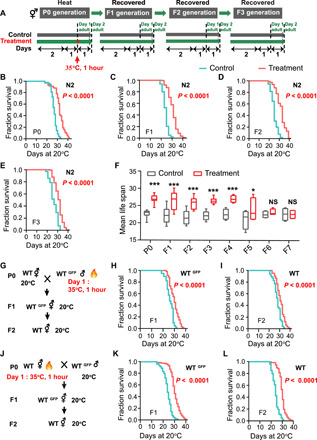
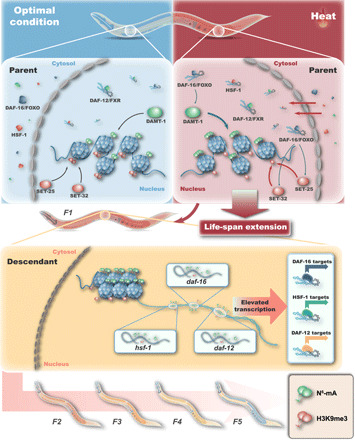
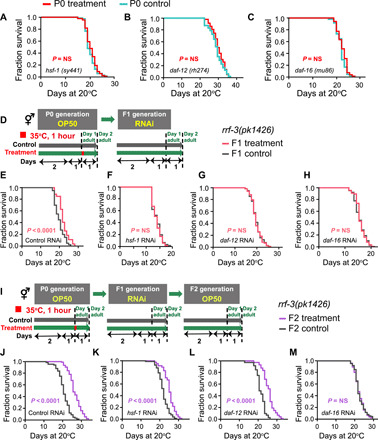
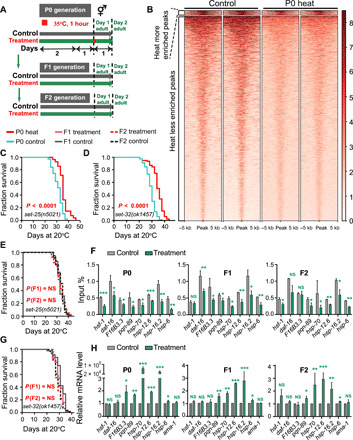
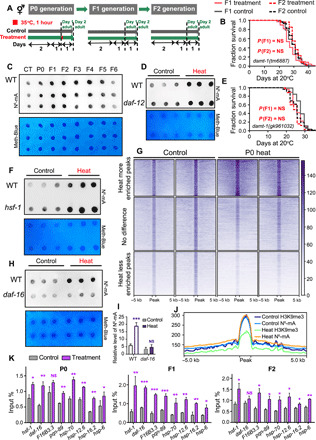
Environmental stress can induce survival advantages that are passed down to multiple generations, representing an evolutionarily advantageous adaptation at the species level. Using the nematode worm as a model, we found that heat shock experienced in either parent could increase the longevity of themselves and up to the fifth generation of descendants. Mechanistic analyses revealed that transcription factor DAF-16/FOXO, heat shock factor HSF-1, and nuclear receptor DAF-12/FXR functioned transgenerationally to implement the hormetic stress response. Histone H3K9me3 methyltransferases SET-25 and SET-32 and DNA N-methyl methyltransferase DAMT-1 participated in transmitting high-temperature memory across generations. H3K9me3 and N-methyladenine could mark heat stress response genes and promote their transcription in progeny to extend life span. We dissected the mechanisms responsible for implementing and transmitting environmental memories in descendants from heat-shocked parents and demonstrated that hormetic stress caused survival benefits could be transmitted to multiple generations through H3K9me3 and N-mA modifications.
环境压力可以诱导生存优势,并传递给多代后代,这代表了物种水平上一种进化上有利的适应性变化。以线虫为模型,我们发现,任何一代亲本所经历的热休克都能延长其自身以及多达五代后代的寿命。机制分析表明,转录因子DAF-16/FOXO、热休克因子HSF-1和核受体DAF-12/FXR通过跨代作用来实现应激性反应。组蛋白H3K9me3甲基转移酶SET-25和SET-32以及DNA N-甲基转移酶DAMT-1参与了跨代传递高温记忆。H3K9me3和N-甲基腺嘌呤可以标记热应激反应基因,并促进其在后代中的转录,从而延长寿命。我们剖析了热休克亲本后代中环境记忆的形成和传递机制,并证明了应激性压力带来的生存益处可以通过H3K9me3和N-甲基腺嘌呤修饰传递给多代后代。