Wang Chunlei, Wei Xiaoyan, Shao Guoliang
Pharmaceutical Preparation Section, Cancer Hospital of The University of Chinese Academy of Sciences (Zhejiang Cancer Hospital), Hangzhou, Zhejiang, China (mainland).
Institute of Cancer and Basic Medicine (IBMC), Chinese Academy of Sciences, Hangzhou, Zhejiang, China (mainland).
Med Sci Monit. 2021 Feb 1;27:e927727. doi: 10.12659/MSM.927727.
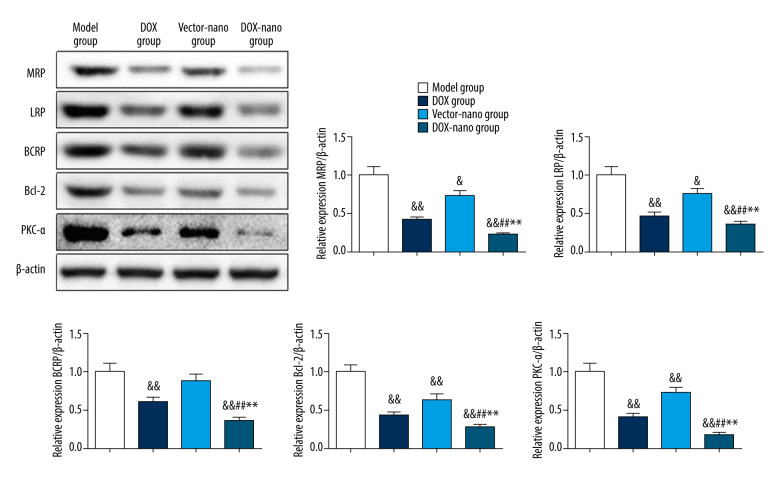
BACKGROUND This study investigated a nanoparticle drug delivery system to reverse multidrug resistance (MDR) and assessed its anticancer efficacy in hepatocellular carcinoma (HCC). MATERIAL AND METHODS Docosahexaenoic acid (DHA) was used as the functional excipient and doxorubicin (DOX) as the chemotherapeutic drug to synthesize DOX nanoparticles (DOX-nano). The human HCC cell line HepG2 was used for experiments. HepG2/DOX, HepG2+DOX, HepG2+DOX-nano, HepG2/DOX+DOX, and HepG2/DOX+DOX-nano groups cells were treated with DOX or DOX-nano (5 μg/mL). Nude mice bearing a HepG2/DOX xenograft were divided into model, DOX, vector-nano, and DOX-nano groups and injected with saline, DOX reagent, vector-nano, and DOX-nano (2 mg/kg), respectively. Next, cytotoxicity, cellular uptake, cell apoptosis and migration, fluorescence imaging, TUNEL assay, and tumor inhibition effects were assessed in vitro and in vivo. Furthermore, expression of MDR-related proteins was also detected using western blotting. RESULTS Fluorescence imaging showed that the DOX uptake in the DOX-nano-treated group was the strongest in the HCC cells or tumors. Cell apoptosis was significantly increased in DOX-nano-treated HepG2/DOX cells and tumors, and cell migration was significantly inhibited in the DOX-nano-treated HepG2/DOX cells compared with the other groups. The tumor inhibitory rate in DOX-nano-injected tumors was also significantly higher than in other groups. The expression of breast cancer resistance protein, B-cell lymphoma 2, lung resistance protein, multidrug resistance protein, and protein kinase C alpha was significantly decreased in DOX-nano-treated HepG2/DOX cells and xenograft tumors. Significantly better antitumor and MDR-reversing effects were also observed in the HepG2+DOX group compared with the HepG2/DOX group. CONCLUSIONS This study revealed the potential efficacy of a DOX-nano drug delivery system for the treatment of HCC, using HepG2/DOX cells and nude mice bearing HepG2/DOX xenografts.
背景 本研究调查了一种纳米颗粒药物递送系统以逆转多药耐药性(MDR),并评估其在肝细胞癌(HCC)中的抗癌疗效。
材料与方法 以二十二碳六烯酸(DHA)作为功能性辅料,阿霉素(DOX)作为化疗药物来合成DOX纳米颗粒(DOX-纳米)。使用人肝癌细胞系HepG2进行实验。用DOX或DOX-纳米(5μg/mL)处理HepG2/DOX、HepG2+DOX、HepG2+DOX-纳米、HepG2/DOX+DOX和HepG2/DOX+DOX-纳米组细胞。将携带HepG2/DOX异种移植瘤的裸鼠分为模型组、DOX组、载体-纳米组和DOX-纳米组,分别注射生理盐水、DOX试剂、载体-纳米和DOX-纳米(2mg/kg)。接下来,在体外和体内评估细胞毒性、细胞摄取、细胞凋亡和迁移、荧光成像、TUNEL检测以及肿瘤抑制作用。此外,还使用蛋白质印迹法检测MDR相关蛋白的表达。
结果 荧光成像显示,DOX-纳米处理组在肝癌细胞或肿瘤中的DOX摄取最强。DOX-纳米处理的HepG2/DOX细胞和肿瘤中的细胞凋亡显著增加,与其他组相比,DOX-纳米处理的HepG2/DOX细胞中的细胞迁移受到显著抑制。DOX-纳米注射肿瘤的肿瘤抑制率也显著高于其他组。DOX-纳米处理的HepG2/DOX细胞和异种移植瘤中乳腺癌耐药蛋白、B细胞淋巴瘤2、肺耐药蛋白、多药耐药蛋白和蛋白激酶Cα的表达显著降低。与HepG2/DOX组相比,HepG2+DOX组也观察到明显更好的抗肿瘤和MDR逆转效果。
结论 本研究揭示了使用HepG2/DOX细胞和携带HepG2/DOX异种移植瘤的裸鼠,DOX-纳米药物递送系统在治疗肝癌方面的潜在疗效。