Division of Global Health Protection, US Centers for Disease Control and Prevention-Kenya, Nairobi, Kenya.
Global Health Program, Washington State University, Nairobi, Kenya.
PLoS Negl Trop Dis. 2021 Feb 1;15(2):e0009049. doi: 10.1371/journal.pntd.0009049. eCollection 2021 Feb.
Brucellosis occurs globally with highly variable incidence in humans from very low in North America and Western Europe to high in the Middle East and Asia. There are few data in Sub-Saharan Africa. This study estimated the incidence of human brucellosis in a pastoralist community in Kenya.
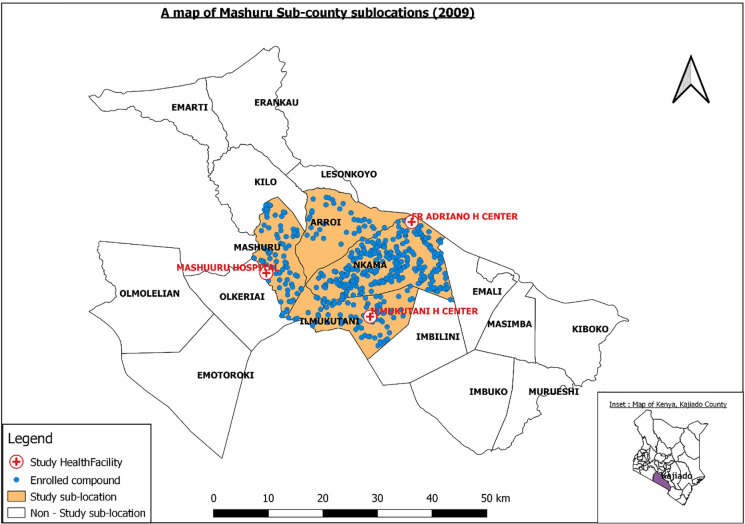
Between February 2015 and January 2016, we enrolled persons living in randomly selected households in Kajiado County. Free health care was offered at three facilities in the study area. Those who met the study clinical case definition completed a standardized questionnaire on demographics, clinical history and presentation. A blood sample was collected and tested by Rose Bengal test (RBT), then later tested at the Kenya Medical Research Institute laboratory for Brucella IgG and IgM by ELISA. Those who tested positive by both RBT and ELISA (IgG or IgM antibodies) were classified as confirmed while those that only tested positive for IgG or IgM antibodies were classified as probable. Further, sera were tested by polymerase chain reaction using a TaqMan Array Card (TAC) for a panel of pathogens causing AFI including Brucella spp. Annual incidence of brucellosis was calculated as the number of confirmed cases in one year/total number in the study population.
We enrolled a cohort of 4746 persons in 804 households. Over half (52.3%) were males and the median age was 18 years (Interquartile range (IQR) 9 months- 32 years). A total of 236 patients were enrolled at three health facilities; 64% were females and the median age was 40.5 years (IQR 28-53 years). Thirty-nine (16.5%) were positive for Brucella antibodies by IgG ELISA, 5/236 (2.1%) by IgM ELISA and 4/236 (1.7%) by RBT. Ten percent (22/217) were positive by TAC. We confirmed four (1.7%) brucellosis cases giving an annual incidence of 84/100,000 persons/year (95% CI 82, 87). The incidence did not significantly vary by gender, age and location of residence.
We report a high incidence of brucellosis in humans among members of this pastoralist community. Brucellosis was the most common cause of febrile illness in this community.
布鲁氏菌病在全球范围内发生,人类发病率差异很大,从北美和西欧的极低水平到中东和亚洲的极高水平不等。撒哈拉以南非洲的数据很少。本研究估计了肯尼亚一个牧民社区中人类布鲁氏菌病的发病率。
2015 年 2 月至 2016 年 1 月期间,我们招募了随机选择的家庭中的居住者。研究区域的三个设施提供免费医疗服务。符合研究临床病例定义的人完成了一份关于人口统计学、临床病史和表现的标准化问卷。采集血液样本,用虎红平板试验(RBT)进行检测,然后在肯尼亚医学研究所实验室用酶联免疫吸附试验(ELISA)检测布鲁氏菌 IgG 和 IgM。通过 RBT 和 ELISA(IgG 或 IgM 抗体)均呈阳性的人被归类为确诊病例,仅 IgG 或 IgM 抗体呈阳性的人被归类为可能病例。此外,使用 TaqMan 阵列卡(TAC)对聚合酶链反应进行检测,以检测引起 AFI 的病原体,包括布鲁氏菌属。布鲁氏菌病的年发病率计算为一年内确诊病例数/研究人群总数。
我们在 804 户家庭中招募了 4746 名队列成员。超过一半(52.3%)为男性,中位年龄为 18 岁(四分位距 9 个月-32 岁)。共有 236 名患者在三个卫生机构就诊;64%为女性,中位年龄为 40.5 岁(28-53 岁)。39 名(16.5%)患者通过 IgG ELISA 检测出布鲁氏菌抗体阳性,5/236(2.1%)通过 IgM ELISA 检测出布鲁氏菌抗体阳性,4/236(1.7%)通过 RBT 检测出布鲁氏菌抗体阳性。217 名患者中的 10%(22 名)通过 TAC 检测出阳性。我们确认了 4 例(1.7%)布鲁氏菌病病例,发病率为 84/100000 人/年(95%CI 82,87)。发病率与性别、年龄和居住地无显著差异。
我们报告了该牧民社区中人类布鲁氏菌病的高发病率。布鲁氏菌病是该社区发热性疾病的最常见原因。