Array.
Acta Biomed. 2020 Nov 5;91(4):e2020138. doi: 10.23750/abm.v91i4.10768.
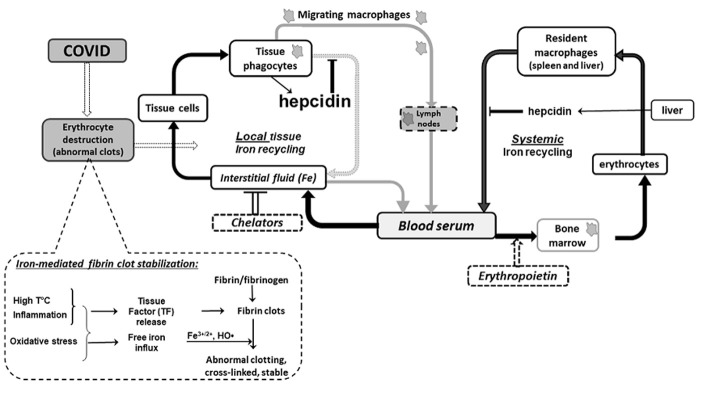
Clinical observations in concert with literary data demonstrate that detrimental complications of COVID19-induced pathology (acute respiratory distress syndrome, multi-organ failure, Kawasaki-like disease etc.), could result from a disturbance of local iron homeostasis (FeH) in damaged tissues followed by abnormal coagulation in small vessels. To resolve these complications the local FeH needs to be recovered. Hepcidin, as a master regulator of FeH is both a major player in the recovery and a marker of an efficacy of the restoration. Therefore, both local and systemic hepcidin levels could serve as a dynamic marker of disease progression (the more hepcidin the worse is disease) and treatment efficacy (after iron homeostasis is recovered hepcidin disappears). On the contrast, artificial attempts to suppress hepcidin expression directly or application of hepcidin antagonists could be detrimental. Overall, more comprehensive research of hepcidin role in COVID-19 pathology is needed.
临床观察与文献资料表明,COVID19 引起的病理损伤的有害并发症(急性呼吸窘迫综合征、多器官衰竭、川崎病样疾病等)可能是由于损伤组织中局部铁稳态(FeH)紊乱,随后小血管发生异常凝血所致。为了解决这些并发症,需要恢复局部 FeH。作为 FeH 的主要调节因子,hepcidin 既是恢复的主要参与者,也是恢复效果的标志物。因此,局部和全身 hepcidin 水平都可以作为疾病进展(hepcidin 水平越高,疾病越严重)和治疗效果(铁稳态恢复后 hepcidin 消失)的动态标志物。相比之下,直接抑制 hepcidin 表达的人工尝试或 hepcidin 拮抗剂的应用可能是有害的。总的来说,需要对 hepcidin 在 COVID-19 病理中的作用进行更全面的研究。