Zeiger Joanna S, Silvers William S, Fleegler Edward M, Zeiger Robert S
Canna Research Group, 3996 Savannah Ct, Boulder, CO, 80301, USA.
Division of Allergy and Clinical Immunology, University of Colorado Denver School of Medicine, 12700 E. 19th Ave., Room 10C03, Aurora, CO, 80045, USA.
J Cannabis Res. 2020 May 18;2(1):18. doi: 10.1186/s42238-020-00023-3.
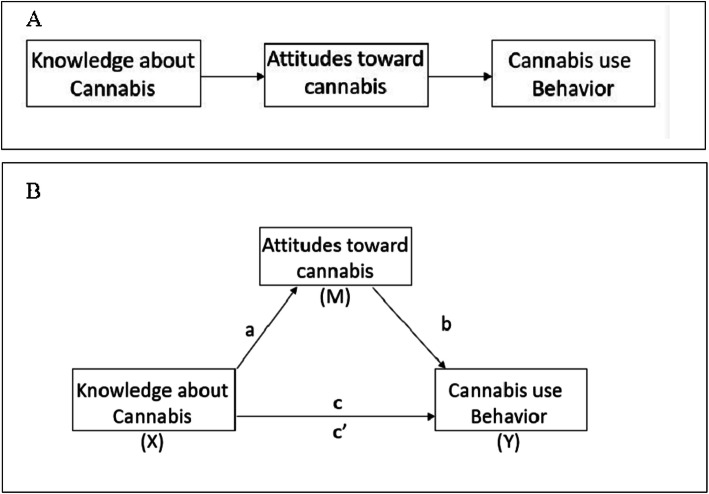
Little is known about how cannabis knowledge and attitudes impact cannabis use behavior.
To test the knowledge-attitudes-behavior paradigm in active adult athletes.
The Athlete Pain, Exercise, and Cannabis Experience (PEACE) Survey, a cross-sectional survey study, used social media and email blasts to recruit participants and SurveyGizmo to collect data.
Self-defined active adult athletes (n = 1161).
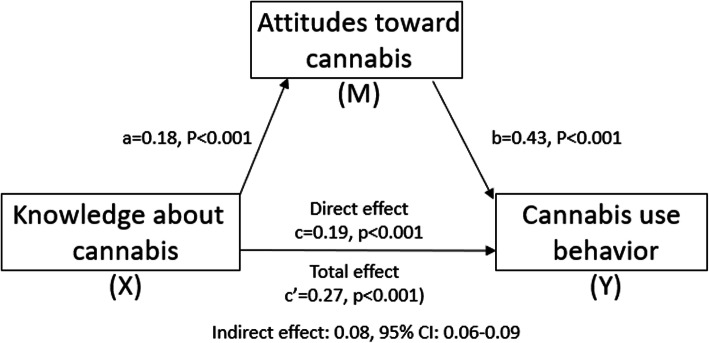
Knowledge about cannabis was evaluated with four questions. Attitudes toward cannabis was evaluated with 11 questions. The attitudes questions were used in a TwoStep Cluster analysis in SPSS to assign group membership by attitudes. Chi-square was used to determine if there were differences in cluster membership by demographic factors and if knowledge about cannabis differed by cluster membership. Regression analysis was performed to determine if cannabis attitudes mediated the relationship between cannabis knowledge and cannabis use.
A three-cluster solution was the best fit to the data. The clusters were named Conservative (n = 374, 32.2%), Unsure (n = 533, 45.9%), and Liberal (n = 254, 21.9). There was a significant difference among the clusters for all 11 attitudes items (all p < 0.001). Attitude cluster membership was significantly different by age (p < 0.001), primary sport (p < 0.05), and knowledge about cannabis (p < 0.001). Athletes in the liberal cluster answered the knowledge questions correctly most often. Attitudes mediated the relationship between cannabis knowledge and cannabis use [Never (32.4%), Past (41.6%), Current (26.0%)] with athletes in the liberal cluster showing more knowledge and greater likelihood to be a current cannabis user (p < 0.001). Among current cannabis users there were differential patterns of cannabis use depending on their attitudes and knowledge; liberal athletes tended to co-use THC and CBD and used cannabis longer. (p < 0.001).
Cannabis education needs to consider attitudes about cannabis, especially among those who might benefit from medical cannabis.
关于大麻知识和态度如何影响大麻使用行为,人们了解甚少。
在活跃的成年运动员中检验知识-态度-行为范式。
运动员疼痛、运动与大麻体验(PEACE)调查,一项横断面调查研究,利用社交媒体和电子邮件招募参与者,并使用SurveyGizmo收集数据。
自我定义为活跃的成年运动员(n = 1161)。
用四个问题评估对大麻的知识。用11个问题评估对大麻的态度。在SPSS中,态度问题用于两步聚类分析,以按态度分配组成员。卡方检验用于确定按人口统计学因素划分的聚类成员是否存在差异,以及大麻知识是否因聚类成员不同而有所差异。进行回归分析以确定大麻态度是否介导了大麻知识与大麻使用之间的关系。
三聚类解决方案最适合数据。这些聚类分别命名为保守型(n = 374,32.2%)、不确定型(n = 533,45.9%)和自由型(n = 254,21.9%)。所有11个态度项目在聚类之间存在显著差异(所有p < 0.001)。态度聚类成员在年龄(p < 0.001)、主要运动项目(p < 0.05)和大麻知识(p < 0.001)方面存在显著差异。自由聚类中的运动员回答知识问题正确的频率最高。态度介导了大麻知识与大麻使用之间的关系[从不使用(32.4%)、过去使用(41.6%)、当前使用(26.0%)],自由聚类中的运动员知识更多,当前使用大麻的可能性更大(p < 0.001)。在当前大麻使用者中,根据他们的态度和知识存在不同的大麻使用模式;自由型运动员倾向于同时使用四氢大麻酚(THC)和大麻二酚(CBD),且使用大麻的时间更长。(p < 0.001)
大麻教育需要考虑对大麻的态度,尤其是在那些可能从医用大麻中受益的人群中。