Aberdeen Centre for Arthritis and Musculoskeletal Health (Epidemiology Group), University of Aberdeen, Aberdeen, UK
Aberdeen Centre for Arthritis and Musculoskeletal Health (Epidemiology Group), University of Aberdeen, Aberdeen, UK.
Ann Rheum Dis. 2021 Jul;80(7):903-911. doi: 10.1136/annrheumdis-2020-219091. Epub 2021 Feb 1.
Cognitive-behavioural therapy (CBT) has been shown to be effective in the management of chronic widespread pain (CWP); we now test whether it can onset among adults at high risk.
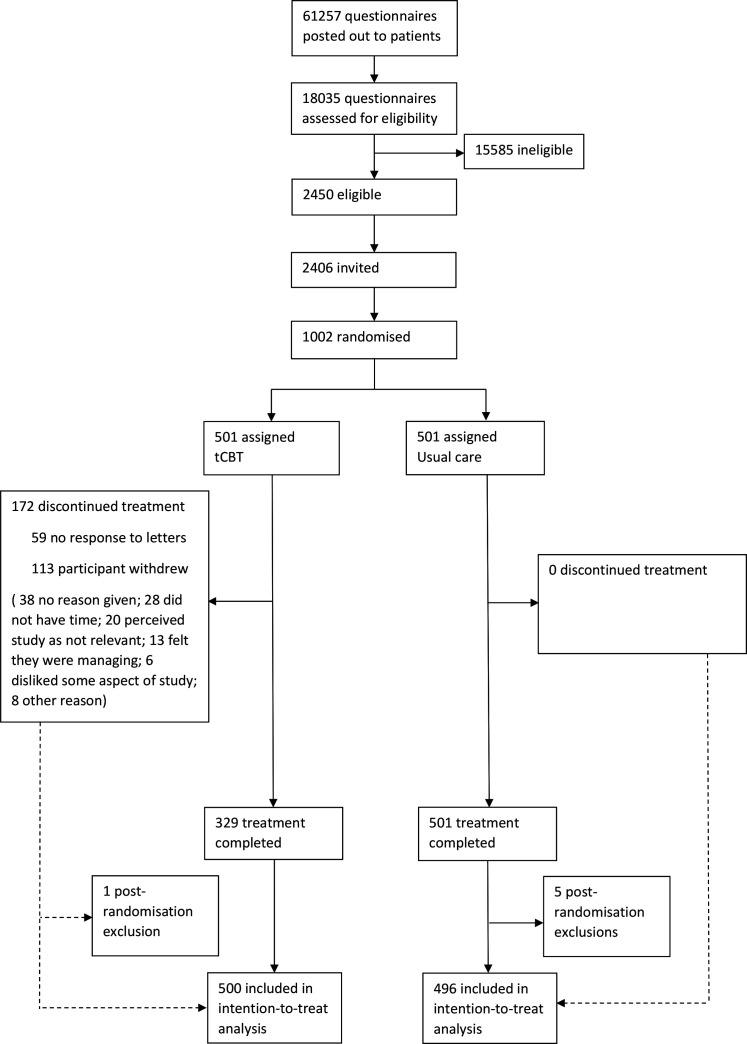
A population-based randomised controlled prevention trial, with recruitment through UK general practices. A mailed screening questionnaire identified adults at high risk of CWP. Participants received either usual care (UC) or a short course of telephone CBT (tCBT). The primary outcome was CWP onset at 12 months assessed by mailed questionnaire. There were seven secondary outcomes including quality of life (EuroQol Questionnaire-five dimensions-five levels/EQ-5D-5L) used as part of a health economic assessment.
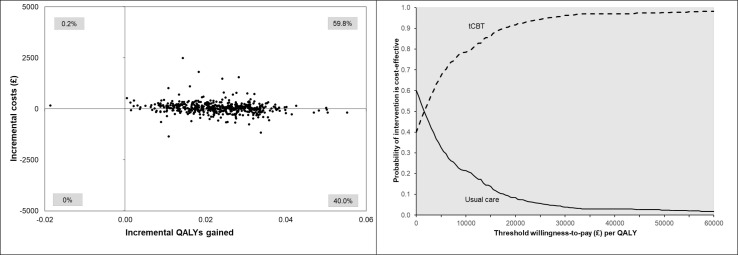
996 participants were randomised and included in the intention-to-treat analysis of which 825 provided primary outcome data. The median age of participants was 59 years; 59% were women. At 12 months there was no difference in the onset of CWP (tCBT: 18.0% vs UC: 17.5%; OR 1.05; 95% CI 0.75 to 1.48). Participants who received tCBT were more likely to report better quality of life (EQ-5D-5L utility score mean difference 0.024 (95% CI 0.009 to 0.040)); and had 0.023 (95% CI 0.007 to 0.039) more quality-adjusted life-years at an additional cost of £42.30 (95% CI -£451.19 to £597.90), yielding an incremental cost-effectiveness ratio of £1828. Most secondary outcomes showed significant benefit for the intervention.
A short course of tCBT did not prevent onset of CWP in adults at high risk, but improved quality of life and was cost-effective. A low-cost, short-duration intervention benefits persons at risk of CWP.
ClinicalTrials.gov Registry (NCT02668003).
认知行为疗法(CBT)已被证明可有效治疗慢性广泛性疼痛(CWP);我们现检验其是否可预防高危人群 CWP 的发病。
本研究为一项基于人群的随机对照预防试验,通过英国普通诊所进行招募。邮寄的筛查问卷识别出 CWP 高危人群。参与者接受常规护理(UC)或简短的电话认知行为疗法(tCBT)。主要结局为 12 个月时通过邮寄问卷评估的 CWP 发病情况。有 7 个次要结局,包括生活质量(欧洲五维健康量表简表/EQ-5D-5L),作为健康经济评估的一部分。
996 名参与者被随机分组并纳入意向治疗分析,其中 825 名提供了主要结局数据。参与者的中位年龄为 59 岁,59%为女性。12 个月时,CWP 发病无差异(tCBT:18.0%vs UC:17.5%;OR 1.05;95%CI 0.75 至 1.48)。接受 tCBT 的参与者更有可能报告生活质量改善(EQ-5D-5L 效用评分平均差异 0.024(95%CI 0.009 至 0.040)),且在增加 42.30 英镑(95%CI -451.19 至 597.90 英镑)成本的情况下,具有 0.023(95%CI 0.007 至 0.039)更多的质量调整生命年,增量成本效益比为 1828 英镑。大多数次要结局均显示干预措施具有显著获益。
短期 tCBT 治疗并未预防高危人群 CWP 的发病,但改善了生活质量且具有成本效益。这种低成本、短疗程的干预措施有益于 CWP 高危人群。
ClinicalTrials.gov 注册(NCT02668003)。