Choi Han, Hahm Suk-Chan, Jeon Yo-Han, Han Jin-Woo, Kim Soo-Yeon, Woo Jong-Min
Graduate School of Art Therapy, Cha University, Seongnam 13488, Korea.
Graduate School of Integrative Medicine, Cha University, Seongnam 13488, Korea.
Healthcare (Basel). 2021 May 28;9(6):642. doi: 10.3390/healthcare9060642.
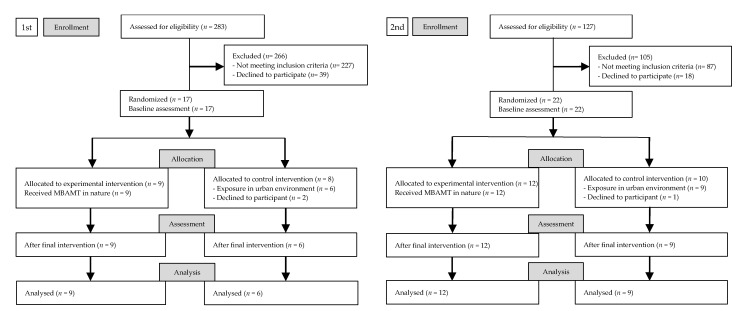
This study aimed to investigate the effects of mindfulness-based mandala coloring made within nature on individuals with chronic widespread musculoskeletal pain (CWP). Thirty-six participants were randomly allocated. In the experimental group, identical interventions and procedures were administered for each experiment. The control group members were untreated and remained in an urban environment. Overall, the experiment showed significant improvements in tender points ( = 8.791, = 0.006), total stress level ( = 14.570, = 0.001), depressive symptoms ( = 15.205, = 0.001), anger symptoms ( = 7.263, = 0.011) and salivary cortisol ( = 10.619, = 0.003) in the experimental group. The results reflect that MBMC within nature is effective in reducing pain, psychological stress responses, and cortisol levels in individuals with CWP. The positive results could be a product of the experimental design rather than the treatment itself. A rigorous experimental design provides better understanding of MBMC within nature.
本研究旨在调查在自然环境中进行的基于正念的曼陀罗填色对慢性广泛性肌肉骨骼疼痛(CWP)患者的影响。36名参与者被随机分配。在实验组中,每次实验都实施相同的干预措施和程序。对照组成员未接受治疗,留在城市环境中。总体而言,实验表明实验组在压痛点(=8.791,=0.006)、总压力水平(=14.570,=0.001)、抑郁症状(=15.205,=0.001)、愤怒症状(=7.263,=0.011)和唾液皮质醇(=10.619,=0.003)方面有显著改善。结果表明,自然环境中的基于正念的曼陀罗填色对减轻CWP患者的疼痛、心理应激反应和皮质醇水平有效。这些积极结果可能是实验设计的产物,而非治疗本身的效果。严谨的实验设计有助于更好地理解自然环境中的基于正念的曼陀罗填色。