Interfaculty Institute of Microbiology and Infection Medicine, University of Tübingen, 72076 Tübingen, Germany.
Department of Quantitative Proteomics, University of Tübingen, 72076 Tübingen, Germany.
Proc Natl Acad Sci U S A. 2021 Feb 9;118(6). doi: 10.1073/pnas.2019988118.
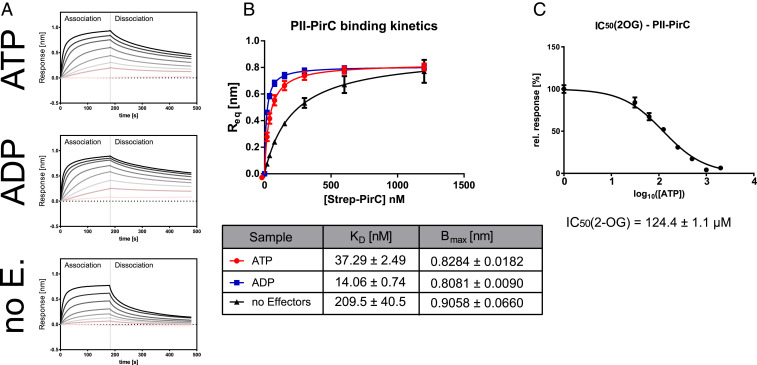
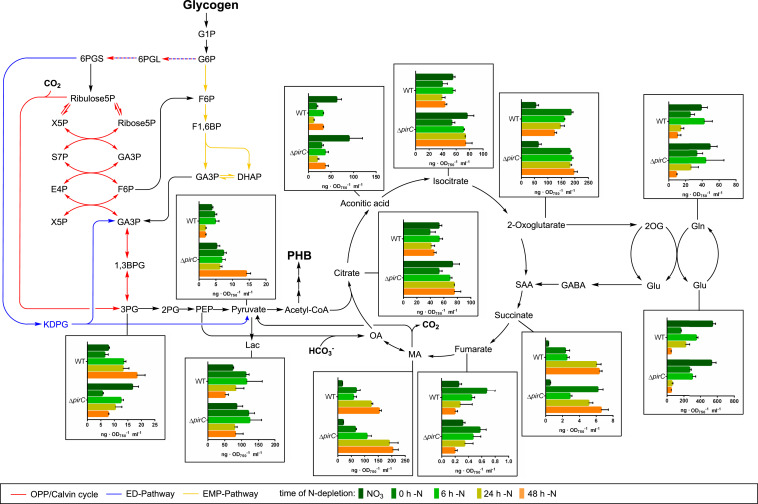
Nitrogen limitation imposes a major transition in the lifestyle of nondiazotrophic cyanobacteria that is controlled by a complex interplay of regulatory factors involving the pervasive signal processor P Immediately upon nitrogen limitation, newly fixed carbon is redirected toward glycogen synthesis. How the metabolic switch for diverting fixed carbon toward the synthesis of glycogen or of cellular building blocks is operated was so far poorly understood. Here, using the nondiazotrophic cyanobacterium sp. PCC 6803 as model system, we identified a novel P interactor, the product of the gene, which we named PirC. We show that PirC binds to and inhibits the activity of 2,3-phosphoglycerate-independent phosphoglycerate mutase (PGAM), the enzyme that deviates newly fixed CO toward lower glycolysis. The binding of PirC to either P or PGAM is tuned by the metabolite 2-oxoglutarate (2-OG), which accumulates upon nitrogen starvation. In these conditions, the high levels of 2-OG dissociate the PirC-P complex to promote PirC binding to and inhibition of PGAM. Accordingly, a PirC-deficient mutant showed strongly reduced glycogen levels upon nitrogen deprivation, whereas polyhydroxybutyrate granules were overaccumulated compared to wild-type. Metabolome analysis revealed an imbalance in 3-phosphoglycerate to pyruvate levels in the mutant, confirming that PirC controls the carbon flux in cyanobacteria via mutually exclusive interaction with either P or PGAM.
氮限制会导致非固氮蓝藻生活方式发生重大转变,这种转变受涉及广泛信号处理器 P 的复杂调控因子控制。氮限制一发生,新固定的碳就会被重新导向糖原合成。目前,人们对如何操纵将固定碳转向糖原或细胞构建块合成的代谢开关知之甚少。在这里,我们使用非固氮蓝藻 sp. PCC 6803 作为模型系统,鉴定出一种新型 P 相互作用蛋白,即基因的产物,我们将其命名为 PirC。我们表明,PirC 结合并抑制了 2,3-磷酸甘油酸非依赖性磷酸甘油酸变位酶(PGAM)的活性,该酶将新固定的 CO 偏离到较低的糖酵解途径。PirC 与 P 或 PGAM 的结合受代谢物 2-氧戊二酸(2-OG)的调节,氮饥饿会导致 2-OG 积累。在这些条件下,高浓度的 2-OG 会使 PirC-P 复合物解离,从而促进 PirC 与 PGAM 结合并抑制其活性。因此,与野生型相比,缺乏 PirC 的突变体在氮饥饿时糖原水平明显降低,而多羟基丁酸颗粒过度积累。代谢组学分析显示突变体中 3-磷酸甘油酸到丙酮酸的水平失衡,证实 PirC 通过与 P 或 PGAM 相互排斥的相互作用来控制蓝藻中的碳通量。