Naderipour Amirreza, Abdul-Malek Zulkurnain, Hajivand Mohammad, Seifabad Zahra Mirzaei, Farsi Mohammad Ali, Nowdeh Saber Arabi, Davoudkhani Iraj Faraji
Institute of High Voltage and High Current, School of Electrical Engineering, Faculty of Engineering, Universiti Teknologi Malaysia, 81310, Johor Bahru, Malaysia.
Young Researchers and Elite Club, Borujerd Branch, Islamic Azad University, Borujerd, Iran.
Sci Rep. 2021 Feb 1;11(1):2728. doi: 10.1038/s41598-021-82440-9.
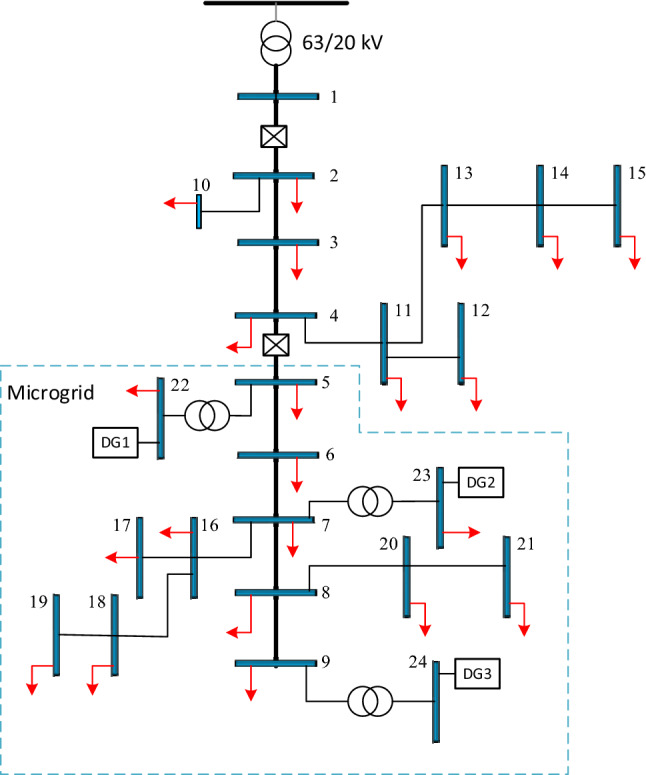
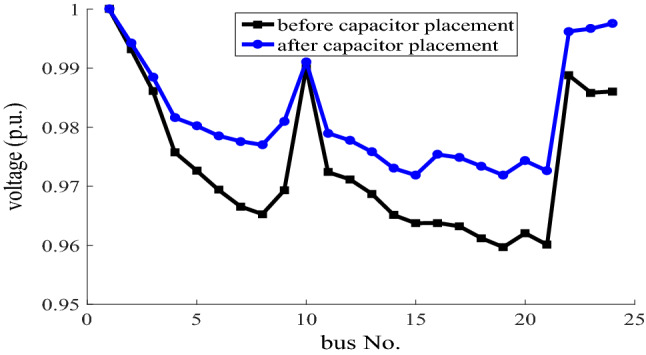
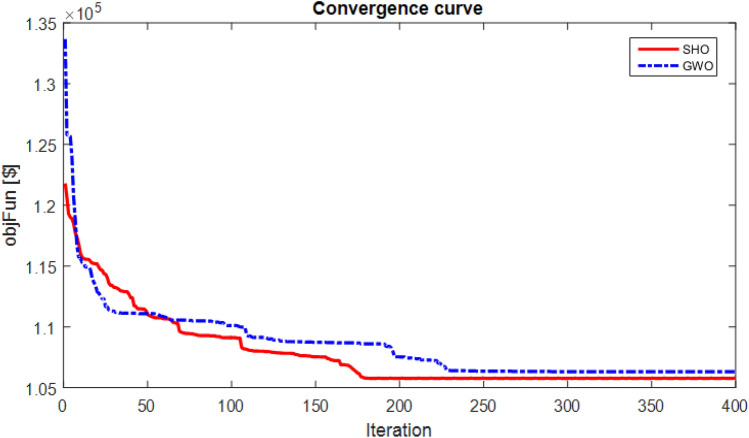
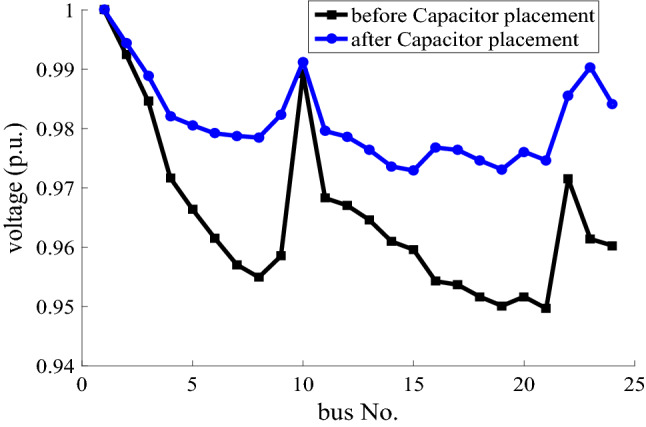
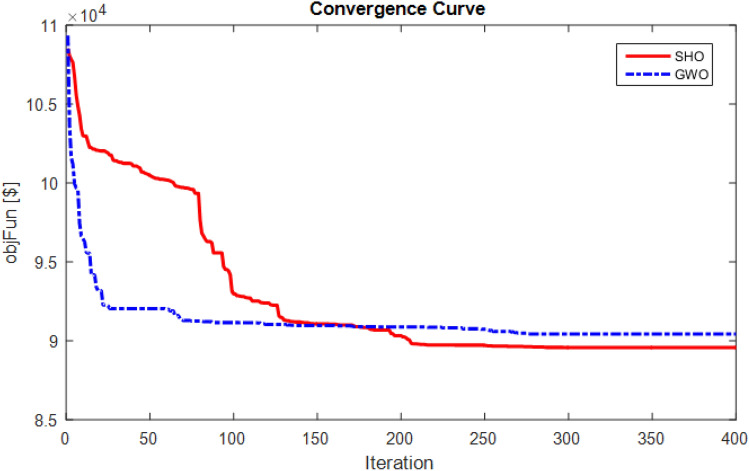
In this paper, the optimal allocation of constant and switchable capacitors is presented simultaneously in two operation modes, grid-connected and islanded, for a microgrid. Different load levels are considered by employing non-dispatchable distributed generations. The objective function includes minimising the energy losses cost, the cost of peak power losses, and the cost of the capacitor. The optimization problem is solved using the spotted hyena optimizer (SHO) algorithm to determine the optimal size and location of capacitors, considering different loading levels and the two operation modes. In this study, a three-level load and various types of loads, including constant power, constant current, and constant impedance are considered. The proposed method is implemented on a 24-bus radial distribution network. To evaluate the performance of the SHO, the results are compared with GWO and the genetic algorithm (GA). The simulation results demonstrate the superior performance of the SHO in reducing the cost of losses and improving the voltage profile during injection and non-injection of reactive power by distributed generations in two operation modes. The total cost and net saving values for DGs only with the capability of active power injection is achieved 105,780 $ and 100,560.54 $, respectively and for DGs with the capability of active and reactive power injection is obtained 89,568 $ and 76,850.46 $, respectively using the SHO. The proposed method has achieved more annual net savings due to the lower cost of losses than other optimization methods.
本文针对微电网,同时给出了恒电容和可切换电容在并网和孤岛两种运行模式下的最优配置。通过采用不可调度分布式发电来考虑不同的负载水平。目标函数包括使能量损耗成本、峰值功率损耗成本和电容器成本最小化。利用斑点鬣狗优化器(SHO)算法求解优化问题,以确定电容器的最优尺寸和位置,同时考虑不同的负载水平和两种运行模式。在本研究中,考虑了三级负载以及包括恒功率、恒电流和恒阻抗在内的各种类型负载。所提出的方法在一个24节点的辐射状配电网中实现。为了评估SHO的性能,将结果与灰狼优化算法(GWO)和遗传算法(GA)进行比较。仿真结果表明,在两种运行模式下,SHO在降低分布式发电注入和不注入无功功率时的损耗成本以及改善电压分布方面具有卓越性能。使用SHO算法时,仅具有有功功率注入能力的分布式发电的总成本和净节约值分别为105,780美元和100,560.54美元,而具有有功和无功功率注入能力的分布式发电的总成本和净节约值分别为89,568美元和76,850.46美元。与其他优化方法相比,所提出的方法由于损耗成本较低而实现了更多的年度净节约。