Logie Carmen, Okumu Moses, Hakiza Robert, Kibuuka Musoke Daniel, Berry Isha, Mwima Simon, Kyambadde Peter, Kiera Uwase Mimy, Loutet Miranda, Neema Stella, Newby Katie, McNamee Clara, Baral Stefan D, Lester Richard, Musinguzi Joshua, Mbuagbaw Lawrence
Factor-Inwentash Faculty of Social Work, University of Toronto, Toronto, ON, Canada.
School of Social Work, University of North Carolina Chapel Hill, Chapel Hill, NC, United States.
JMIR Res Protoc. 2021 Feb 2;10(2):e26192. doi: 10.2196/26192.
HIV is the leading cause of mortality among youth in sub-Saharan Africa. Uganda hosts over 1.43 million refugees, and more than 83,000 live in Kampala, largely in informal settlements. There is limited information about HIV testing uptake and preferences among urban refugee and displaced youth. HIV self-testing is a promising method for increasing testing uptake. Further, mobile health (mHealth) interventions have been effective in increasing HIV testing uptake and could be particularly useful among youth.
This study aims to evaluate the feasibility and effectiveness of two HIV self-testing implementation strategies (HIV self-testing intervention alone and HIV self-testing combined with an mHealth intervention) in comparison with the HIV testing standard of care in terms of HIV testing outcomes among refugee/displaced youth aged 16 to 24 years in Kampala, Uganda.
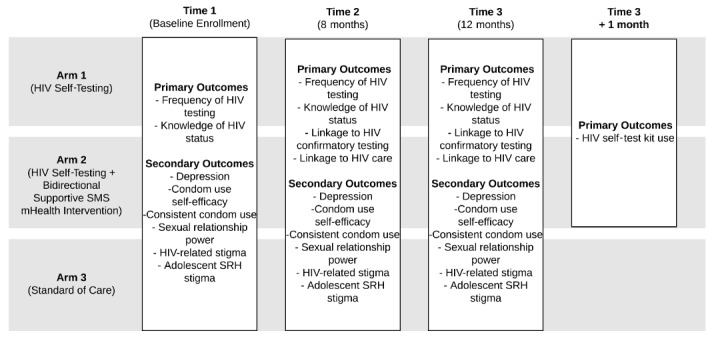
A three-arm cluster randomized controlled trial will be implemented across five informal settlements grouped into three sites, based on proximity, and randomization will be performed with a 1:1:1 method. Approximately 450 adolescents (150 per cluster) will be enrolled and followed for 12 months. Data will be collected at the following three time points: baseline enrollment, 8 months after enrollment, and 12 months after enrollment. Primary outcomes (HIV testing frequency, HIV status knowledge, linkage to confirmatory testing, and linkage to HIV care) and secondary outcomes (depression, condom use efficacy, consistent condom use, sexual relationship power, HIV stigma, and adolescent sexual and reproductive health stigma) will be evaluated.
The study has been conducted in accordance with CONSORT (Consolidated Standards of Reporting Trials) guidelines. The study has received ethical approval from the University of Toronto (June 14, 2019), Mildmay Uganda (November 11, 2019), and the Uganda National Council for Science and Technology (August 3, 2020). The Tushirikiane trial launched in February 2020, recruiting a total of 452 participants. Data collection was paused for 8 months due to COVID-19. Data collection for wave 2 resumed in November 2020, and as of December 10, 2020, a total of 295 participants have been followed-up. The third, and final, wave of data collection will be conducted between February and March 2021.
This study will contribute to the knowledge of differentiated HIV testing implementation strategies for urban refugee and displaced youth living in informal settlements. We will share the findings in peer-reviewed manuscripts and conference presentations.
ClinicalTrials.gov NCT04504097; https://clinicaltrials.gov/ct2/show/NCT04504097.
INTERNATIONAL REGISTERED REPORT IDENTIFIER (IRRID): DERR1-10.2196/26192.
在撒哈拉以南非洲地区,艾滋病毒是青年死亡的主要原因。乌干达收容了超过143万难民,其中8.3万多人居住在坎帕拉,主要集中在非正式定居点。关于城市难民和流离失所青年的艾滋病毒检测接受情况和偏好的信息有限。艾滋病毒自我检测是提高检测接受率的一种有前景的方法。此外,移动健康(mHealth)干预措施在提高艾滋病毒检测接受率方面已取得成效,对青年可能特别有用。
本研究旨在评估两种艾滋病毒自我检测实施策略(单独的艾滋病毒自我检测干预和艾滋病毒自我检测与移动健康干预相结合)与艾滋病毒检测标准护理相比,对乌干达坎帕拉16至24岁难民/流离失所青年艾滋病毒检测结果的可行性和有效性。
将在五个非正式定居点开展一项三臂整群随机对照试验,根据距离将这些定居点分为三个地点,并采用1:1:1的方法进行随机分组。将招募约450名青少年(每个整群150名),并随访12个月。将在以下三个时间点收集数据:基线入组时、入组后8个月和入组后12个月。将评估主要结局(艾滋病毒检测频率、艾滋病毒感染状况知晓情况、与确证检测的联系以及与艾滋病毒护理的联系)和次要结局(抑郁、避孕套使用效果、持续使用避孕套、性关系掌控力、艾滋病毒污名以及青少年性与生殖健康污名)。
本研究已按照CONSORT(试验报告统一标准)指南进行。该研究已获得多伦多大学(2019年6月14日)、乌干达米尔德梅医院(2019年11月11日)以及乌干达国家科学技术委员会(2020年8月3日)的伦理批准。“Tushirikiane”试验于2020年2月启动,共招募了452名参与者。由于新冠疫情,数据收集暂停了8个月。2020年11月恢复了第二轮数据收集,截至2020年12月10日,已对295名参与者进行了随访。第三轮也是最后一轮数据收集将于2021年2月至3月进行。
本研究将有助于了解针对居住在非正式定居点的城市难民和流离失所青年的差异化艾滋病毒检测实施策略。我们将在同行评审的手稿和会议报告中分享研究结果。
ClinicalTrials.gov NCT04504097;https://clinicaltrials.gov/ct2/show/NCT04504097。
国际注册报告识别码(IRRID):DERR1-10.2196/26192。