Logie Carmen H, Okumu Moses, Admassu Zerihun, MacKenzie Frannie, Tailor Lauren, Kortenaar Jean-Luc, Perez-Brumer Amaya, Ahmed Rushdia, Batte Shamilah, Hakiza Robert, Kibuuka Musoke Daniel, Katisi Brenda, Nakitende Aidah, Juster Robert-Paul, Marin Marie-France, Kyambadde Peter
Factor Inwentash Faculty of Social Work, University of Toronto, Toronto, ON, Canada.
United Nations University Institute for Water, Environment, and Health, Hamilton, ON, Canada.
J Migr Health. 2024 Feb 8;9:100215. doi: 10.1016/j.jmh.2024.100215. eCollection 2024.
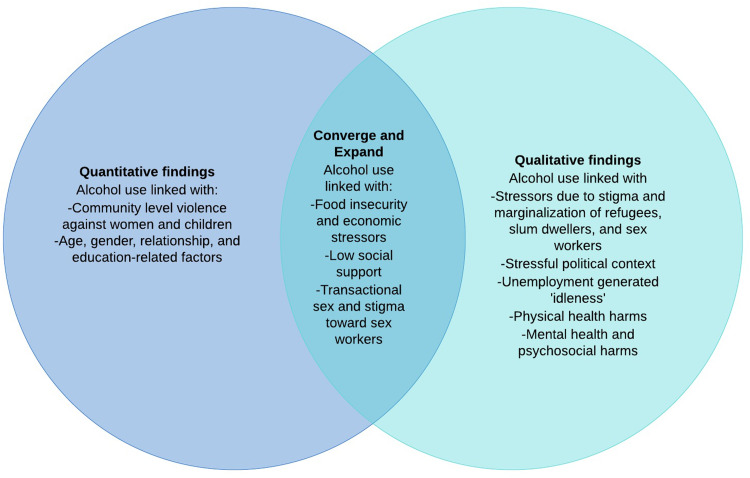
Urban refugees may be disproportionately affected by socio-environmental stressors that shape alcohol use, and this may have been exacerbated by additional stressors in the COVID-19 pandemic. This multi-method study aimed to understand experiences of, and contextual factors associated with, alcohol use during the pandemic among urban refugee youth in Kampala, Uganda. We conducted a cross-sectional survey ( = 335), in-depth individual interviews (IDI) ( = 24), and focus groups ( = 4) with urban refugee youth in Kampala. We also conducted key informant interviews ( = 15) with a range of stakeholders in Kampala. We conducted multivariable logistic regression analyses with survey data to examine socio-demographic and ecosocial (structural, community, interpersonal) factors associated with ever using alcohol and alcohol misuse. We applied thematic analyses across qualitative data to explore lived experiences, and perceived impacts, of alcohol use. Among survey participants ( = 335, mean age= 20.8, standard deviation: 3.01), half of men and one-fifth of women reported ever using alcohol. Among those reporting any alcohol use, half ( = 66, 51.2 %) can be classified as alcohol misuse. In multivariable analyses, older age, gender (men vs. women), higher education, and perceived increased pandemic community violence against women and children were associated with significantly higher likelihood of ever using alcohol. In multivariable analyses, very low food security, relationship status, transactional sex, and lower social support were associated with increased likelihood of alcohol misuse. Qualitative findings revealed: (1) alcohol use as a coping mechanism for stressors (e.g., financial insecurity, refugee-related stigma); and (2) perceived impacts of alcohol use on refugee youth health (e.g., physical, mental). Together findings provide insight into multi-level contexts that shape vulnerability to alcohol mis/use among urban refugee youth in Kampala and signal the need for gender-tailored strategies to reduce socio-environmental stressors.
城市难民可能受到影响饮酒行为的社会环境压力因素的影响尤其严重,而在新冠疫情期间,额外的压力因素可能使这种情况更加恶化。这项多方法研究旨在了解乌干达坎帕拉城市难民青年在疫情期间的饮酒经历以及与之相关的背景因素。我们对坎帕拉的城市难民青年进行了一项横断面调查(n = 335)、深度个人访谈(IDI)(n = 24)和焦点小组访谈(n = 4)。我们还对坎帕拉的一系列利益相关者进行了关键信息访谈(n = 15)。我们使用调查数据进行多变量逻辑回归分析,以研究与曾经饮酒和酒精滥用相关的社会人口学和生态社会(结构、社区、人际)因素。我们对定性数据进行了主题分析,以探索饮酒的生活经历和感知影响。在调查参与者中(n = 335,平均年龄 = 20.8,标准差:3.01),一半的男性和五分之一的女性报告曾经饮酒。在报告有饮酒行为的人中,一半(n = 66,51.2%)可被归类为酒精滥用。在多变量分析中,年龄较大、性别(男性与女性)、受教育程度较高以及感知到疫情期间社区针对妇女和儿童的暴力行为增加与曾经饮酒的可能性显著更高相关。在多变量分析中,极低的粮食安全、恋爱状况、交易性行为和较低的社会支持与酒精滥用的可能性增加相关。定性研究结果显示:(1)饮酒作为应对压力因素(如经济不安全、与难民相关的耻辱感)的一种机制;(2)饮酒对难民青年健康(如身体、心理)的感知影响。综合研究结果有助于深入了解塑造坎帕拉城市难民青年酒精滥用/使用易感性的多层次背景,并表明需要制定针对性别的策略来减少社会环境压力因素。