Spatial Epidemiology Lab (SpELL), Université Libre de Bruxelles, Bruxelles, Belgium.
Department of Microbiology, Immunology and Transplantation, Rega Institute, KU Leuven, Leuven, Belgium.
Mol Biol Evol. 2021 Jul 29;38(8):3486-3493. doi: 10.1093/molbev/msab031.
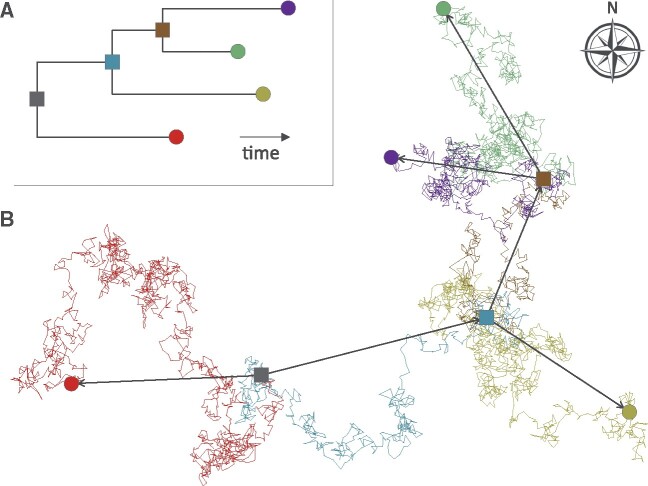
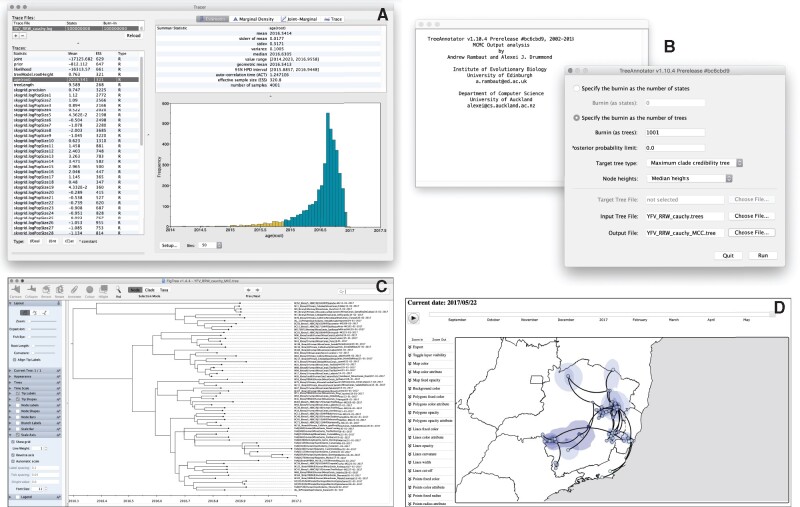
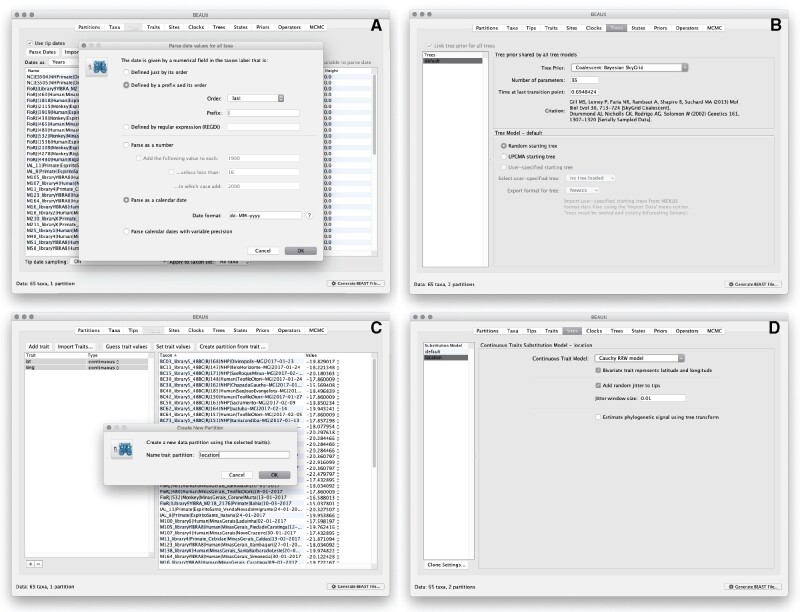
Spatially explicit phylogeographic analyses can be performed with an inference framework that employs relaxed random walks to reconstruct phylogenetic dispersal histories in continuous space. This core model was first implemented 10 years ago and has opened up new opportunities in the field of phylodynamics, allowing researchers to map and analyze the spatial dissemination of rapidly evolving pathogens. We here provide a detailed and step-by-step guide on how to set up, run, and interpret continuous phylogeographic analyses using the programs BEAUti, BEAST, Tracer, and TreeAnnotator.
具有宽松随机游走功能的推断框架可用于进行空间显式系统地理学分析,以重建连续空间中的系统发育扩散历史。该核心模型于 10 年前首次实施,为系统发育动力学领域开辟了新的机会,使研究人员能够绘制和分析快速进化病原体的空间传播。我们在此提供了一个详细的分步指南,介绍如何使用 BEAUti、BEAST、Tracer 和 TreeAnnotator 程序设置、运行和解释连续系统地理学分析。