Schäfer Natalie, Bühler Michael, Heyer Lisa, Röhr Merle I S, Beuerle Florian
Institut für Organische Chemie, Julius-Maximilians-Universität Würzburg, Am Hubland, 97074, Würzburg, Germany.
Center for Nanosystems Chemistry (CNC), Julius-Maximilians-Universität Würzburg, Theodor-Boveri-Weg, 97074, Würzburg, Germany.
Chemistry. 2021 Apr 1;27(19):6077-6085. doi: 10.1002/chem.202005276. Epub 2021 Mar 3.
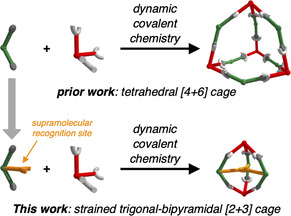
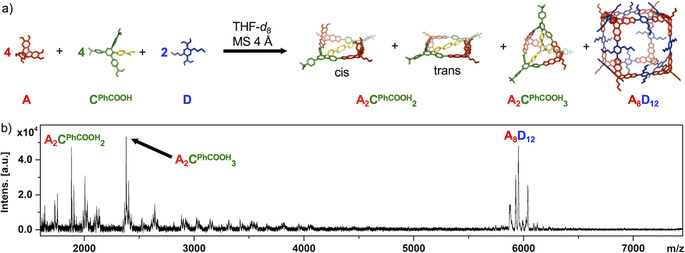
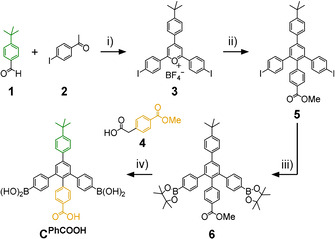
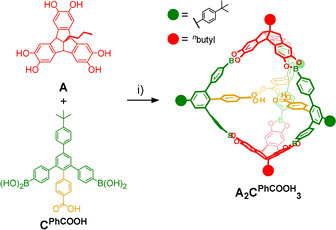
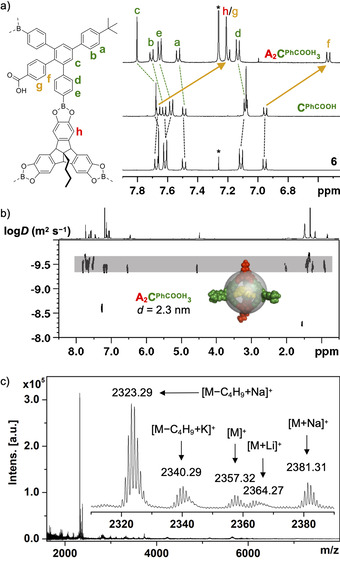
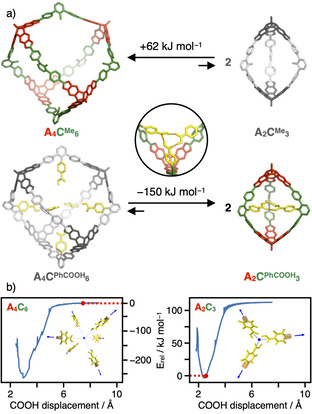
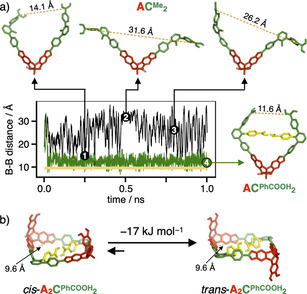
A highly strained covalent organic cage compound was synthesized from hexahydroxy tribenzotriquinacene (TBTQ) and a meta-terphenyl-based diboronic acid with an additional benzoic acid substituent in 2'-position. Usually, a 120° bite angle in the unsubstituted ditopic linker favors the formation of a [4+6] cage assembly. Here, the introduction of the benzoic acid group is shown to lead to a perfectly preorganized circular hydrogen-bonding array in the cavity of a trigonal-bipyramidal [2+3] cage, which energetically overcompensates the additional strain energy caused by the larger mismatch in bite angles for the smaller assembly. The strained cage compound was analyzed by mass spectrometry and H, C and DOSY NMR spectroscopy. DFT calculations revealed the energetic contribution of the hydrogen-bonding template to the cage stability. Furthermore, molecular dynamics simulations on early intermediates indicate an additional kinetic effect, as hydrogen bonding also preorganizes and rigidifies small oligomers to facilitate the exclusive formation of smaller and more strained macrocycles and cages.
由六羟基三苯并三萘醌(TBTQ)和在2'-位带有附加苯甲酸取代基的间三联苯二硼酸合成了一种高度应变的共价有机笼状化合物。通常,未取代的双齿连接体中120°的咬合角有利于形成[4+6]笼状组装体。在此,苯甲酸基团的引入导致在三角双锥[2+3]笼的腔内形成完美的预组织圆形氢键阵列,这在能量上补偿了由较小组装体咬合角较大失配引起的额外应变能。通过质谱、氢谱、碳谱和扩散排序核磁共振光谱对该应变笼状化合物进行了分析。密度泛函理论计算揭示了氢键模板对笼稳定性的能量贡献。此外,对早期中间体的分子动力学模拟表明存在额外的动力学效应,因为氢键也会预组织并使小寡聚物刚性化,以促进形成更小、应变更大的大环和笼状化合物。