Abdelrahman Hamdan, Seyed-Emadaldin Sadat, Krajnovic Branko, Ezzati Ali, Abdelgawaad Ahmed Shawky
Spine Center, 62480Helios Hospitals Erfurt, Germany.
Department of Orthopaedics and Trauma, Assiut University Medical School, Egypt.
Global Spine J. 2022 Sep;12(7):1420-1427. doi: 10.1177/2192568221990421. Epub 2021 Feb 3.
A prospective cohort study in a high-flow spine center in Germany.
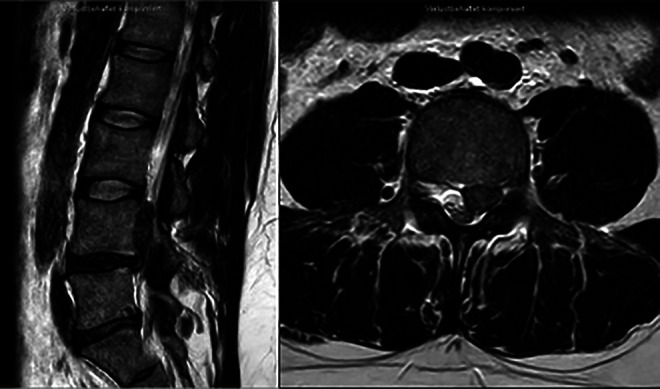
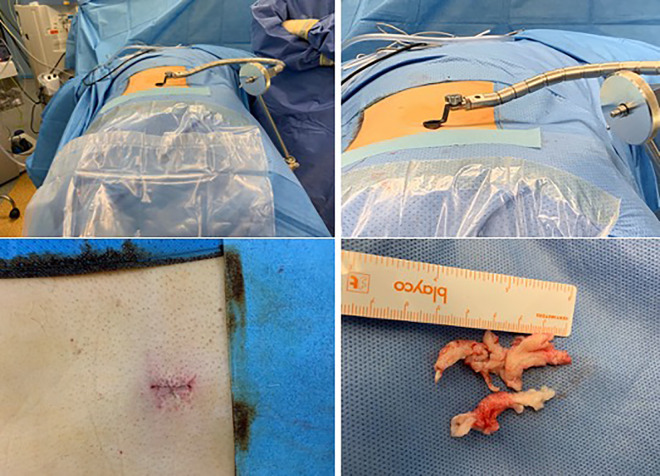
This study aimed to evaluate clinical outcomes and complications of the trans-tubular translaminar microscopic-assisted percutaneous nucleotomy in cases of cranially migrated lumbar disc herniations (LDH).
Between January 2013 and January 2018, 66 consecutive patients with cranio-laterally migrated LDH were operated upon. The following outcome measures were evaluated: Visual Analog Scale (VAS) for leg and back pain; Oswestry Disability Index (ODI) and Macnab´s criteria. All patients were operated upon with trans-tubular Translaminar Microscopic-assisted Percutaneous Nucleotomy (TL-MAPN). Perioperative radiographic and clinical evaluations were reported. The mean follow-up period was 32 months.
The mean age was 59 years. L4/L5 was the commonest affected level (27 patients). The mean preoperative VAS for leg pain was 6.44 (±2.06), improved to 0,35 (±0.59) postoperatively. Dural injury occurred in 1 patient, treated with dural patch. Improved neurological function was reported in 41/44 Patients (neurological improvement rate of 93%) at the final follow up. There was a significant improvement in the mean ODI values, from 50.19 ± 4.92 preoperatively to 10.14 ± 2.22 postoperatively . Sixty four out of 66 patients (96%) showed an excellent or good functional outcome according to Macnab´s criteria. No recurrent herniations were observed.
The translaminar approach is a viable minimal invasive technique for cranially migrated LDH. The preservation of the flavum ligament is one of the main advantages of this technique. It is an effective, safe and reproducible minimally invasive surgical alternative in treatment of cranially migrated LDHs.
在德国一家高流量脊柱中心进行的前瞻性队列研究。
本研究旨在评估经管状经椎板显微辅助经皮髓核摘除术治疗颅侧移位腰椎间盘突出症(LDH)的临床疗效和并发症。
2013年1月至2018年1月期间,对66例连续的颅侧-外侧移位LDH患者进行了手术。评估了以下结果指标:腿部和背部疼痛的视觉模拟量表(VAS);奥斯威斯功能障碍指数(ODI)和麦克纳布标准。所有患者均接受经管状经椎板显微辅助经皮髓核摘除术(TL-MAPN)。报告了围手术期的影像学和临床评估结果。平均随访期为32个月。
平均年龄为59岁。L4/L5是最常受累的节段(27例患者)。术前腿部疼痛的平均VAS为6.44(±2.06),术后改善至0.35(±0.59)。1例患者发生硬脊膜损伤,采用硬脊膜补片治疗。在最后一次随访时,41/44例患者(神经功能改善率为93%)报告神经功能得到改善。平均ODI值有显著改善,从术前的50.19±4.92提高到术后的10.14±2.22。根据麦克纳布标准,66例患者中有64例(96%)显示出优良的功能结果。未观察到复发性疝。
经椎板入路是治疗颅侧移位LDH的一种可行的微创技术。保留黄韧带是该技术的主要优点之一。它是治疗颅侧移位LDH的一种有效、安全且可重复的微创外科替代方法。