Jangra Sonia, Ye Chengjin, Rathnasinghe Raveen, Stadlbauer Daniel, Krammer Florian, Simon Viviana, Martinez-Sobrido Luis, García-Sastre Adolfo, Schotsaert Michael
Department of Microbiology, Icahn School of Medicine at Mount Sinai New York, NY, USA.
Global Health and Emerging Pathogens Institute, Icahn School of Medicine at Mount Sinai New York, NY, USA.
medRxiv. 2021 Jan 29:2021.01.26.21250543. doi: 10.1101/2021.01.26.21250543.
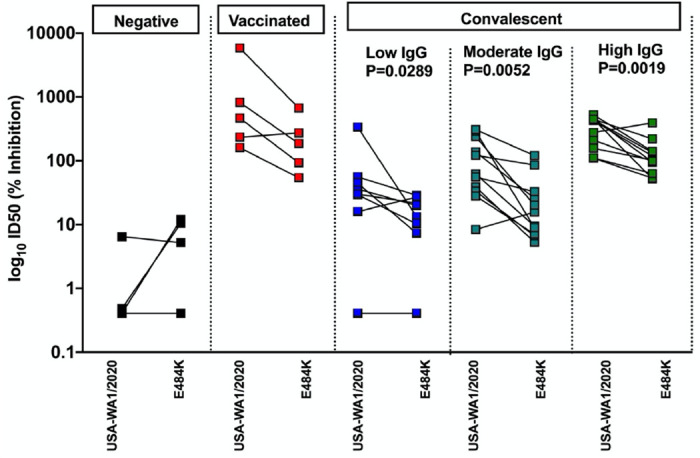
One year in the coronavirus disease 2019 (COVID-19) pandemic, the first vaccines are being rolled out under emergency use authorizations. It is of great concern that newly emerging variants of severe acute respiratory syndrome coronavirus 2 (SARS-CoV-2) can escape antibody-mediated protection induced by previous infection or vaccination through mutations in the spike protein. The glutamate (E) to Lysine (K) substitution at position 484 (E484K) in the receptor binding domain (RBD) of the spike protein is present in the rapidly spreading variants of concern belonging to the B.1.351 and P.1 lineages. We performed microneutralization assays with both the USA-WA1/2020 virus and a recombinant (r)SARS-CoV-2 virus that is identical to USA-WA1/2020 except for the E484K mutation introduced in the spike RBD. We selected 34 sera from study participants based on their SARS-CoV-2 spike ELISA antibody titer (negative [N=4] versus weak [N=8], moderate [N=11] or strong positive [N=11]). In addition, we included sera from five individuals who received two doses of the Pfizer SARS-CoV-2 vaccine BNT162b2. Serum neutralization efficiency was lower against the E484K rSARS-CoV-2 (vaccination samples: 3.4 fold; convalescent low IgG: 2.4 fold, moderate IgG: 4.2 fold and high IgG: 2.6 fold) compared to USA-WA1/2020. For some of the convalescent donor sera with low or moderate IgG against the SARS-CoV-2 spike, the drop in neutralization efficiency resulted in neutralization ID50 values similar to negative control samples, with low or even absence of neutralization of the E484K rSARS-CoV-2. However, human sera with high neutralization titers against the USA-WA1/2020 strain were still able to neutralize the E484K rSARS-CoV-2. Therefore, it is important to aim for the highest titers possible induced by vaccination to enhance protection against newly emerging SARS-CoV-2 variants. Two vaccine doses may be needed for induction of high antibody titers against SARS-CoV-2. Postponing the second vaccination is suggested by some public health authorities in order to provide more individuals with a primer vaccination. Our data suggests that this may leave vaccinees less protected against newly emerging variants.
在2019冠状病毒病(COVID-19)大流行的一年里,首批疫苗正在紧急使用授权下推出。令人高度担忧的是,严重急性呼吸综合征冠状病毒2(SARS-CoV-2)新出现的变种能够通过刺突蛋白的突变逃避先前感染或疫苗接种诱导的抗体介导的保护作用。刺突蛋白受体结合域(RBD)中第484位谷氨酸(E)到赖氨酸(K)的替换(E484K)存在于属于B.1.351和P.1谱系的快速传播的关注变种中。我们用美国WA1/2020病毒和一种重组(r)SARS-CoV-2病毒进行了微量中和试验,该重组病毒除了在刺突RBD中引入了E484K突变外,与美国WA1/2020相同。我们根据研究参与者的SARS-CoV-2刺突ELISA抗体滴度(阴性[N = 4]、弱阳性[N = 8]、中度阳性[N = 11]或强阳性[N = 11])选择了34份血清。此外,我们还纳入了5名接受两剂辉瑞SARS-CoV-2疫苗BNT162b2的个体的血清。与美国WA1/2020相比,针对E484K rSARS-CoV-2的血清中和效率较低(疫苗接种样本:3.4倍;康复期低IgG:2.4倍、中度IgG:4.2倍和高IgG:2.6倍)。对于一些针对SARS-CoV-2刺突的IgG水平低或中度的康复期供体血清,中和效率的下降导致中和ID50值与阴性对照样本相似,对E484K rSARS-CoV-2的中和作用低甚至没有。然而,对美国WA1/2020毒株具有高中和滴度的人血清仍然能够中和E484K rSARS-CoV-2。因此,重要的是要通过疫苗接种诱导尽可能高的滴度,以增强对新出现的SARS-CoV-2变种的保护。可能需要两剂疫苗来诱导针对SARS-CoV-2的高抗体滴度。一些公共卫生当局建议推迟第二次疫苗接种,以便为更多人提供初次疫苗接种。我们的数据表明,这可能会使疫苗接种者对新出现的变种的保护作用降低。