Department of Epidemiology, School of Public Health, Cheeloo College of Medicine, Shandong University, Jinan, China.
Department of Nutrition and Food Hygiene, School of Public Health, Cheeloo College of Medicine, Shandong University, Jinan, China.
J Clin Hypertens (Greenwich). 2021 Apr;23(4):766-772. doi: 10.1111/jch.14127. Epub 2021 Feb 3.
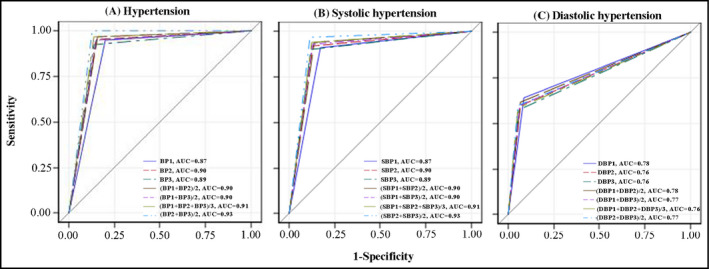
The performance of different BP readings and their combinations at a visit to identify children and adolescents with pediatric hypertension remains controversial. We aimed to assess the utility of different blood pressure (BP) readings and their combinations obtained at the initial screening visit for identifying Chinese children and adolescents with hypertension. Participants were 7831 children and adolescents aged 6-17 years measured as part of a cross-sectional survey conducted in Jinan, China between September 2012 and November 2014. BP was measured three times at up to three visits. Elevated BP at the initial visit was defined as systolic BP and/or diastolic BP ≥ age- and sex-specific 95th percentiles using the Chinese BP references for children and adolescents based on different BP readings and their combinations. Participants with elevated BP using (BP2+BP3)/2 across three visits were defined as having hypertension. Of the different readings or combinations examined, the mean of the last two readings at the initial visit had the best predictive utility for children and adolescents with hypertension (sensitivity: 100.0%; specificity: 86.9%; positive predictive value: 27.6%; negative predictive value: 100.0%). This was also reflected in the area under the curve being highest for the mean of the last two readings (0.93, 95% confidence interval: 0.93-0.94) compared with any of the other readings or combinations (BP1, BP2, BP3, [BP1+BP2]/2, [BP1+BP3]/2, and [BP1+BP2+BP3]/3; all p < .001). Taking three measurements of BP and using the average of the last two readings at a screening visit may be optimal for the identification of hypertension in youth.
不同血压读数及其组合在一次就诊时用于识别儿童和青少年高血压的表现仍存在争议。我们旨在评估在初始筛查就诊时获得的不同血压读数及其组合用于识别中国儿童和青少年高血压的效用。参与者为 7831 名年龄在 6-17 岁的儿童和青少年,他们是 2012 年 9 月至 2014 年 11 月在中国济南进行的横断面调查的一部分。血压在多达三次就诊时测量三次。初诊时的高血压定义为收缩压和/或舒张压≥基于中国儿童和青少年血压参考值的年龄和性别特异性第 95 百分位数,该参考值基于不同的血压读数及其组合。使用三次就诊时的(BP2+BP3)/2 中两次以上读数升高的参与者被定义为患有高血压。在所检查的不同读数或组合中,初诊时最后两次读数的平均值对高血压儿童和青少年具有最佳预测效用(敏感性:100.0%;特异性:86.9%;阳性预测值:27.6%;阴性预测值:100.0%)。这也反映在最后两次读数的平均值的曲线下面积最高(0.93,95%置信区间:0.93-0.94),高于任何其他读数或组合(BP1、BP2、BP3、[BP1+BP2]/2、[BP1+BP3]/2 和 [BP1+BP2+BP3]/3;所有 p 值均<.001)。在筛查就诊时进行三次血压测量并使用最后两次读数的平均值可能是识别青少年高血压的最佳方法。