Department of Microbiology, Tumor and Cell Biology, Science for Life Laboratory, Karolinska Institute, Stockholm, Sweden.
Department of Ecology and Genetics, Evolutionary Biology Centre, Science for Life Laboratory, Uppsala University, Sweden.
Genome Biol Evol. 2021 Apr 5;13(4). doi: 10.1093/gbe/evab016.
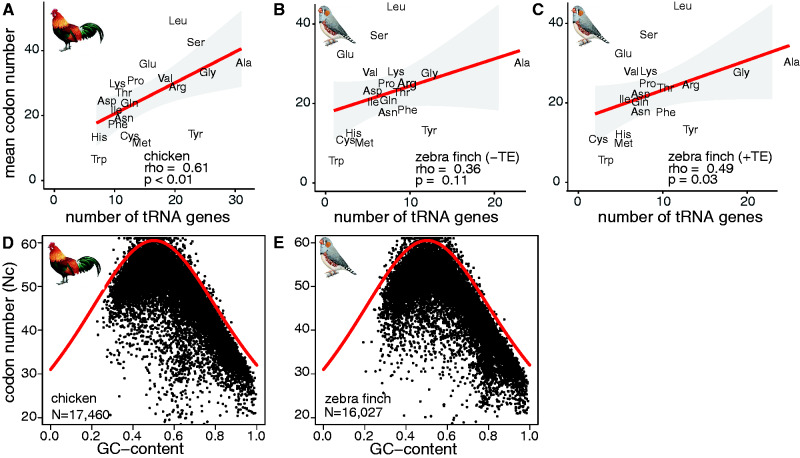
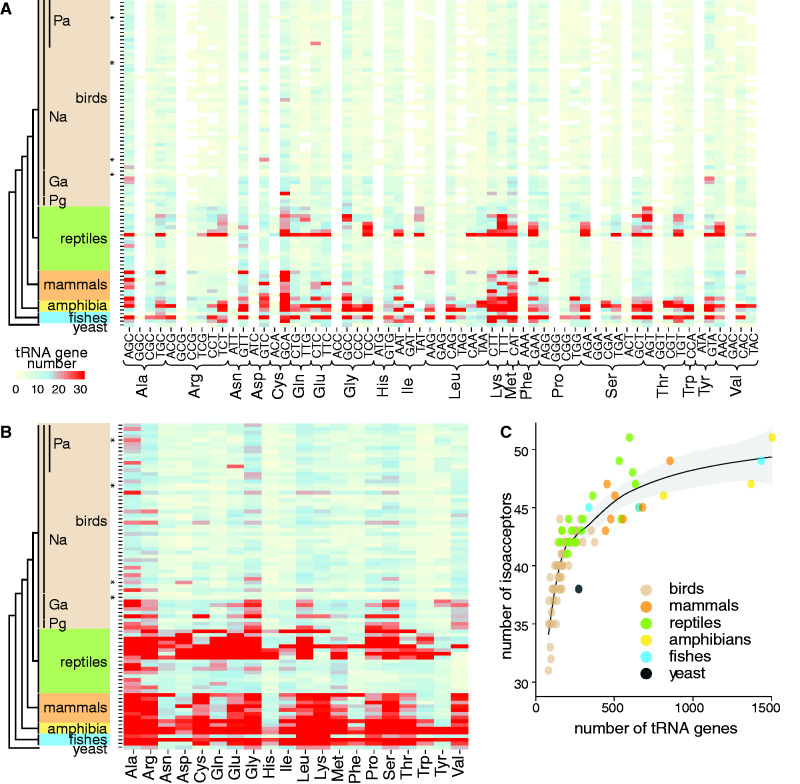
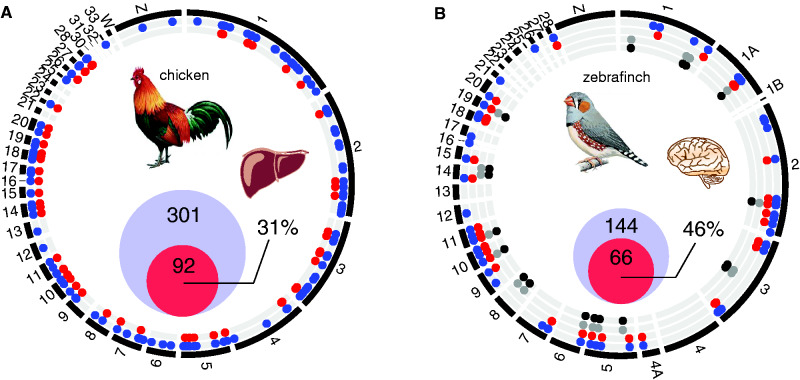
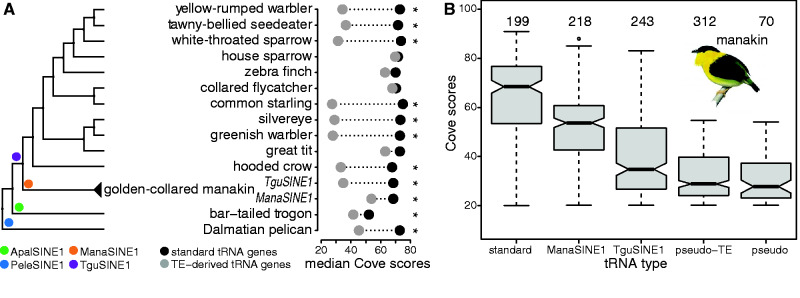
As a highly diverse vertebrate class, bird species have adapted to various ecological systems. How this phenotypic diversity can be explained genetically is intensively debated and is likely grounded in differences in the genome content. Larger and more complex genomes could allow for greater genetic regulation that results in more phenotypic variety. Surprisingly, avian genomes are much smaller compared to other vertebrates but contain as many protein-coding genes as other vertebrates. This supports the notion that the phenotypic diversity is largely determined by selection on non-coding gene sequences. Transfer RNAs (tRNAs) represent a group of non-coding genes. However, the characteristics of tRNA genes across bird genomes have remained largely unexplored. Here, we exhaustively investigated the evolution and functional consequences of these crucial translational regulators within bird species and across vertebrates. Our dense sampling of 55 avian genomes representing each bird order revealed an average of 169 tRNA genes with at least 31% being actively used. Unlike other vertebrates, avian tRNA genes are reduced in number and complexity but are still in line with vertebrate wobble pairing strategies and mutation-driven codon usage. Our detailed phylogenetic analyses further uncovered that new tRNA genes can emerge through multiplication by transposable elements. Together, this study provides the first comprehensive avian and cross-vertebrate tRNA gene analyses and demonstrates that tRNA gene evolution is flexible albeit constrained within functional boundaries of general mechanisms in protein translation.
作为高度多样化的脊椎动物类群,鸟类已经适应了各种生态系统。这种表型多样性在遗传上是如何解释的,这是一个激烈争论的问题,可能源于基因组内容的差异。更大和更复杂的基因组可以允许更大的遗传调控,从而产生更多的表型多样性。令人惊讶的是,与其他脊椎动物相比,鸟类的基因组要小得多,但却包含了与其他脊椎动物一样多的编码蛋白质的基因。这支持了这样一种观点,即表型多样性主要是由非编码基因序列的选择决定的。转移 RNA(tRNA)代表了一组非编码基因。然而,鸟类基因组中 tRNA 基因的特征在很大程度上仍未得到探索。在这里,我们详尽地研究了这些关键的翻译调节因子在鸟类物种和整个脊椎动物中的进化和功能后果。我们对代表每个鸟类目 55 个鸟类基因组的密集采样显示,平均有 169 个 tRNA 基因,其中至少有 31%是活跃使用的。与其他脊椎动物不同,鸟类的 tRNA 基因数量和复杂性减少,但仍符合脊椎动物的摆动配对策略和突变驱动的密码子使用。我们详细的系统发育分析进一步揭示了新的 tRNA 基因可以通过转座元件的倍增而出现。总之,这项研究提供了第一个全面的鸟类和跨脊椎动物 tRNA 基因分析,并表明 tRNA 基因的进化是灵活的,尽管在蛋白质翻译的一般机制的功能边界内受到限制。