Department of Otolaryngology, University of Pittsburgh, Pittsburgh, Pennsylvania.
Department of Neurobiology, University of Pittsburgh, Pittsburgh, Pennsylvania.
J Neurophysiol. 2021 Apr 1;125(4):1095-1110. doi: 10.1152/jn.00350.2019. Epub 2021 Feb 3.
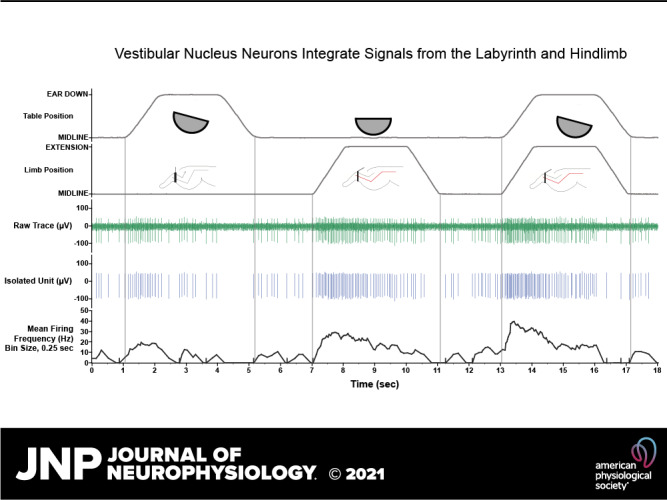
We recently demonstrated in decerebrate and conscious cat preparations that hindlimb somatosensory inputs converge with vestibular afferent input onto neurons in multiple central nervous system (CNS) locations that participate in balance control. Although it is known that head position and limb state modulate postural reflexes, presumably through vestibulospinal and reticulospinal pathways, the combined influence of the two inputs on the activity of neurons in these brainstem regions is unknown. In the present study, we evaluated the responses of vestibular nucleus (VN) neurons to vestibular and hindlimb stimuli delivered separately and together in conscious cats. We hypothesized that VN neuronal firing during activation of vestibular and limb proprioceptive inputs would be well fit by an additive model. Extracellular single-unit recordings were obtained from VN neurons. Sinusoidal whole body rotation in the roll plane was used as the search stimulus. Units responding to the search stimulus were tested for their responses to 10° ramp-and-hold roll body rotation, 60° extension hindlimb movement, and both movements delivered simultaneously. Composite response histograms were fit by a model of low- and high-pass filtered limb and body position signals using least squares nonlinear regression. We found that VN neuronal activity during combined vestibular and hindlimb proprioceptive stimulation in the conscious cat is well fit by a simple additive model for signals with similar temporal dynamics. The mean value for goodness of fit across all units was 0.74 ± 0.17. It is likely that VN neurons that exhibit these integrative properties participate in adjusting vestibulospinal outflow in response to limb state. Vestibular nucleus neurons receive convergent information from hindlimb somatosensory inputs and vestibular inputs. In this study, extracellular single-unit recordings of vestibular nucleus neurons during conditions of passively applied limb movement, passive whole body rotations, and combined stimulation were well fit by an additive model. The integration of hindlimb somatosensory inputs with vestibular inputs at the first stage of vestibular processing suggests that vestibular nucleus neurons account for limb position in determining vestibulospinal responses to postural perturbations.
我们最近在去大脑猫和清醒猫的实验中证明,后肢躯体感觉输入与前庭传入输入在多个参与平衡控制的中枢神经系统(CNS)位置上融合。虽然已知头部位置和肢体状态通过前庭脊髓和网状脊髓途径调节姿势反射,但这两种输入对这些脑干区域神经元活动的综合影响尚不清楚。在本研究中,我们评估了前庭核(VN)神经元对前庭和后肢刺激的反应,这些刺激在清醒猫中单独和同时传递。我们假设,在激活前庭和肢体本体感受输入时,VN 神经元的放电可以很好地符合加法模型。我们从 VN 神经元中获得了细胞外单细胞记录。使用滚平面的正弦全身旋转作为搜索刺激。对响应搜索刺激的单位进行了测试,以测试它们对 10°斜坡保持滚体旋转、60°后肢运动以及同时传递的两种运动的反应。复合反应直方图通过使用最小二乘非线性回归对肢体和身体位置信号进行低通和高通滤波的模型进行拟合。我们发现,在清醒猫中同时进行前庭和后肢本体感受刺激时,VN 神经元的活动可以很好地符合具有相似时间动态的简单加法模型。所有单位的拟合优度平均值为 0.74±0.17。很可能表现出这些整合特性的 VN 神经元参与根据肢体状态调整前庭脊髓传出。前庭核神经元接收来自后肢躯体感觉输入和前庭输入的会聚信息。在这项研究中,在外周施加肢体运动、被动全身旋转和联合刺激期间,前庭核神经元的细胞外单细胞记录可以很好地符合加法模型。前庭处理的第一阶段中后肢躯体感觉输入与前庭输入的整合表明,前庭核神经元在确定前庭脊髓对姿势扰动的反应时考虑了肢体位置。