National Institute of Nursing Research, National Institutes of Health, Bethesda, MD, USA.
Clinical Center, National Institutes of Health, Bethesda, MD, USA.
Cancer Med. 2021 Mar;10(5):1623-1633. doi: 10.1002/cam4.3749. Epub 2021 Feb 3.
Metabolomics is the newest -omics methodology and allows for a functional snapshot of the biochemical activity and cellular state. The goal of this study is to characterize metabolomic profiles associated with cancer-related fatigue, a debilitating symptom commonly reported by oncology patients.
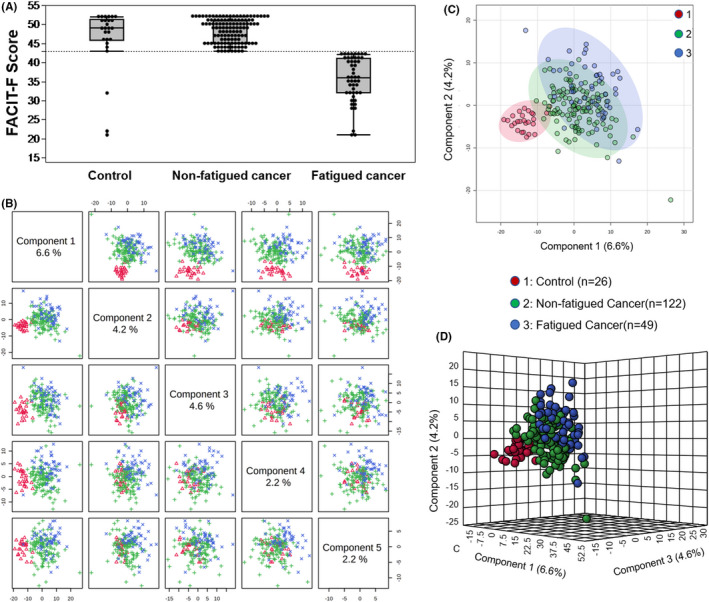
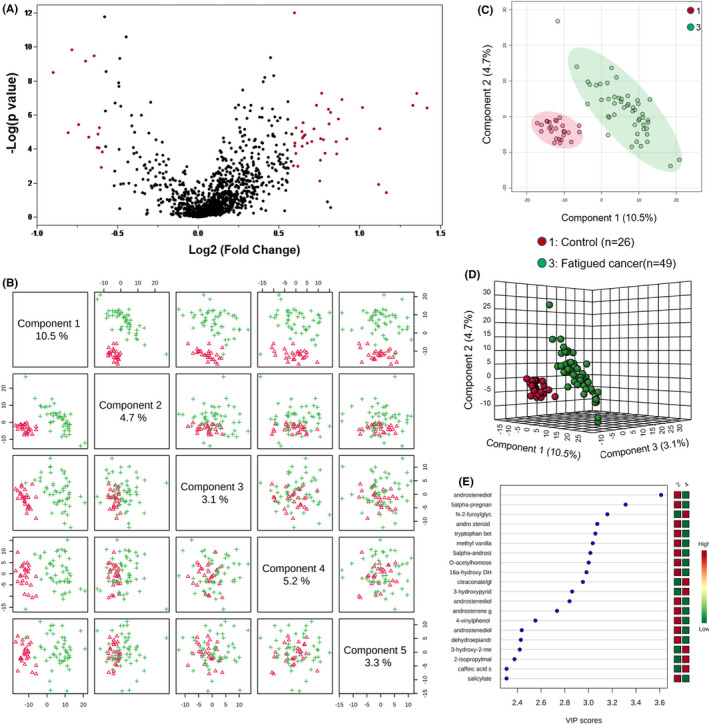
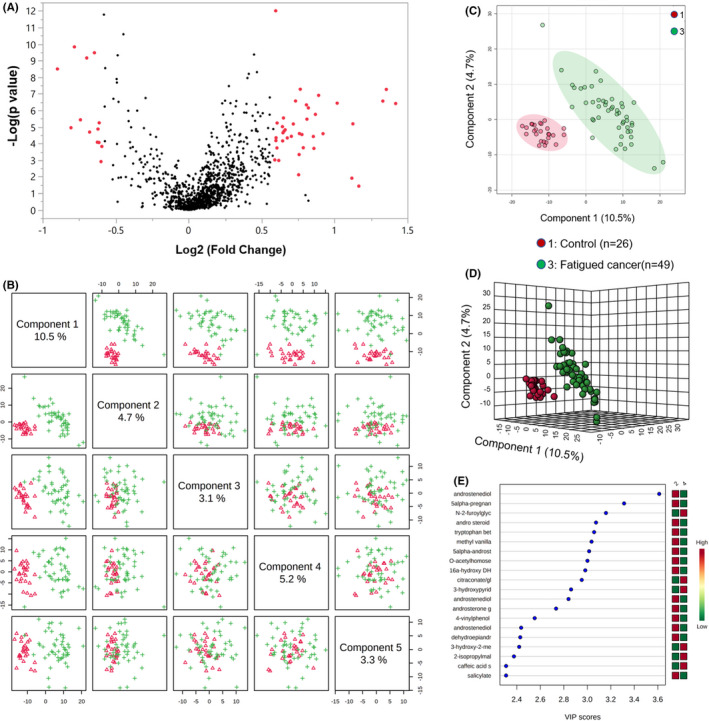
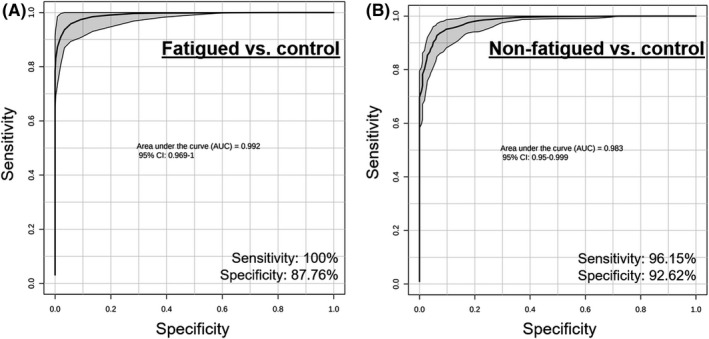
Untargeted ultrahigh performance liquid chromatography/mass spectrometry metabolomics approach was used to identify metabolites in plasma samples collected from a total of 197 participants with or without cancer. Partial least squares-discriminant analysis (PLS-DA) was used to identify discriminant metabolite features, and diagnostic performance of selected classifiers was quantified using area under the receiver operating characteristics (AUROC) curve analysis. Pathway enrichment analysis was performed using Fisher's exact test and the Kyoto Encyclopedia of Genes and Genomes (KEGG) metabolic pathway database.
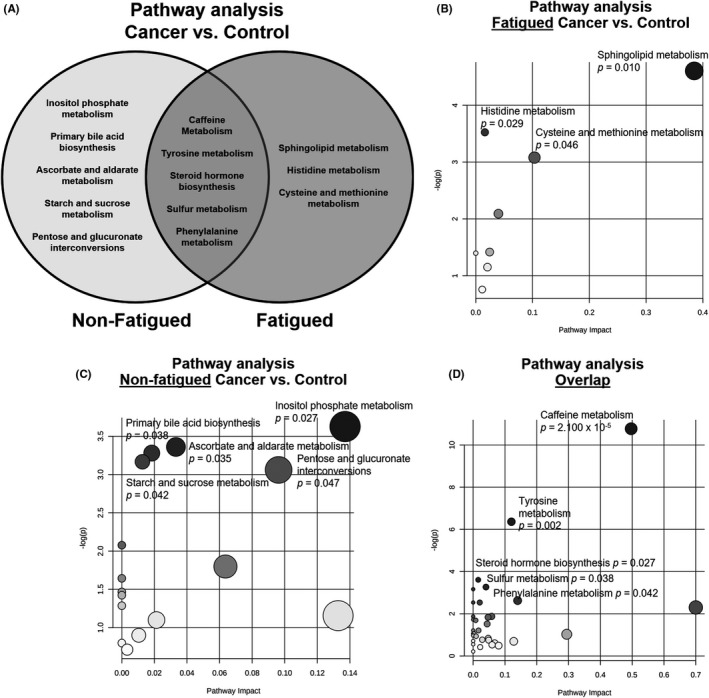
The global metabolomics approach yielded a total of 1120 compounds of known identity. Significant metabolic pathways unique to fatigued cancer versus control groups included sphingolipid metabolism, histidine metabolism, and cysteine and methionine metabolism. Significant pathways unique to non-fatigued cancer versus control groups included inositol phosphate metabolism, primary bile acid biosynthesis, ascorbate and aldarate metabolism, starch and sucrose metabolism, and pentose and glucuronate interconversions. Pathways shared between the two comparisons included caffeine metabolism, tyrosine metabolism, steroid hormone biosynthesis, sulfur metabolism, and phenylalanine metabolism.
We found significant metabolomic profile differences associated with cancer-related fatigue. By comparing metabolic signatures unique to fatigued cancer patients with metabolites associated with, but not unique to, fatigued cancer individuals (overlap pathways) and metabolites associated with cancer but not fatigue, we provided a broad view of the metabolic phenotype of cancer-related fatigue.
代谢组学是最新的组学方法,可以对生化活性和细胞状态进行功能快照。本研究的目的是描述与癌症相关的疲劳相关的代谢组学特征,这是肿瘤患者常报告的一种使人虚弱的症状。
使用非靶向超高液相色谱/质谱代谢组学方法鉴定了来自 197 名癌症患者或无癌症患者的血浆样本中的代谢物。使用偏最小二乘判别分析(PLS-DA)识别判别代谢物特征,并使用接收者操作特征(ROC)曲线分析定量评估所选分类器的诊断性能。使用 Fisher 精确检验和京都基因与基因组百科全书(KEGG)代谢途径数据库进行途径富集分析。
全局代谢组学方法共鉴定出 1120 种已知成分的化合物。与对照组相比,疲劳性癌症独有的显著代谢途径包括鞘脂代谢、组氨酸代谢、半胱氨酸和蛋氨酸代谢。与对照组相比,非疲劳性癌症独有的显著途径包括肌醇磷酸盐代谢、初级胆汁酸生物合成、抗坏血酸和醛酸代谢、淀粉和蔗糖代谢以及戊糖和葡萄糖醛酸转化。两个比较共有的途径包括咖啡因代谢、酪氨酸代谢、甾体激素生物合成、硫代谢和苯丙氨酸代谢。
我们发现与癌症相关的疲劳相关的代谢组学特征存在显著差异。通过比较疲劳性癌症患者特有的代谢特征与与疲劳性癌症个体相关但非特有的代谢物(重叠途径)以及与癌症相关但与疲劳无关的代谢物,我们提供了癌症相关疲劳的代谢表型的广泛视图。