Department of Ocular Oncology and Oculoplasty, Tilganga Institute of Ophthalomology, Kathmandu, Nepal.
Cancer Rep (Hoboken). 2021 Aug;4(4):e1347. doi: 10.1002/cnr2.1347. Epub 2021 Feb 3.
Metastatic disease to the eye most commonly involves choroid followed by orbit leading to varied ocular manifestations. By comparison, it is relatively rarer than primary malignancies of eye as well as metastasis in other parts of the body.
The aim of this study is to evaluate the common eye and orbital structures involved in secondary ocular and metastatic disease, to describe its clinical manifestations and outline the management done.
A retrospective study of newly diagnosed cases of ocular metastasis in last 2 years conducted in our recently established department of ocular oncology at a tertiary eye care hospital in Nepal. Demography, age and sex distribution were noted. The patients were segregated into those with secondary or metastatic ocular malignancies. Detail study on the metastatic disease to eye was made in regards to presenting symptoms, signs, primary site of cancer, and the treatment done. Details of the investigations done, like biopsy and imaging were also recorded.
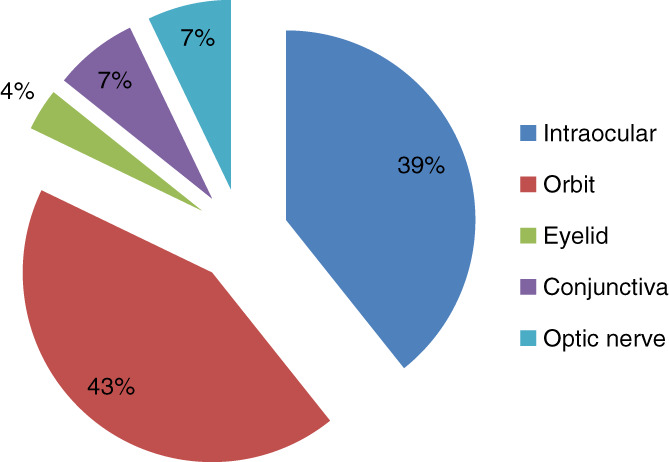
There were a total of 28 patients, whose age group ranged from 9 years to 69 years with median age of 43 years. Females constituted 46% of total patients. Both the eyes were involved in 9 patients (32%). Eye was secondarily involved by paranasal sinus tumors and Non Hodgkin lymphoma (7 patients each). Ocular metastasis was commonly seen from broncogenic carcinoma in four and breast carcinoma in three patients. Simultaneous metastasis to other parts of the body was also seen in 61% of our patients. Diminution of vision in 49% was the most common presenting feature followed by proptosis in 16% and palpable mass in 14% of patients. Orbit in 43% cases is the commonest ocular structure involved. Histopathologic diagnosis was done in 32% only while rest was based on imaging alone. The most common treatment done was chemotherapy in 57% patients.
Ocular metastasis can display a wide variety of clinical and imaging features and therefore a high degree of suspicion is required. It is often associated with simultaneous metastasis to other parts of the body as well, hence the importance of earlier diagnosis and metastatic workup.
眼部转移性疾病最常累及脉络膜,其次是眼眶,导致各种眼部表现。相比之下,眼部原发性恶性肿瘤和身体其他部位的转移较为少见。
本研究旨在评估眼部和眼眶继发性眼转移的常见结构,描述其临床表现,并概述所做的治疗。
对过去 2 年在尼泊尔一家三级眼科医院新诊断的眼部转移性肿瘤患者进行回顾性研究。记录人口统计学数据、年龄和性别分布。将患者分为继发性或转移性眼部恶性肿瘤。详细研究眼部转移性疾病的表现症状、体征、癌症原发部位和所做的治疗。还记录了活检和影像学等检查的详细信息。
共有 28 例患者,年龄在 9 岁至 69 岁之间,中位数为 43 岁。女性占总患者的 46%。9 例患者(32%)双眼受累。眼眶分别有 7 例(25%)由鼻窦肿瘤和非霍奇金淋巴瘤转移而来。4 例患者有肺部来源的癌,3 例有乳腺来源的癌,最常见的眼部转移癌。61%的患者同时有其他部位的转移。视力下降在 49%的患者中最为常见,其次是眼球突出(16%)和可触及的肿块(14%)。43%的患者眶骨受累。仅 32%的患者进行了组织病理学诊断,其余患者仅根据影像学诊断。最常见的治疗方法是化疗(57%)。
眼部转移性疾病可表现出广泛的临床和影像学特征,因此需要高度怀疑。它通常与其他部位的同时转移有关,因此早期诊断和转移检查非常重要。