Department of Medicine, Section of Epidemiology and Population Sciences, Baylor College of Medicine, Houston, TX 77030, USA.
Department of Cancer Biology, Dana-Farber Cancer Institute, Boston, MA 02215, USA.
Cells. 2021 Feb 1;10(2):293. doi: 10.3390/cells10020293.
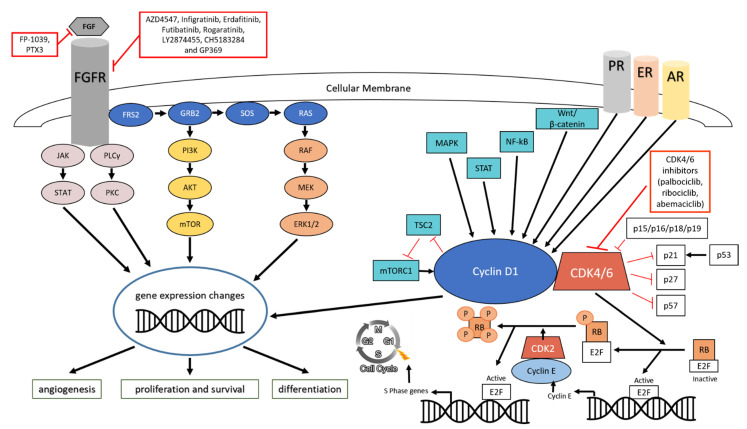
Breast cancer (BC) is the most common cause of cancer-related death in women worldwide. Therapies targeting molecular pathways altered in BC had significantly enhanced treatment options for BC over the last decades, which ultimately improved the lives of millions of women worldwide. Among various molecular pathways accruing substantial interest for the development of targeted therapies are cyclin-dependent kinases (CDKs)-in particular, the two closely related members CDK4 and CDK6. CDK4/6 inhibitors indirectly trigger the dephosphorylation of retinoblastoma tumor suppressor protein by blocking CDK4/6, thereby blocking the cell cycle transition from the G1 to S phase. Although the CDK4/6 inhibitors abemaciclib, palbociclib, and ribociclib gained FDA approval for the treatment of hormone receptor (HR)-positive, human epidermal growth factor receptor 2 (HER2)-negative BC as they significantly improved progression-free survival (PFS) in randomized clinical trials, regrettably, some patients showed resistance to these therapies. Though multiple molecular pathways could be mechanistically responsible for CDK4/6 inhibitor therapy resistance, one of the most predominant ones seems to be the fibroblast growth factor receptor (FGFR) pathway. FGFRs are involved in many aspects of cancer formation, such as cell proliferation, differentiation, and growth. Importantly, FGFRs are frequently mutated in BC, and their overexpression and/or hyperactivation correlates with CDK4/6 inhibitor resistance and shortened PFS in BC. Intriguingly, the inhibition of aberrant FGFR activity is capable of reversing the resistance to CDK4/6 inhibitors. This review summarizes the molecular background of FGFR signaling and discusses the role of aberrant FGFR signaling during cancer development in general and during the development of CDK4/6 inhibitor resistance in BC in particular, together with other possible mechanisms for resistance to CDK4/6 inhibitors. Subsequently, future directions on novel therapeutic strategies targeting FGFR signaling to overcome such resistance during BC treatment will be further debated.
乳腺癌(BC)是全球女性癌症相关死亡的最常见原因。在过去几十年中,针对 BC 中改变的分子途径的治疗方法显著增强了 BC 的治疗选择,最终改善了全球数以百万计的女性的生活。在为开发靶向治疗而引起广泛关注的各种分子途径中,细胞周期蛋白依赖性激酶(CDKs)-特别是两个密切相关的成员 CDK4 和 CDK6-受到了特别关注。CDK4/6 抑制剂通过阻断 CDK4/6 间接触发视网膜母细胞瘤肿瘤抑制蛋白的去磷酸化,从而阻止细胞周期从 G1 期向 S 期的过渡。尽管 CDK4/6 抑制剂 abemaciclib、palbociclib 和 ribociclib 因显著改善了随机临床试验中的无进展生存期(PFS)而获得了 FDA 批准,用于治疗激素受体(HR)阳性、人表皮生长因子受体 2(HER2)阴性 BC,但遗憾的是,一些患者对这些治疗产生了耐药性。尽管有多种分子途径可能在机制上导致 CDK4/6 抑制剂耐药,但其中最主要的途径之一似乎是成纤维细胞生长因子受体(FGFR)途径。FGFRs 参与癌症形成的许多方面,如细胞增殖、分化和生长。重要的是,FGFRs 在 BC 中经常发生突变,其过表达和/或过度激活与 BC 中 CDK4/6 抑制剂耐药和 PFS 缩短相关。有趣的是,抑制异常 FGFR 活性能够逆转对 CDK4/6 抑制剂的耐药性。本综述总结了 FGFR 信号的分子背景,并讨论了异常 FGFR 信号在癌症发展中的作用,特别是在 BC 中 CDK4/6 抑制剂耐药性的发展中的作用,以及对 CDK4/6 抑制剂耐药性的其他可能机制。随后,将进一步讨论针对 FGFR 信号的新型治疗策略的未来方向,以克服 BC 治疗过程中的这种耐药性。