Rijs Zeger, Shifai A Naweed, Bosma Sarah E, Kuppen Peter J K, Vahrmeijer Alexander L, Keereweer Stijn, Bovée Judith V M G, van de Sande Michiel A J, Sier Cornelis F M, van Driel Pieter B A A
Department of Orthopedic Surgery, Leiden University Medical Center, Albinusdreef 2, 2333 ZA Leiden, The Netherlands.
Department of Surgery, Leiden University Medical Center, Albinusdreef 2, 2333 ZA Leiden, The Netherlands.
Cancers (Basel). 2021 Feb 1;13(3):557. doi: 10.3390/cancers13030557.
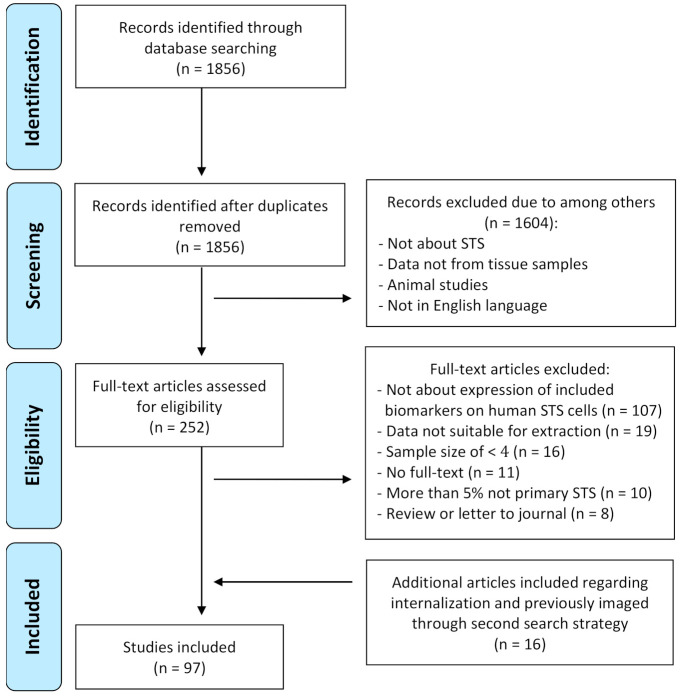
Surgery is the mainstay of treatment for localized soft tissue sarcomas (STS). The curative treatment highly depends on complete tumor resection, as positive margins are associated with local recurrence (LR) and prognosis. However, determining the tumor margin during surgery is challenging. Real-time tumor-specific imaging can facilitate complete resection by visualizing tumor tissue during surgery. Unfortunately, STS specific tracers are presently not clinically available. In this review, STS-associated cell surface-expressed biomarkers, which are currently already clinically targeted with monoclonal antibodies for therapeutic purposes, are evaluated for their use in near-infrared fluorescence (NIRF) imaging of STS. Clinically targeted biomarkers in STS were extracted from clinical trial registers and a PubMed search was performed. Data on biomarker characteristics, sample size, percentage of biomarker-positive STS samples, pattern of biomarker expression, biomarker internalization features, and previous applications of the biomarker in imaging were extracted. The biomarkers were ranked utilizing a previously described scoring system. Eleven cell surface-expressed biomarkers were identified from which 7 were selected as potential biomarkers for NIRF imaging: TEM1, VEGFR-1, EGFR, VEGFR-2, IGF-1R, PDGFRα, and CD40. Promising biomarkers in common and aggressive STS subtypes are TEM1 for myxofibrosarcoma, TEM1, and PDGFRα for undifferentiated soft tissue sarcoma and EGFR for synovial sarcoma.
手术是局限性软组织肉瘤(STS)治疗的主要手段。根治性治疗高度依赖于肿瘤的完整切除,因为切缘阳性与局部复发(LR)和预后相关。然而,在手术中确定肿瘤切缘具有挑战性。实时肿瘤特异性成像可通过在手术中可视化肿瘤组织来促进完整切除。不幸的是,目前尚无用于STS的特异性示踪剂。在本综述中,评估了目前已被单克隆抗体用于治疗目的的与STS相关的细胞表面表达生物标志物在STS近红外荧光(NIRF)成像中的应用。从临床试验登记册中提取了STS中临床靶向的生物标志物,并进行了PubMed检索。提取了有关生物标志物特征、样本量、生物标志物阳性STS样本的百分比、生物标志物表达模式、生物标志物内化特征以及该生物标志物在成像中的先前应用的数据。利用先前描述的评分系统对生物标志物进行排名。鉴定出11种细胞表面表达的生物标志物,其中7种被选为NIRF成像的潜在生物标志物:TEM1、VEGFR-1、EGFR、VEGFR-2、IGF-1R、PDGFRα和CD40。在常见且侵袭性强的STS亚型中,有前景的生物标志物包括:黏液纤维肉瘤的TEM1、未分化软组织肉瘤的TEM1和PDGFRα以及滑膜肉瘤的EGFR。