Pinto Mauricio, Mathis Thibaud, Massin Pascale, Akesbi Jad, Lereuil Théo, Voirin Nicolas, Matonti Frédéric, Fajnkuchen Franck, Conrath John, Milazzo Solange, Korobelnik Jean-François, Baillif Stéphanie, Denis Philippe, Creuzot-Garcher Catherine, Srour Mayer, Dupas Bénédicte, Sudhalkar Aditya, Bilgic Alper, Tadayoni Ramin, Souied Eric H, Dot Corinne, Kodjikian Laurent
Department of Ophthalmology, Croix-Rousse University Hospital, 69004 Lyon, France.
UMR-CNRS 5510 Matéis, 69100 Villeurbane, France.
Pharmaceutics. 2021 Feb 1;13(2):194. doi: 10.3390/pharmaceutics13020194.
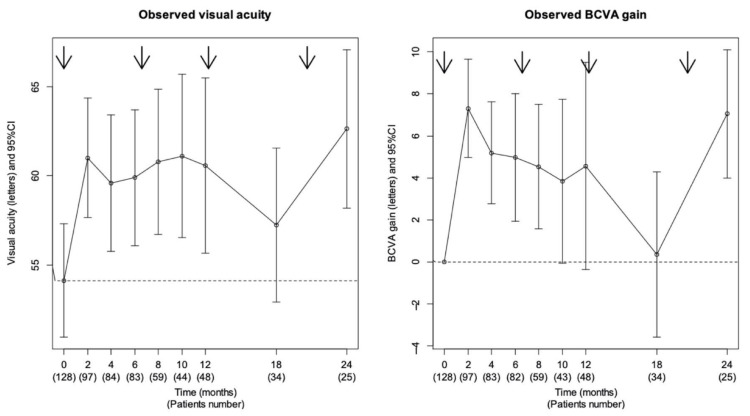
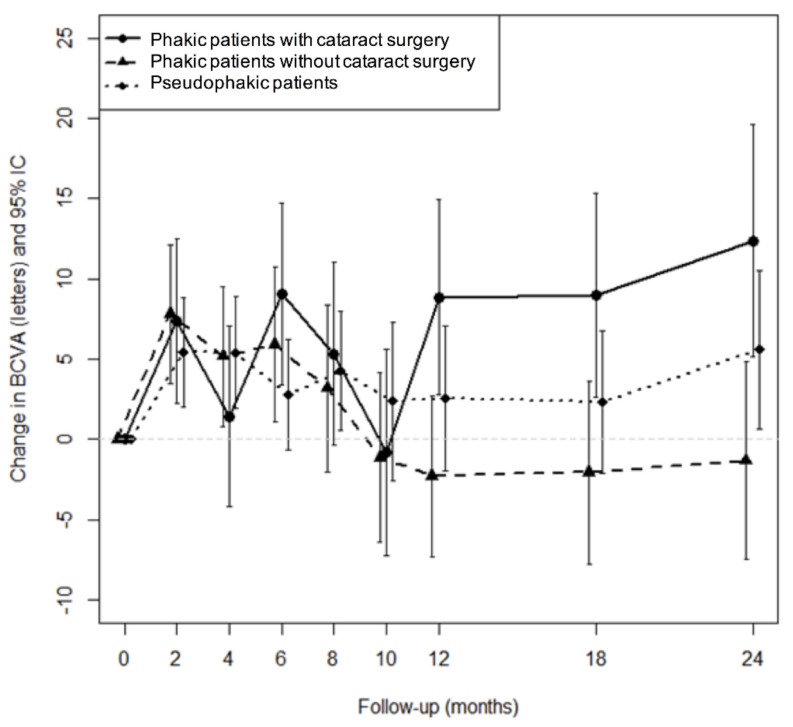
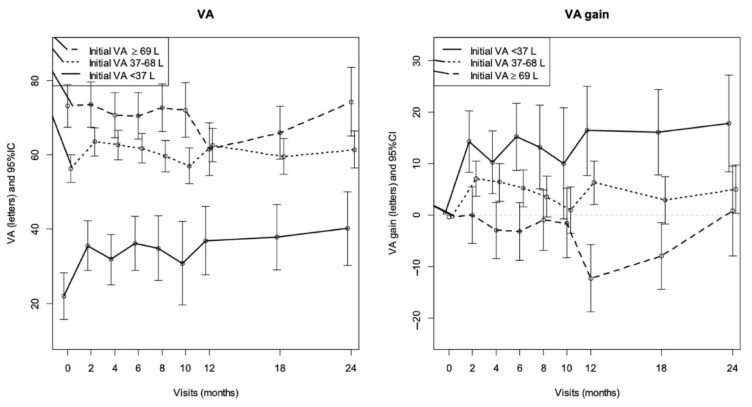
The purpose of this study is to evaluate the visual acuity (VA) gain profiles between patients with drug-naive diabetic macular edema (DME) treated by dexamethasone implant (DEX-implant) and assess the baseline anatomical and functional factors that could influence the response to the treatment in real-life conditions. A retrospective, multi-center observational study included 129 eyes with drug-naive DME treated by DEX-implant. The Median follow-up was 13 months. Two groups of VA gain trajectories were identified-Group A, with 71% ( = 96) of patients whose average VA gain was less than five letters and Group B, with 29% ( = 33) of patients with an average gain of 20 letters. The probability of belonging to Group B was significantly higher in patients with baseline VA < 37 letters ( = 0.001). Ellipsoid zone alterations (EZAs) or disorganization of retinal inner layers (DRILs) were associated with a lower final VA (53.0 letters versus 66.4, = 0.002) but without a significant difference in VA gain (4.9 letters versus 6.8, = 0.582). Despite a low baseline VA, this subgroup of patients tends to have greater visual gain, encouraging treatment with DEX-implant in such advanced-stage disease. However, some baseline anatomic parameters, such as the presence of EZAs or DRILs, negatively influenced final vision.
本研究的目的是评估接受地塞米松植入物(DEX-植入物)治疗的初治糖尿病性黄斑水肿(DME)患者的视力(VA)改善情况,并评估在实际临床条件下可能影响治疗反应的基线解剖学和功能因素。一项回顾性、多中心观察性研究纳入了129只接受DEX-植入物治疗的初治DME患眼。中位随访时间为13个月。确定了两组VA改善轨迹——A组,71%(n = 96)的患者平均VA改善小于5个字母;B组,29%(n = 33)的患者平均改善20个字母。基线VA<37个字母的患者属于B组的概率显著更高(P = 0.001)。椭圆体带改变(EZAs)或视网膜内层紊乱(DRILs)与较低的最终视力相关(53.0个字母对66.4个字母,P = 0.002),但VA改善无显著差异(4.9个字母对6.8个字母,P = 0.582)。尽管基线视力较低,但该亚组患者往往有更大的视力改善,这鼓励在这种晚期疾病中使用DEX-植入物进行治疗。然而,一些基线解剖学参数,如EZAs或DRILs的存在,对最终视力有负面影响。