Huang Yu-Te, Chang Yen-Chieh, Meng Ping-Ping, Lin Chun-Ju, Lai Chun-Ting, Hsia Ning-Yi, Chen Huan-Sheng, Tien Peng-Tai, Bair Henry, Lin Jane-Ming, Chen Wen-Lu, Tsai Yi-Yu
Department of Ophthalmology, China Medical University Hospital, China Medical University, Taichung, Taiwan.
School of Medicine, College of Medicine, China Medical University, Taichung, Taiwan.
Front Med (Lausanne). 2022 Jun 9;9:852022. doi: 10.3389/fmed.2022.852022. eCollection 2022.
To identify optical coherence tomography (OCT) biomarkers that may predict functional and anatomical outcomes in diabetic macular edema (DME) patients treated with intravitreal dexamethasone (DEX) implant.
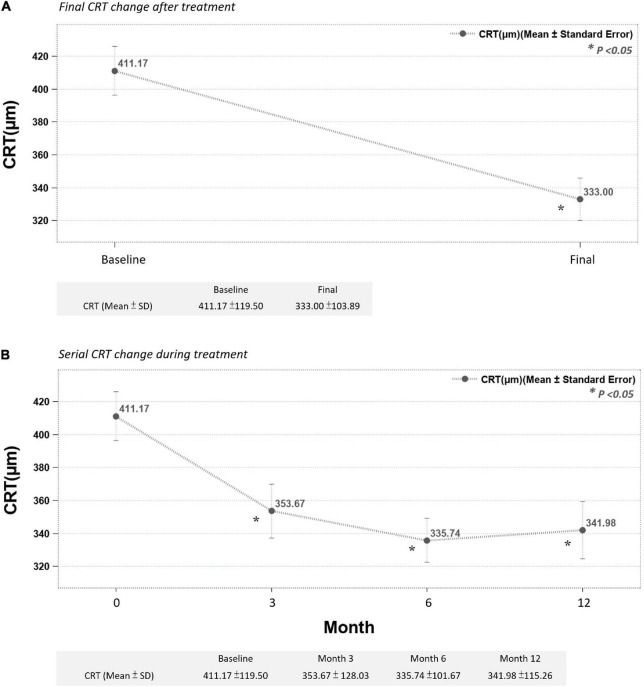
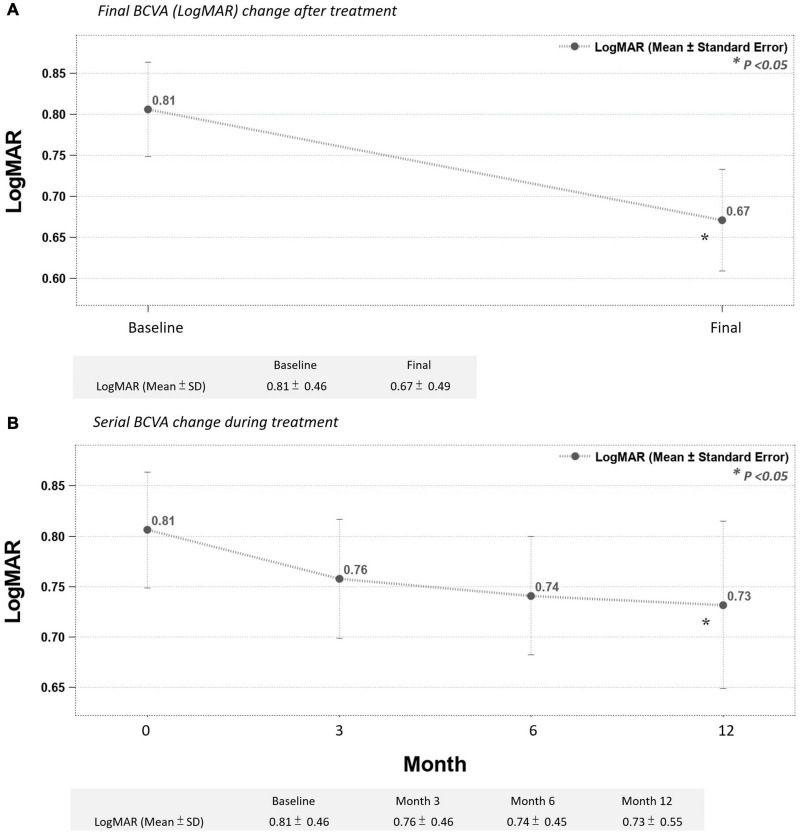
Sixty-four eyes from 50 patients with DME were enrolled. Best-corrected visual acuity (BCVA) and OCT biomarkers including central retinal thickness (CRT), subretinal fluid (SRF), intraretinal cysts (IRC), ellipsoid zone disruption (EZD), disorganization of retinal inner layers (DRIL), hard exudate (HE), hyperreflective foci (HRF), epiretinal membrane (ERM), and vitreomacular interface (VMI) changes were evaluated at baseline and at 3, 6, and 12 months after treatment. Multiple logistic analysis was performed to evaluate each OCT biomarker as a predictive factor for functional and anatomical improvement at the end of treatment.
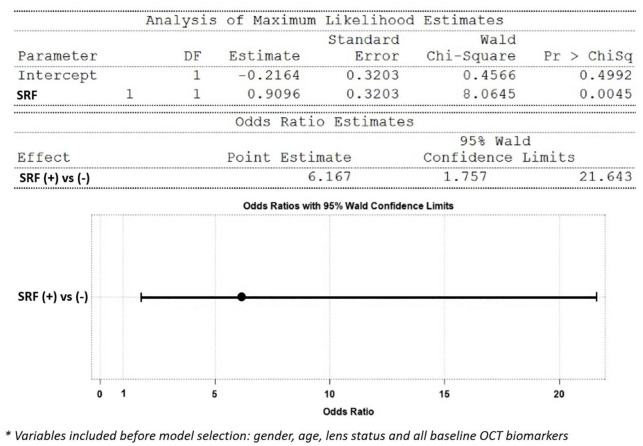
The presence of SRF at baseline was associated with a favorable outcome, with CRT improving by more than 100 μm after treatment from multivariate logistic regression analysis [odds ratio 6.16 (1.75-21.6)]. In addition, baseline SRF predicted a greater CRT improvement from multiple regression analysis (model R-square 0.11, = 0.006). The reduction of DRIL, SRF, LONLC, IRC, and EZD were correlated with better CRT improvement (more than 100 μm) ( < 0.05). SRF and EZD recovery can also predict better visual prognosis ( < 0.05).
OCT biomarkers can be used to predict who may benefit the most after DEX treatment. We suggest that the DEX implant should be considered as a first line treatment in DME patients with SRF.
识别可预测接受玻璃体内地塞米松(DEX)植入治疗的糖尿病性黄斑水肿(DME)患者功能和解剖学结局的光学相干断层扫描(OCT)生物标志物。
纳入50例DME患者的64只眼。在基线以及治疗后3、6和12个月评估最佳矫正视力(BCVA)和OCT生物标志物,包括中心视网膜厚度(CRT)、视网膜下液(SRF)、视网膜内囊肿(IRC)、椭圆体带破坏(EZD)、视网膜内层紊乱(DRIL)、硬性渗出(HE)、高反射灶(HRF)、视网膜前膜(ERM)以及玻璃体黄斑界面(VMI)变化。进行多因素逻辑分析以评估每个OCT生物标志物作为治疗结束时功能和解剖学改善的预测因素。
多因素逻辑回归分析显示,基线时存在SRF与良好结局相关,治疗后CRT改善超过100μm[比值比6.16(1.75 - 21.6)]。此外,多因素回归分析显示基线SRF可预测更大的CRT改善(模型决定系数0.11,P = 0.006)。DRIL、SRF、LONLC、IRC和EZD的减少与更好的CRT改善(超过100μm)相关(P < 0.05)。SRF和EZD的恢复也可预测更好的视力预后(P < 0.05)。
OCT生物标志物可用于预测哪些患者在DEX治疗后可能获益最大。我们建议,对于有SRF的DME患者,应考虑将DEX植入作为一线治疗。