Palliative Care Center, Al-Sabah Medical Area, Al-Shuwaikh, Kuwait.
Geriatrics and Gerontology Department, Faculty of Medicine, Ain Shams University, Al- Abbaseya, Cairo, Egypt.
BMC Palliat Care. 2021 Feb 3;20(1):25. doi: 10.1186/s12904-021-00717-2.
Cancer-related pain is a complicated symptom that often coincides with fatigue, depression, and anxiety. Although many safe treatments are available, inadequate control of Cancer-related pain continues to lead to suffering in cancer patients. This study's aim is to describe pain control, and the pattern of change in opioid and adjuvant medication prescriptions, before and after referral to the Palliative Care Center.
We conducted a prospective cohort study in adult cancer patients the Palliative Care Center between January 1, 2016 and December 30, 2017. We measured pain intensity and other associated symptoms via the Revised Edmonton Symptom Assessment System (ESAS-r) and documented detailed analgesics and adjuvant medication history before starting any palliative care and on days 0, 3, 6, and 14.
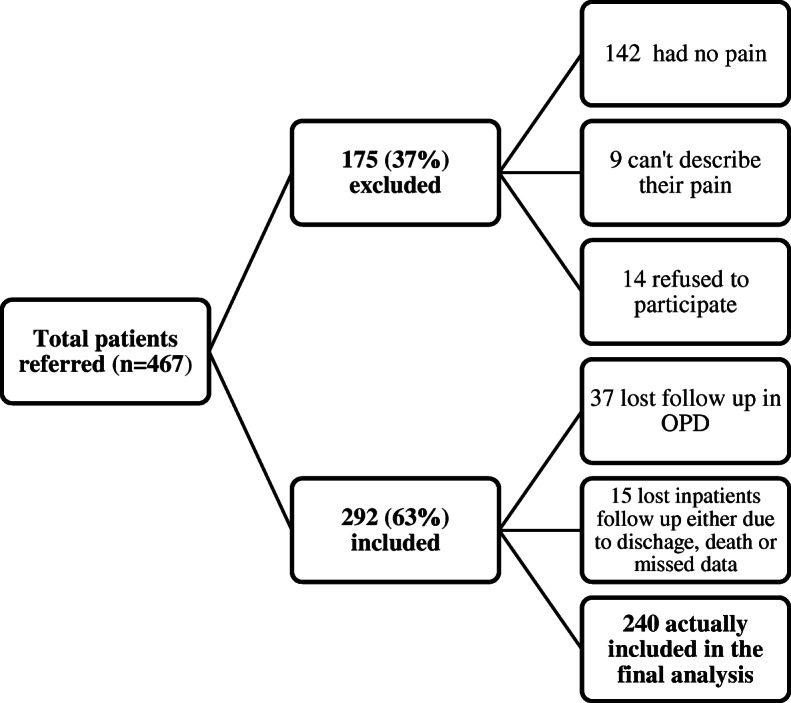
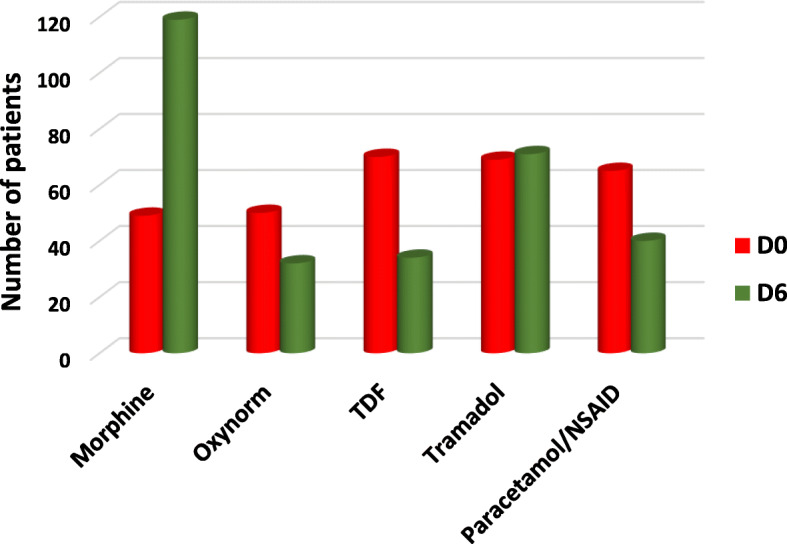
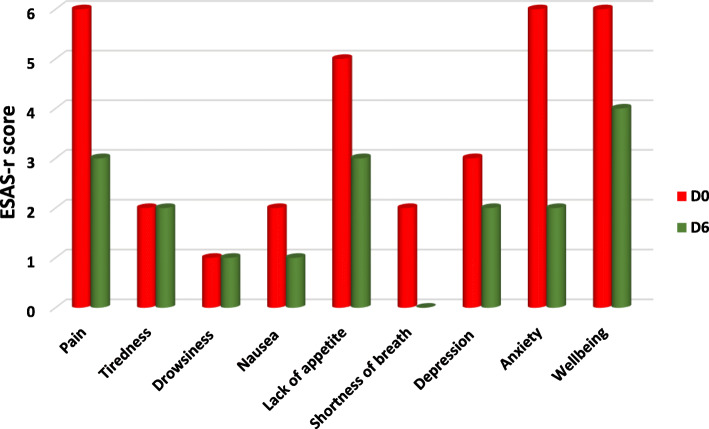
The analysis included 240 patients whose cancer-related pain, anxiety, and depression scores meaningfully improved by day 6. The changes in the median (interquartile ranges) of Cancer-related pain, anxiety, and depression scores from day 0 to day 6 were: 6 (4-8) to 3 (1-4); 6 (4-9) to 2 (1-4); and 3 (2-6) to 2 (1-4), respectively, with p < 0.001 for all. Morphine was the most common opioid administered; the percentage using it increased from 20.4% (n = 49) before referral to 49.6% (n = 119) on day 6 (p < 0.001). The median morphine equivalent daily dose decreased from a median (interquartile ranges) of 60(31-93) mg/day before referral to 34(22-66) mg/day on day 6 (p < 0.001). There was also a statistically significant increase in the percentage of patients taking adjuvant medications, from 38.8% before referral to 84.2% on day 6 (p < 0.001). Comparing D0 to D6, the number of patients using Gabapentinoids significantly increased from 57(23.75%) to 79(32.9%) (p < 0.001), amitriptyline dramatically increased from 14 (5.8%) to 44 (18.3%) (p < 0.001), and other antidepressant drugs increased from 15 (6.2%) to 34 (14.1%) (p < 0.001).
After referral to the Palliative Care Center, patients' pain and other symptoms scores decreased significantly, even with lower median morphine equivalent daily doses, arguably through more appropriately directed opioid use. This is evidence for the effectiveness of the comprehensive program at the Palliative Care Center in Kuwait.
癌症相关疼痛是一种复杂的症状,常伴有疲劳、抑郁和焦虑。尽管有许多安全的治疗方法,但癌症相关疼痛的控制仍然不足,导致癌症患者遭受痛苦。本研究的目的是描述疼痛控制以及阿片类药物和辅助药物处方模式在转至姑息治疗中心前后的变化。
我们在 2016 年 1 月 1 日至 2017 年 12 月 30 日期间对姑息治疗中心的成年癌症患者进行了一项前瞻性队列研究。我们使用修订后的埃德蒙顿症状评估系统(ESAS-r)来测量疼痛强度和其他相关症状,并记录开始任何姑息治疗前和第 0、3、6 和 14 天的详细阿片类药物和辅助药物使用史。
分析包括 240 名患者,他们的癌症相关疼痛、焦虑和抑郁评分在第 6 天明显改善。从第 0 天到第 6 天,癌症相关疼痛、焦虑和抑郁评分的中位数(四分位距)变化为:6(4-8)降至 3(1-4);6(4-9)降至 2(1-4);3(2-6)降至 2(1-4),所有评分均<0.001。吗啡是最常用的阿片类药物;在转至第 6 天使用吗啡的比例从 20.4%(n=49)增加到 49.6%(n=119)(p<0.001)。吗啡等效日剂量中位数从转至第 6 天的中位数(四分位距)60(31-93)mg/天降至 34(22-66)mg/天(p<0.001)。服用辅助药物的患者比例也有统计学显著增加,从转至第 6 天的 38.8%增加到 84.2%(p<0.001)。与 D0 相比,在 D6 使用加巴喷丁类药物的患者数量从 57(23.75%)显著增加到 79(32.9%)(p<0.001),阿米替林从 14(5.8%)急剧增加到 44(18.3%)(p<0.001),其他抗抑郁药物从 15(6.2%)增加到 34(14.1%)(p<0.001)。
转至姑息治疗中心后,患者的疼痛和其他症状评分显著下降,即使吗啡等效日剂量中位数较低,这可能是通过更合理地使用阿片类药物实现的。这证明了科威特姑息治疗中心综合方案的有效性。