Tang Bo, Lei Xiong, Ai Junhua, Huang Zhixiang, Shi Jun, Li Taiyuan
Nanchang University Medical College, Nanchang, Jiangxi Province, China.
Department of General Surgery, The First Affiliated Hospital of Nanchang University, Nanchang, 330006, Jiangxi Province, China.
World J Surg Oncol. 2021 Feb 3;19(1):38. doi: 10.1186/s12957-021-02128-2.
Robotic and laparoscopic surgery for rectal cancer has been applied in the clinic for decades; nevertheless, which surgical approach has a lower rate of postoperative complications is still inconclusive. Therefore, the aim of this meta-analysis was to compare the postoperative complications within 30 days between robotic and laparoscopic rectal cancer surgery based on randomized controlled trials.
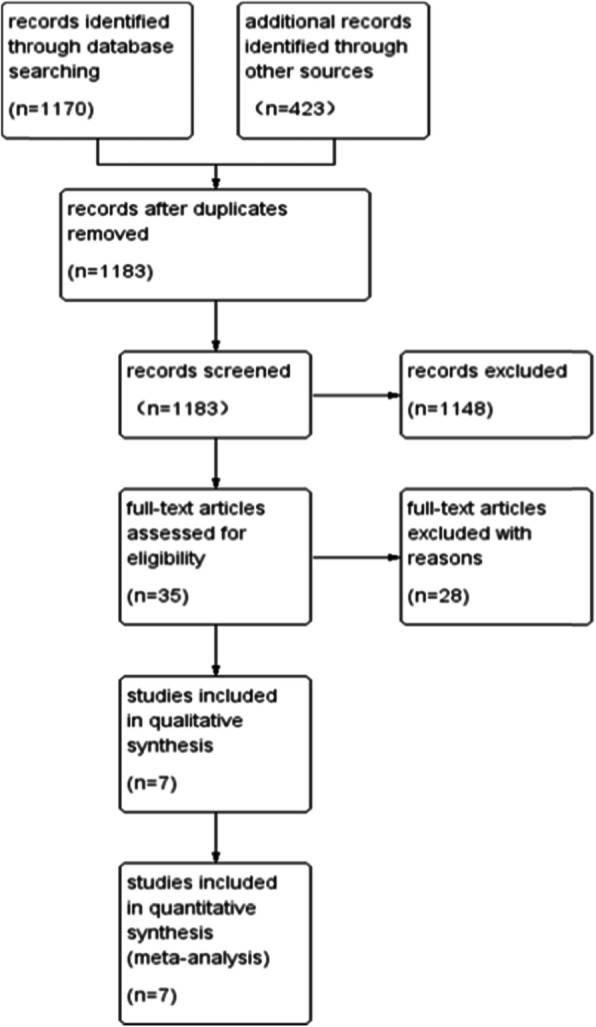
Randomized controlled trials (until May 2020) that compared robotic and laparoscopic rectal cancer surgery were searched through PubMed, EMBASE, the Cochrane Library, China National Knowledge Infrastructure (CNKI), Wanfang Data Knowledge Service Platform, and China Biology Medicine disc (CBMdisc). Data regarding sample size, clinical and demographic characteristics, and postoperative complications within 30 days, including overall postoperative complications, severe postoperative complications (Clavien-Dindo score ≥ III), anastomotic leakage, surgical site infection, bleeding, ileus, urinary complications, respiratory complications, conversion to open surgery, unscheduled reoperation, perioperative mortality, and pathological outcomes, were extracted. The results were analyzed using RevMan v5.3.
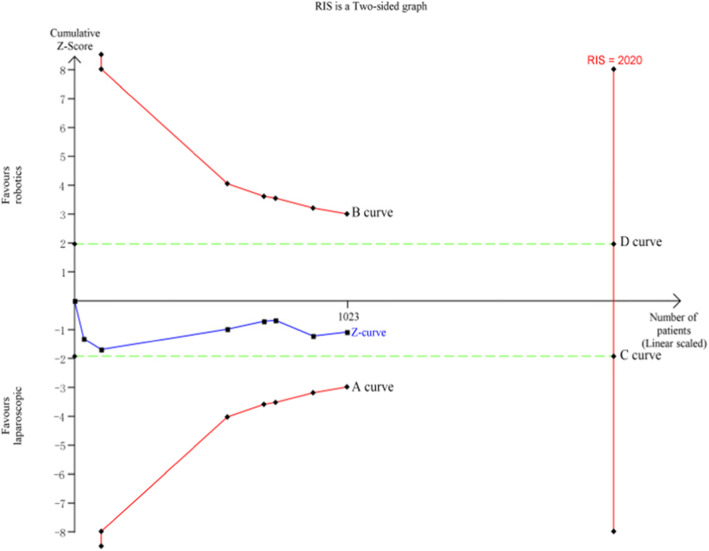
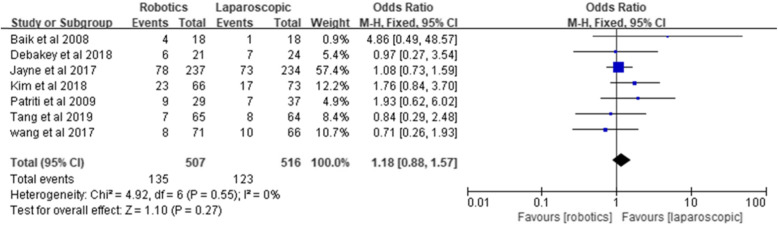
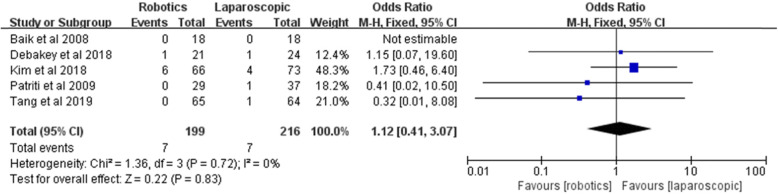
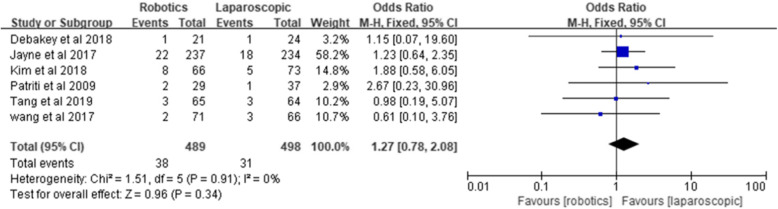
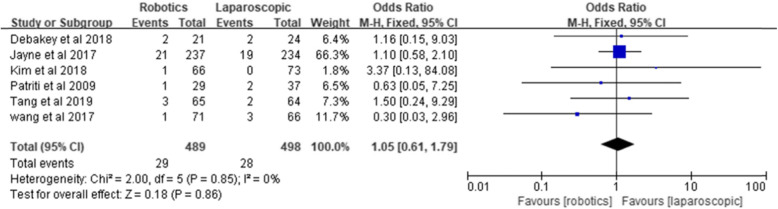
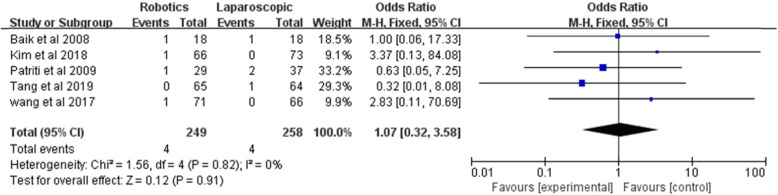
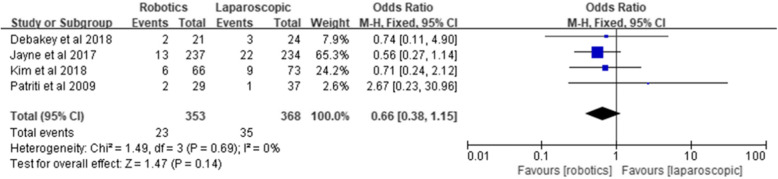
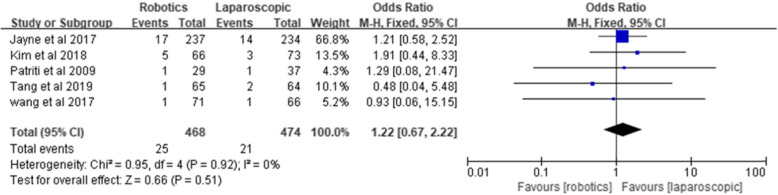
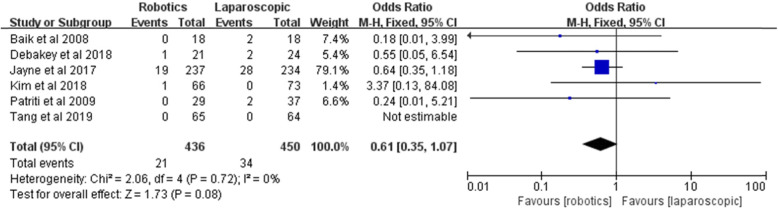
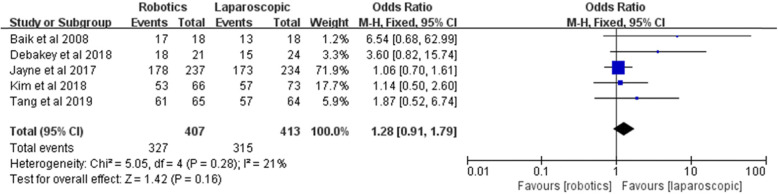
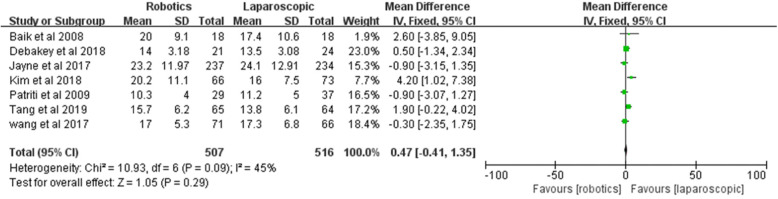
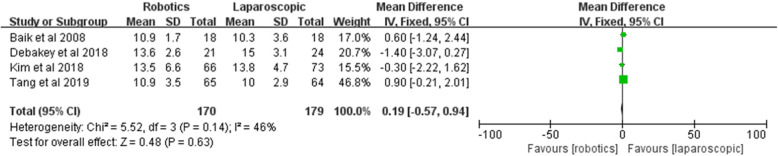
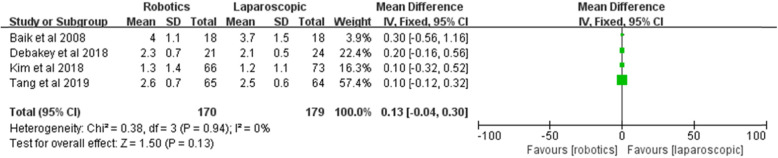
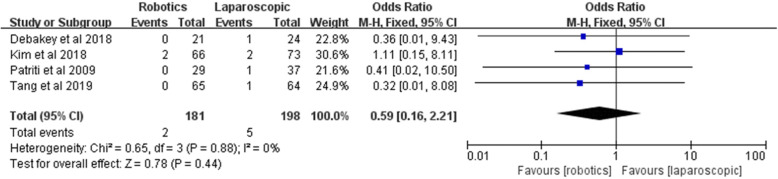
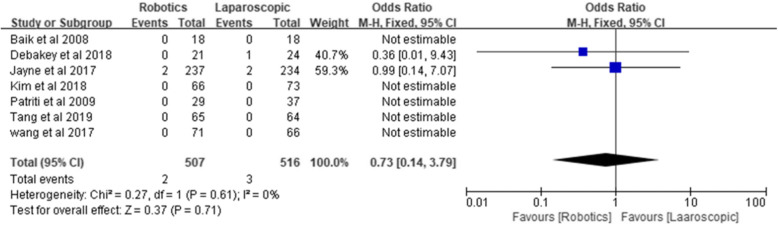
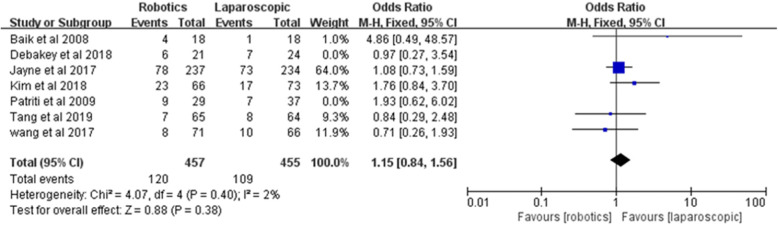
Seven randomized controlled trials that included 507 robotic and 516 laparoscopic rectal cancer surgery cases were included. Meta-analysis showed that the overall postoperative complications within 30 days [Z = 1.1, OR = 1.18, 95% CI (0.88-1.57), P = 0.27], severe postoperative complications [Z = 0.22, OR = 1.12, 95% CI (0.41-3.07), P = 0.83], anastomotic leakage [Z = 0.96, OR = 1.27, 95% CI (0.78-2.08), P = 0.34], surgical site infection [Z = 0.18, OR = 1.05, 95% CI (0.61-1.79), P = 0.86], bleeding [Z = 0.19, OR = 0.89, 95% CI (0.27-2.97), P = 0.85], ileus [Z = 1.47, OR = 0.66, 95% CI (0.38-1.15), P = 0.14], urinary complications [Z = 0.66, OR = 1.22, 95% CI (0.67-2.22), P = 0.51], respiratory complications [Z = 0.84, OR = 0.64, 95% CI (0.22-1.82), P = 0.40], conversion to open surgery [Z = 1.73, OR = 0.61, 95% CI (0.35-1.07), P = 0.08], unscheduled reoperation [Z = 0.14, OR = 0.91, 95% CI (0.26-3.20), P = 0.89], perioperative mortality [Z = 0.28, OR = 0.79, 95% CI (0.15-4.12), P = 0.78], and pathological outcomes were similar between robotic and laparoscopic rectal surgery.
Robotic surgery for rectal cancer was comparable to laparoscopic surgery with respect to postoperative complications within 30 days.
机器人手术和腹腔镜手术治疗直肠癌已在临床应用数十年;然而,哪种手术方式术后并发症发生率更低仍尚无定论。因此,本荟萃分析的目的是基于随机对照试验比较机器人手术与腹腔镜直肠癌手术30天内的术后并发症。
通过PubMed、EMBASE、Cochrane图书馆、中国知网(CNKI)、万方数据知识服务平台和中国生物医学文献数据库(CBMdisc)检索比较机器人手术与腹腔镜直肠癌手术的随机对照试验(截至2020年5月)。提取有关样本量、临床和人口统计学特征以及30天内术后并发症的数据,包括术后总体并发症、严重术后并发症(Clavien-Dindo评分≥Ⅲ级)、吻合口漏、手术部位感染、出血、肠梗阻、泌尿系统并发症、呼吸系统并发症、中转开腹手术、计划外再次手术、围手术期死亡率和病理结果。使用RevMan v5.3软件对结果进行分析。
纳入7项随机对照试验,共507例机器人直肠癌手术病例和516例腹腔镜直肠癌手术病例。荟萃分析显示,机器人手术与腹腔镜直肠癌手术在30天内的术后总体并发症[Z = 1.1,OR = 1.18,95%CI(0.88 - 1.57),P = 0.27]、严重术后并发症[Z = 0.22,OR = 1.12,95%CI(0.41 - 3.07),P = 0.83]、吻合口漏[Z = 0.96,OR = 1.27,95%CI(0.78 - 2.08),P = 0.34]、手术部位感染[Z = 0.18,OR = 1.05,95%CI(0.61 - 1.79),P = 0.86]、出血[Z = 0.19,OR = 0.89,95%CI(0.27 - 2.97),P = 0.85]、肠梗阻[Z = 1.47,OR = 0.66,95%CI(0.38 - 1.15),P = 0.14]以及泌尿系统并发症[Z = 0.66,OR = 1.22,95%CI(0.67 - 2.22),P = 0.51]、呼吸系统并发症[Z = 0.84,OR = 0.64,95%CI(0.22 - 1.82),P = 0.40]、中转开腹手术[Z = 1.73,OR = 0.61,95%CI(0.35 - 1.07),P = 0.08]、计划外再次手术[Z = 0.14,OR = 0.91,95%CI(0.26 - 3.20),P = 0.89]、围手术期死亡率[Z = 0.28,OR = 0.79,95%CI(0.15 - 4.12),P = 0.78]及病理结果方面相似。
机器人直肠癌手术与腹腔镜手术在30天内的术后并发症方面相当。